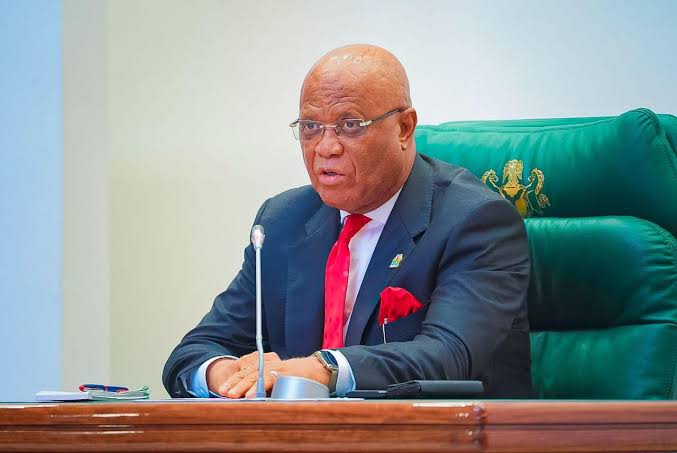
Nigerian governors are usually not keen to log out on the execution of condemned criminals, at the same time as findings by LEADERSHIP Weekend revealed that the federal authorities spends N4.3m day by day to feed 3823 inmates on dying row.
Consequently, the variety of inmates on Nigeria’s dying row has surged to three,823 as of June 2025.
Specialists say these inmates stay trapped in a authorized limbo: sentenced to dying however not executed, left alive, but forgotten by the justice system.
LEADERSHIP Weekend writes that whereas ultimate justice is stalled, these people linger in overcrowded prisons, draining the system’s restricted assets and elevating deep moral and humanitarian considerations.
The Nigerian Correctional Service (NCoS) confirmed that of the three,823 inmates on dying row, 3,742 are male and 81 are feminine, a pointy rise from 3,688 in March 2025 and three,590 in September 2024.
It’s now not information that regardless of the constitutional energy of state governors to authorise executions or commute sentences, such choices are not often made, leading to an overburdened correctional system and a mounting fiscal load.
Based on information obtained by LEADERSHIP Weekend from a high official on the Ministry of Inside, Nigeria’s whole inmate inhabitants, together with the 78,446 who’ve largely pale from public consciousness, prices the federal authorities about ₦58.8 million to feed them day by day.
Till just lately, every inmate was allotted ₦750 day by day for meals, a determine deemed grossly insufficient. Nevertheless, following widespread protests and appeals, President Bola Ahmed Tinubu raised it to ₦1,125 in August 2024 for awaiting-trial inmates.
Vital stakeholders and a few retired senior jail officers who craved anonymity informed LEADERSHIP Weekend that even with the upward evaluate, ₦1,125 nonetheless falls wanting the ₦1,346 benchmark required for a wholesome day by day food regimen, leaving a ₦221 dietary deficit per inmate – a spot jail specialists warn might have severe penalties.
“Poor feeding can set off violence,” a senior official at a correctional facility informed our correspondent through phone dialog.
“It’s not only a welfare difficulty; it’s a nationwide safety concern,” he mentioned, including that diet and inmate behaviour are intently linked.
An unique doc obtained by LEADERSHIP Weekend reveals that the fiscal implications are staggering.
Between January and February 2025, the NCoS spent ₦3.3 billion to feed roughly 50,000 awaiting-trial inmates in simply two months. With 50,000 inmates fed at ₦1,125 day by day, the estimated price would hit ₦20.6 billion for the complete 12 months.
In whole, the NCoS budgeted ₦38 billion for foodstuffs in 2025 alone, with dying row inmates included in that allocation, although their prices are usually not itemised individually.
An skilled and a former meals provide contractor to the Kuje custodial facility, who pleaded to not be named, mentioned, “Regardless of this spending, jail diet stays inadequate. The day by day allowance doesn’t cowl a balanced food regimen. The federal government should see inmate feeding as a part of nationwide safety planning.”
Talking on governors’ refusal to signal dying warrants, a scenario which continues to gas the disaster. human rights activist Esor Ekpe argues that this discretion, whether or not to signal or commute, is wielded inconsistently, trapping inmates in perpetual authorized limbo.
“Their silence is shaping the lives of 1000’s,” he mentioned.
Former senior prisons officer and safety skilled, Mr. Idem Ekpo, mirrored on Nigeria’s execution historical past.
“For the reason that democratic period started in 1999, executions have been extraordinarily uncommon. The final main wave was below Common Sani Abacha, together with the infamous 1995 hanging of Ken Saro-Wiwa’s ‘Ogoni 9.’ Solely a handful occurred in 2013 and 2016. With out motion, dying row continues to develop unchecked.”
Ekpo careworn that executions are constitutionally tied to governors’ signatures.
“They maintain the important thing, however many select to not use it. The result’s a bloated, overburdened, and more and more unsustainable system.”
Nevertheless, the Nigerian Correctional Service has argued that the feeding allocation, whereas tight, stays according to worldwide norms and home rules.
The nationwide spokesperson of the Nigerian Correctional Service ( NCoS), Deputy Controller of Corrections Umar Abubakar, informed LEADERSHIP Weekend that the price of feeding inmates in Nigeria was not excessively excessive given the present {economic} scenario.
He additional defined that the Service operates below a finances authorized by the federal authorities, saying that the allocation per inmate is modest sufficient to make sure that inmates obtain the minimal required diet as stipulated by worldwide requirements and home rules.
“It is crucial for the general public to grasp that meals is a fundamental provision for people in custody, a lot of whom are awaiting trial and constitutionally presumed harmless.
“The present ₦1,125 feeding fee is a results of latest opinions, and one other evaluate is already into account,” he mentioned.
Umar added that the Service ensures minimal dietary requirements are met in accordance with international and home rules.
“These are fundamental provisions for folks in custody, a lot of whom are nonetheless awaiting trial and presumed harmless below the legislation. Furthermore, the service is actively in search of methods to advertise agricultural initiatives inside custodial centres and farm centres. By way of inmate-run farms and vocational programmes, we’re producing meals objects to make sure meals safety inside the services, and empowering inmates with beneficial abilities for reintegration.
“These efforts exhibit the service’s dedication to fiscal duty, rehabilitation, and the humane therapy of all individuals in custody, according to nationwide and worldwide correctional greatest practices,” he defined.
He additional confirmed that the Nigerian Correctional Service (NCoS) at the moment spends ₦1,125 per inmate per day on feeding, following a 50 per cent enhance from the preliminary ₦750 carried out in August 2024 by a presidential directive.
In the meantime, the federal authorities’s strategy to correctional reform seems to be shifting. The Minister of Interior beforehand emphasised that “correctional centres at the moment are locations of hope and transformation,” pointing to interventions reminiscent of elevated allowances, skill-building efforts, and the introduction of digital libraries.
Nonetheless, specialists warn that until decisive motion is taken, together with clearing the dying row backlog and adequately funding diet, prisons could change into flashpoints for unrest.
“The day by day ₦1,125 could meet the books, but it surely doesn’t meet the physique’s wants. The hole between coverage and observe stays vast, and for 1000’s on dying row, justice, whether or not by mercy or execution, appears agonisingly out of attain.”
Loss of life row delay as a consequence of appellate litigation
A Bauchi-based authorized practitioner, Barr. Sufiyanu Gambo Idris has revealed that the failure to implement dying penalty judgements in Nigeria is due primarily to extended enchantment processes and state governors’ lack of political will.
Talking to LEADERSHIP Weekend on the problem, Idris famous that the majority capital punishment sentences are handed down by decrease courts reminiscent of Excessive Courts and Higher Shariah Courts.
He careworn that convicts in such circumstances have the authorized proper to enchantment the rulings to the Supreme Courtroom, a course of that always results in years of delay.
“Till the ultimate appellate courtroom affirms the conviction, execution can’t be carried out,” he mentioned.
Idris mentioned that past the authorized bottlenecks, the reluctance of state governors to log out on dying warrants kinds one other important hurdle.
“Even when all authorized avenues have been exhausted, governors, who’re constitutionally required to authorise executions, usually lack the political will to take action,” he added.
No Akwa Ibom governor has signed a dying warrant since 1999
For the reason that inception of the present civilian dispensation, no democratically elected governor since 1999 has signed any dying warrant for the execution of condemned prisoners in Akwa Ibom state.
A senior official of the Division of Public Prosecution (DPP) disclosed this to LEADERSHIP Weekend, who wouldn’t need his identify in print.
Based on him, throughout the 4 prisons in Uyo, Eket, Ikot Ekpene and Ikot Abasi, “we have now numerous inmates on dying row, however we will’t verify the present quantity now as a consequence of the truth that a few of the prisoners wrongly given dying sentences had been just lately freed after their circumstances had been reviewed on the Appeal Courtroom to find they had been convicted in error.”
“Like on Thursday, October 10, 2025, one man from Ibesikpo Asutan native authorities space was sentenced to dying for killing his brother over an allegation of utilizing witchcraft powers to dam his progress within the Uyo Excessive Courtroom.
“As an example, two indigenes of Mkpat Enin LGA, whom the Decide wrongly sentenced to dying after one depraved man from their village framed them up for alleged involvement in phantom kidnapping, had been freed after 12 years awaiting execution.
‘God intervened. They had been freed a couple of weeks in the past after spending over 12 years in jail awaiting execution following the pursuance of the case by an excellent Samaritan to the Appeal Courtroom as a result of the suspects didn’t have the assets to enchantment the case.
Extra report by GODWIN ENNA, Katsina, Muhd Zangina Kura, Dutse, Nnamdi Mbawike, Enugu, Okem Inexperienced Mbah, Yenagoa, ACHOR ABIMAJE,Jos, IDRIS SALISU, Gusau, , IDRIS SALISU, Gusau, Francis Okoye, Maiduguri, Alo Abiola, Ado-Ekiti, Longtong Yakubu, Kano, Felix Igbekoyi, Asaba, EMMANUEL MGBEAHURIKE, Owerri, Anayo Onukwugha, Port Harcourt, Angela Nkwo-Akpolu, Owerri, KALU EZIYI, Umuahia, KABIR WURMA, Birnin Kebbi, OBINNA OGBONNAYA, Abakaliki Abdullahi Olesin, Ilorin, ABU NMODU, Minna,
“So, that’s the reason an correct determine of convicts awaiting execution in Akwa Ibom can’t be established, as a result of even some are randomly transferred, generally outdoors the state,” he disclosed.
Nevertheless, a supply near the governor mentioned, “Some governors are sure by their conscience, and would relatively favor the condemned criminals stay in perpetuity in jail relatively than their arms be tainted by human blood.”
Govs restricted by worldwide conventions
Moreover, he famous that governors are sure by worldwide human rights legal guidelines and conventions Nigeria signed with respective affiliate our bodies to the United Nations, including that “open execution of such criminals might entice outrage and petitions regarding human rights abuse by the federal government.”
“Our governor is a pastor, and a religious Christian, who owns and administers his personal Church, so I consider sure by his religion as a Christian, he wouldn’t need to signal any dying warrant for anybody to be killed as a result of that they had by no means been such a precedent on this state below any civilian dispensation from the period of Obong Victor Attah; Chief Godswill Akpabio; Mr. Udom Emmanuel and now Pastor Umo Eno,” he mentioned.
However Clifford Thomas, chairman of Akwa Ibom Human Rights Neighborhood (AIHRC) defined that the execution of condemned criminals, although constitutionally offered, might quantity to injustice if, after years, it turns into open data that the executed individual was not responsible, as has been taking place in Nigeria and different superior nations.”
Abia gov not eager on executing inmates
Based on a senior Abia State Governor Alex Otti administration, each motion should have its response, however generally “a bit of thought looking back is significant”.
’”Recall that final week, the governor, in his magnanimity, secured the discharge of three individuals who had been on the dying row for 26 years in Lagos. The message in that is that he needs the authorities to assume twice concerning the execution of condemned individuals.”
LEADERSHIP Weekend was denied data on the variety of inmates on dying row on the Abia State command headquarters of the NCS on safety grounds.
A dependable supply, who pleaded anonymity, famous that due to its sensitivity, such data is normally requested and equipped solely on the directive of the controllers.
However Stan Elekwa, a human rights activist, advised commuting such convictions to long-term imprisonment, “as has change into the case in some societies now.”
Kaduna Lawyer Explains Why Condemned Criminals Are Not Executed
A Kaduna-based authorized practitioner, Hiifan Abuul, informed LEADERSHIP Weekend in Kaduna, that “the penal legal guidelines below which offences are outlined additionally prescribe the penalty to the identical.
“The dying penalty inside our felony legal guidelines is a penalty for capital offences reminiscent of homicide/culpable murder” although sentencing is all the time on the discretion of the trial decide. In some circumstances, they might take into account life imprisonment instead sentence,” Abuul added.
Human Rights Obstacles Hindering Execution of Inmates – Gov Otu’s Aide
In Cross River State, the Secretary of the Administration of Felony Justice Monitoring Committee in Cross River State, Barr. James Ibor has recognized constitutional obstacles as being chargeable for the execution of jail inmates on the dying row in Cross River State.
Ibor acknowledged that, a few years in the past, the Cross River State Authorities subscribed to Amnesty Worldwide’s Coverage of discouraging the execution of dying row inmates, stressing that alone prevents the state authorities from executing prisoners on dying row.
“Fortunately, all of the governors of Cross River State subscribed to that coverage. Once more, with the state of our scientific growth, the federal government offers room for error. What occurs when any individual who had been condemned based mostly on details that turn into incorrect?” he requested.
Ibor acknowledged that to permit people who’re on dying row to serve life sentences was preferable as a result of, generally, new details that exonerate the inmates can emerge, stressing that it’s simpler to compensate such inmates than after they had been executed.
“Analysis has proven constantly that the dying penalty shouldn’t be a deterrent. When you execute a convict, simply because a convict had been sentenced to dying, it’s tough to reverse the execution when new details emerge that exonerate the individual from the crime.”
Efforts to get the lawyer basic and commissioner for justice in Cross River to talk on the problem failed. Textual content messages and calls despatched to him had been by no means replied to, and he didn’t name our report again.
Governors worry executing harmless individuals
The particular adviser to the Cross River State Governor, Barr. Ekpeyong Akiba acknowledged that the chance of executing harmless individuals remained one of many strongest arguments why the governments had been unable to hold out execution judgements.
He careworn that along with its affiliation with civil societies and several other worldwide organisations, the federal government additionally respects the dignity and sanctity of human life.
Scarcity of hangmen
He additional acknowledged that the dearth of hangmen was additionally an element militating towards the execution of jail inmates within the dying row within the state.
“When criminals are sentenced to dying, the federal government generally finds it tough as a result of it lacks hangmen who be sure that these condemned by the legislation undergo the method. Even in Nigeria, I have no idea if we have now hangmen.
“It’s tough to rent a hangman outdoors the nation. The executors, whom we name hangmen, are tough to return by,” he acknowledged.
A go to to the Nigeria Correctional Service’s headquarters in Calabar, Cross River State, on Wednesday didn’t yield any outcomes.
The State Controller of the Service, Mr. Richard Moses Williams, wouldn’t disclose the precise variety of inmates on dying row.
No executions in Katsina
An investigation has revealed that Katsina State is now not finishing up executions for dying row inmates, regardless of having people convicted of capital offences.
Officers say the executions are stalled as a consequence of a mixture of things: pending authorized appeals, the governor’s refusal to signal dying warrants, and rising strain from human rights advocates.
“The legislation permits the governor to authorise executions, however that hasn’t occurred in recent times,” a senior correctional officer confirmed. “Most governors are cautious due to each native and worldwide considerations over the dying penalty.”
Whereas the Nigeria Correctional Service (NCS) in Katsina has not launched the precise variety of condemned inmates in 2025, sources affirm that the inhabitants on dying row is rising. Many have been awaiting execution for over 10 years.
The price burden can be mounting. With a day by day feeding price of ₦750 per inmate and 1000’s of prisoners throughout the state, the annual meals finances runs into a whole bunch of hundreds of thousands of naira, a good portion of which works to long-term inmates or condemned inmates.
Katsina’s 2025 finances allotted funds for jail assist, however figures particular to dying row weren’t disclosed.
Chairman of Civil Society {Groups} in Katsina, Abdurahaman Abdullahi, admitted that executions are not often tracked or publicly identified.
“Some do occur, however they’re not reported. If circumstances don’t entice consideration, they’re forgotten,” he mentioned.
50 Inmates on Loss of life Row In Jigawa
Based on the Jigawa State lawyer basic and commissioner for justice, Hon Bello Abdulkadir Fanini, the final report obtained from the Correctional Service confirmed that the entire variety of inmates on dying row within the state was 50.
He famous that 38 had been convicted by a state increased courtroom whereas 12 had been transferred from different jurisdictions.
Hon Fanini recognized three main elements that delay execution: the authorized course of, wherein some circumstances are pending on enchantment, whereas some had been commuted to life imprisonment.
“Typically, as authorized advisors, we advise the governor to grant them a complete pardon after spending years in life imprisonment and exhibiting good conduct within the Correctional Service residence,” mentioned the commissioner.
Launch Loss of life Row Inmates After 20 Years
The President of the Civil Rights Realisation and Development Community, Barrister Olu Omatayo advocated the discharge of prisoners on dying row who’ve spent as much as 20 years or above.
He acknowledged that those that had spent 20 years or extra on dying row should have learnt their classes and shall be useful to society and themselves.
“There was advocacy for the abolition of the dying penalty as a result of a whole lot of nations have abolished it. Prisoners on dying row who’ve spent 20 years or extra ought to be freed, whereas those that have spent 10 years or extra ought to be commuted to life imprisonment,” he acknowledged.
A supply on the Enugu Correctional Centre informed our correspondent that the official price of feeding every inmate day by day was N1,125, a rise from N750 in January 2025.
In Enugu, there was no report of the signing of a dying warrant for a very long time. Nonetheless, in train of his prerogative of mercy, Governor Peter Mbah just lately freed some inmates and pardoned one other on parole.
The gesture was aimed toward exercising his prerogative of mercy to decongest the state’s correctional centre.
Feeding allocation for inmates grossly insufficient — Bayelsa Comptroller
The Comptroller of the Nigeria Correctional Service in Bayelsa State, Imo Ikahokhuele, has mentioned the present feeding allowance of N1,125 per inmate per day is inadequate.
Talking to LEADERSHIP Weekend about challenges and prices of working correctional services, he defined that the federal authorities beforehand allotted N750 per inmate day by day however just lately elevated it to N1,125. Whereas the rise is a step ahead, it stays far under what is important to offer correct meals, particularly amid rising meals costs and inflation.
He mentioned, “You can’t isolate the entire finances for inmates’ care. Upkeep of infrastructure, healthcare, clothes, water provide, and generator servicing all fall below budgetary allocation. For feeding alone, the present N1,125 per inmate is grossly insufficient. The federal authorities raised it from N750 to N1,125, however with the {economic} scenario, that quantity nonetheless falls brief.”
He revealed that Bayelsa at the moment holds about 691 inmates, down barely from round 700 the earlier week. Caring for them requires important assets, together with funding for meals, water, healthcare, and electrical energy.
“In case of illness outbreaks, reminiscent of chickenpox, speedy intervention is important to guard inmates’ rights to life,” Ikahokhuele added.
Refusal to signal dying warrants, a betrayal of justice
The Bayelsa State chairman of the Civil Liberties Organisation (CLO), Comrade David West, criticised state governors for refusing to signal dying warrants for convicted criminals.
He advised many governors worry ethical or non secular penalties or the burden of authorising executions.
West mentioned, “Governors are afraid, presumably fearing ‘the blood of one other man’ shall be upon them, however the legislation requires their signature. Refusing to signal retains condemned prisoners alive on the state’s expense and denies justice. Governors who refuse to signal are unfit for workplace.”
He emphasised that signing dying warrants upholds justice and deters severe crimes.
Authorized Perspective on Signing Loss of life Warrants
Human rights lawyer Barrister Anthony Ndeze has defined that governors are usually not legally compelled to signal dying warrants; it’s discretionary. Whereas the legislation permits for the dying penalty, governors could grant clemency based mostly on circumstances or private beliefs.
“Governors could hesitate due to religion or worry that they bear duty, however in actuality, they adjust to the legislation. Signing the warrant shouldn’t be an act of killing—it’s the legislation that enforces the sentence,” he mentioned.
Political, non secular elements hindering executions
The North Central Coordinator of Civil Liberties Organisations (CLO), Comrade Steve Aluko, mentioned governors keep away from signing dying warrants as a consequence of political causes, worry of miscarriage of justice, or sentiment. Whereas some governors act cautiously, many lack the political will to implement capital punishment even when circumstances are clear.
He added that non secular, ethnic, or political elements usually affect governors’ reluctance to authorise executions.
We’ve bought the sting. Get real-time studies, breaking scoops, and unique angles delivered straight to your telephone. Don’t accept stale information. Be a part of THISTIMES on WhatsApp for twenty-four/7 updates →
Be a part of Our WhatsApp Channel