The emergence of Atiku Abubakar as the ADC presidential candidate, ADEMU IDAKWO reports, has triggered fresh tensions over zoning, unity and party stability ahead of the 2027 election.
The nomination of former Vice President Atiku Abubakar as presidential candidate of the African Democratic Congress (ADC) may have handed the party its most recognisable political figure ahead of the 2027 general election. Still, the outcome of the party’s first major internal contest has also exposed deep cracks within the opposition platform over zoning, regional balance, and the party’s future direction.
Although the presidential primary, conducted through a direct voting system across the states and the Federal Capital Territory, largely produced the outcome many party insiders had anticipated, the aftermath of the exercise has triggered anxiety within sections of the party, particularly among supporters of southern aspirants who believe the emergence of another northern candidate could complicate the ADC’s political calculations ahead of 2027.
Official figures released by the party showed that the ADC has a total registered membership of 3,113,599, of which 2,527,977 participated in the presidential primary.
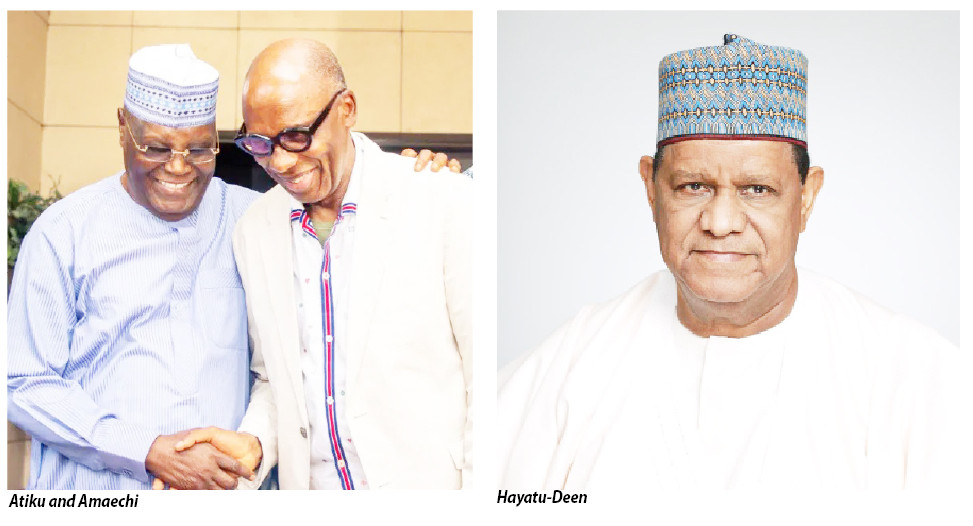
Atiku secured 1,846,370 votes to emerge the winner of the contest, defeating former Minister of Transportation, Rotimi Amaechi, who polled 504,117 votes, while businessman and presidential hopeful Mohammed Hayatu-Deen scored 177,120 votes.
Despite the wide margin of victory, signs of internal discontent emerged almost immediately after the exercise, with supporters of Amaechi and Hayatu-Deen openly questioning the process’s credibility and warning that unresolved grievances could deepen divisions within the party.
Amaechi, in a strongly worded statement rejecting the outcome of the primary, described the results as “concocted” and lacking credibility, alleging widespread voter disenfranchisement across several parts of the country.
“I unequivocally reject the concocted results being announced,” the former Rivers State governor declared.
“I had initially stated that I would only accept the outcome of the primaries if the process were free, fair and transparent, and I stand by my word.
“I will not accept results from a process that does not reflect the values that the ADC had pledged to uphold.”
Amaechi further alleged that many party members were prevented from participating in the exercise.
“There’s no way that about eighty per cent of members of the party were not allowed to vote, and you expect me to accept such results. Then what makes us different from the others?” he queried.
He also accused the ADC of allegedly engaging in the same electoral practices it frequently accuses the ruling All Progressives Congress (APC) and the Independent National Electoral Commission (INEC) of perpetrating.
“A party that criticises the ruling APC and INEC for vote buying, rigging and writing of results cannot itself engage in vote buying, writing of results and other electoral malpractices. This is not acceptable,” he added.
Hayatu-Deen also raised concerns about the exercise’s credibility, alleging widespread irregularities and attempts to pressure him into stepping down in favour of another candidate.
Speaking after voting in his ward in Borno State, Hayatu-Deen claimed he received several phone calls urging him to withdraw from the race in favour of another aspirant.
“This should be a free, fair and transparent election. Anybody capable of contesting any office has the right to present himself for service,” he said.
He further alleged that false information was circulated in some states claiming he had stepped down from the contest. At the same time, party members in other areas were allegedly denied the opportunity to vote.
“For example, in Kaduna State, party faithful were told that consensus had been reached and that Mohammed Hayatu-Deen had stepped down. In Zaria, where I have many supporters, the election had not taken place as of 5 pm.
“People were denied their rights. This act is criminal and fraudulent,” he stated.
Hayatu-Deen also alleged that electoral officials in parts of Borno State abandoned result sheets after voting had taken place.
As criticism intensified, the ADC leadership moved swiftly to defend the exercise’s credibility and reassure party members that grievances would be addressed through internal mechanisms.
Speaking on Arise Television at the venue of the collation centre, media aide to the ADC National Chairman, Kola Ologbondiyan, dismissed allegations of manipulation as “strange,” insisting that the party had established structures for resolving disputes arising from the exercise.
According to him, aggrieved aspirants and stakeholders were expected to channel complaints through the party’s appeal committee rather than resort to public confrontation.
Ologbondiyan acknowledged the logistical difficulties of conducting a nationwide direct primary election, noting that the exercise was held simultaneously in more than 8,000 wards across the country.
“A hundred per cent compliance may not be possible, but when there is substantial compliance, everybody will accept the process,” he said.
Beyond the controversy over the conduct of the primaries, the developments have once again brought the long-running debate over zoning and power rotation to the centre of national political discourse.
While northern blocs within the ADC argued that Atiku remained the opposition figure with the widest national appeal and political experience needed to confront the APC, some southern stakeholders insisted that the presidency should remain in the South in the interest of equity and political balance after President Bola Tinubu’s first term.
Several party insiders said concerns over regional dominance and internal power distribution had quietly trailed political negotiations within the ADC long before the primary.
Apparently aware of the growing unease within the party, Atiku used his acceptance speech at the Transcorp Hilton in Abuja to appeal for reconciliation and unity among aggrieved stakeholders.
“I must state at this juncture that this is not the time to celebrate. No one was defeated because we are one party and we all need to recognise the fierce urgency of the moment,” he said.
The former Vice President urged party members to close ranks and focus on what he described as the broader mission of rescuing Nigeria from economic hardship, insecurity and political intolerance under the APC-led administration.
In a direct appeal to his fellow contestants, Atiku specifically invited Rotimi Amaechi and Mohammed Hayatu-Deen to work with him in strengthening the party.
“I invite Chief Chibuike Rotimi Amaechi and Alhaji Mohammed Hayatu-Deen to join me in this fight to save our democracy and our country,” he declared.
Signs of possible reconciliation also emerged shortly after the primaries, following reports of consultations between Atiku Abubakar and former Minister of Transportation, Rotimi Amaechi.
Speaking after the meeting, the ADC presidential candidate stressed the need for patriotic Nigerians to unite to confront what he described as the country’s growing drift, economic hardship, and political uncertainty.
Atiku also accused the APC government of undermining opposition parties through intimidation and alleged interference in party affairs.
The ADC candidate further unveiled broad policy priorities expected to shape his campaign, including security, education, healthcare, economic reforms and restructuring of power-sharing arrangements among the constituent units of the federation.
Former Senate President and National Chairman of the ADC, David Mark, also appealed for unity after the conclusion of the exercise, urging all aspirants and their supporters to rally behind the party’s candidate ahead of the 2027 general election.
Speaking shortly after the collation of results, Mark praised party members for what he described as a peaceful and democratic exercise conducted across the country’s 8,809 wards.
“This primary has ended, and we now have a candidate. I appeal to my brothers, Rotimi Amaechi and Mohammed Hayatu-Deen, and all their supporters, to close ranks and work together with Alhaji Atiku Abubakar for the success of our great party,” Mark said.
“There is no victor and no vanquished in this contest. What is most important is the unity of the ADC and our collective mission to rescue Nigeria.”
Mark also urged aggrieved aspirants and stakeholders to pursue their complaints through internal party mechanisms rather than resort to public protests.
Offering an independent perspective on the controversy, Dr. Christian Okeke, a lecturer in the Department of Political Science at Nnamdi Azikiwe University, argued that the emergence of another northern candidate should not automatically be interpreted as a political threat to the South.
“I do not think that the emergence of any northern candidate in the 2027 presidential election is a threat in any way. Political aspiration remains a constitutional right, and northerners clinching party nominations is not a problem at all,” he said.
According to him, there is currently no legally binding national agreement on power rotation between the North and the South.
“It has not violated any known law, and there is no national agreement on rotation between the North and South anywhere. If the country is serious about rotation, it should make it a constitutional matter based on geo-political balancing to guarantee equity,” he stated.
Dr Okeke also questioned whether southern political elites could unite behind a single candidate ahead of 2027.
“The question is: can the South agree to rally round one candidate to ensure that power does not elude the zone at this time? Arguably, it is an impossible feat to achieve,” he said.
Speaking with LEADERSHIP Sunday in Abuja, South-South public affairs analyst, Tonye John, said the emergence of another northern presidential candidate under the ADC had deepened concerns over the future of power rotation in the country.
According to him, many southern stakeholders believe the party may have breached what he described as an “unwritten gentleman’s agreement” on zoning and political balance.
“There is growing concern in the South that the spirit of power rotation has been ignored. Whether written or unwritten, many political actors believed the ADC would respect the mood of the country after years of agitation for inclusiveness and balance,” he said.
Tonye John warned that failure to manage the fallout from the primary properly could weaken trust within sections of the party ahead of the 2027 elections.
“If the ADC is not careful, this could create resentment within parts of the South-South and South-West where many stakeholders expected the opposition party to present a southern candidate as a symbol of fairness and national cohesion,” he added.
Speaking on the development, Abuja-based analyst Suleiman Haruna said. At the same time, Atiku Abubakar’s political experience and national network cannot be ignored; the ADC must carefully manage perceptions surrounding zoning if it hopes to maintain nationwide support ahead of 2027.
“In Nigeria’s political reality, zoning and power rotation are sensitive issues that cannot simply be dismissed. Some southern political stakeholders may feel uncomfortable with another northern candidacy at this time, especially when expectations for a southern continuation are still strong,” he said.
He, however, noted that the party could still overcome such concerns if it succeeded in building a broad-based national movement driven more by economic hardship, insecurity, and governance issues than by regional sentiments.
“The challenge before the ADC now is how to convince Nigerians that competence, unity and national rescue are more important than regional calculations,” he added.
Political observers believe the coming days will determine whether the ADC can successfully manage its first major internal crisis or slide into deeper factional disputes.
While Atiku’s supporters insist his emergence strengthens the party’s national outlook, critics within the ADC fear unresolved zoning concerns and regional dissatisfaction could eventually threaten party unity ahead of the 2027 elections.
Whether the party can successfully overcome those internal contradictions may ultimately determine if the ADC evolves into a genuine national alternative in 2027 or becomes another opposition platform weakened by internal disputes before the general election.
We’ve got the edge. Get real-time reports, breaking scoops, and exclusive angles delivered straight to your phone. Don’t settle for stale news. Join THISTIMES on WhatsApp for 24/7 updates →
Join Our WhatsApp Channel