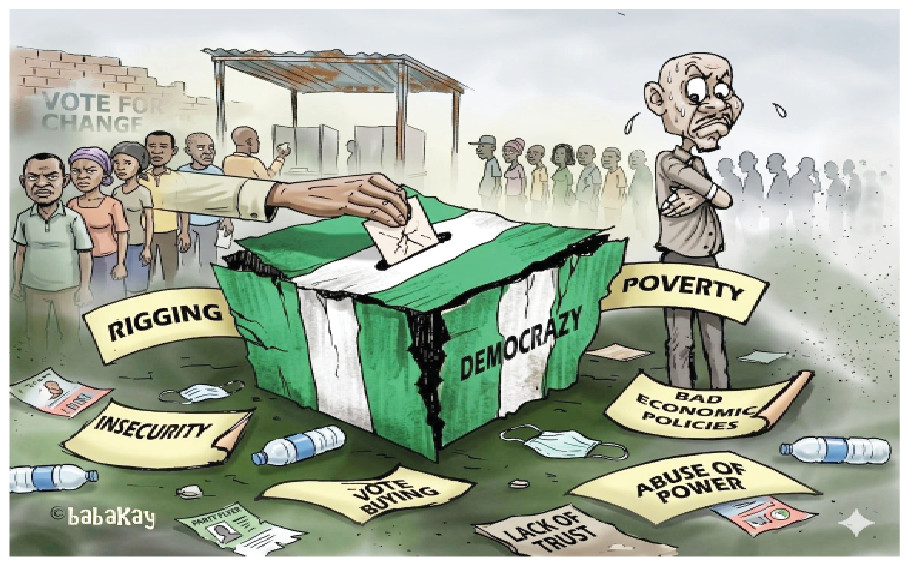
The main threat to Nigerian democracy is no longer a lack of understanding of elections but the growing doubt that elections matter. What is often labelled voter apathy is actually a rational response. When citizens believe their votes matter, hope drives them; when manipulation seems possible, disengagement follows—not from disdain for democracy, but from a sense of abandonment and frustration.
INEC now faces the challenge of restoring electoral trust. The Commission is not just an election manager; it is the institution that confers democratic legitimacy. Its conduct shapes whether elections are accepted as legitimate or dismissed as empty rituals. As long as INEC is trusted, winners gain acceptance and losers concede peacefully; when INEC is distrusted, every action is viewed with suspicion, and every result becomes a source of conflict.
The Broken Promise of 2023
Any honest assessment must begin with 2023. That election was meant to mark a new era of transparency, anchored on the Bimodal Voter Accreditation System and the INEC Result Viewing Portal. INEC repeatedly assured Nigerians that technology would narrow the space for manipulation. Those assurances raised expectations, especially among young voters and citizens who had begun to believe that the system might finally be forced to respect the ballot. But on election day, the promise collapsed where it mattered most. Presidential results were not uploaded in real time as expected, and INEC’s later explanation that an “HTTP error” caused by a configuration bug disrupted the presidential upload did little to heal the wound.
The problem was not just failed technology; it was failed trust. INEC’s promises of transparency became central, and when those promises were broken, the damage was institutional. The European Union Election Observation Mission said INEC’s failures eroded trust and recommended clearer laws, transparent appointments, and real-time publication of results.
Once trust is broken on such a large scale, it cannot be restored by statements alone; only consistent, transparent actions can begin to rebuild it. Thus, the 2027 elections will not be routine—they will serve as a test of INEC’s credibility. It will also determine the survival of democracy in Nigeria.
Neutrality Under Suspicion
Professor Joash Ojo Amupitan’s 2025 appointment was meant as a fresh start. Though initially praised as apolitical, new leadership alone cannot erase old doubts. Renewal comes not from biographies but from consistent conduct.
The controversy around social media allegations against the new chairman spread quickly. INEC’s investigation cleared him, but the incident showed how disinformation thrives where trust is weak. Stronger trust would have ended the issue quickly.
More concerning are controversies over INEC’s handling of party affairs, such as the ADC leadership dispute. INEC cited court orders, while critics claimed interference. In a democracy, procedural fairness must be visible, not just claimed. Recent incidents show public trust remains fragile.
Nowhere is this perception problem sharper than in INEC’s oversight of party primaries and internal party affairs. Four pressing issues demand urgent attention.
First, there are persistent concerns about possible partisan appointments. Elections are ultimately run by people, not abstractions. If resident electoral commissioners (REC), electoral officers, ICT staff, and other personnel are perceived as politically compromised, the whole process is at risk. International IDEA has noted recurring controversies over appointments since 2015, which have worsened in 2023. For example, Osun legislators have alleged bias in the selection of officials for the 2026 election—whether or not these claims are true, they reveal growing fears that electoral integrity can be undermined even before ballots are cast.
Second is the issue of strategic redeployments. When key electoral officials are moved close to major elections, especially amid claims of political pressure, confidence in the electoral process suffers. INEC may have administrative reasons for moving personnel, but in a climate of distrust, timing is substance. A redeployment may be lawful, but if it appears to serve partisan convenience, it damages neutrality. The Commission must therefore learn that administrative opacity is no longer harmless. Every major personnel decision before a sensitive election must be explained clearly, proactively and publicly.
Third is INEC’s attempt to prescribe timelines for party primaries in ways the court found inconsistent with the Electoral Act 2026. In May 2026, the Federal High Court in Abuja invalidated INEC’s timetable for the conduct of primaries and nomination of candidates, holding that INEC could not lawfully abridge statutory windows granted to political parties for submission, withdrawal and substitution of candidates. This was not a mere procedural quarrel. It went to the heart of political participation. An electoral umpire must regulate the game; it must not reshape the field in a manner that favours older, richer and better-established parties over emerging alternatives.
Fourth is the perception of selective urgency. Opposition parties often accuse INEC of moving swiftly when their internal disputes arise, while showing greater patience when ruling-party complications emerge. INEC may reject this charge, and in specific cases, it may have legal explanations. But the persistence of the perception is itself a governance failure. An umpire cannot afford to appear hurried toward one side and hesitant toward the other. Neutrality is not only a legal condition; it is a democratic performance that must be seen, felt and believed.
The structural problem is even deeper. Nigeria’s appointment framework still leaves INEC vulnerable to suspicion. The President nominates the INEC Chairman, subject to Senate confirmation. Both the executive and the legislature are controlled by politicians with direct stakes in electoral outcomes. Even when a chairman is personally competent, the pathway to office creates an inherited confidence deficit. Until Nigeria develops a more transparent, multi-stakeholder and insulated appointment process, every INEC leadership will begin under a cloud.
The Road to 2027
The Electoral Act 2026 offers some progress. President Tinubu signed the amended electoral law in February 2026, and the legislation gives statutory weight to electronic transmission and the IReV debate that dominated public anger after 2023. But Nigerians have already learned a painful lesson: technology cannot save democracy where institutional will is weak. Machines can capture, transmit and display information. They cannot manufacture integrity. If the law still leaves room for vague exceptions such as “communication failure,” then the architecture of manipulation may be narrowed but not fully sealed. Legal analysts have rightly warned that undefined communication failure can create evidentiary and accountability problems in election disputes.
This is why INEC’s crisis cannot be solved by another portal, another device, another chairman or another assurance. Credibility is built long before election day. It is built into how ad hoc staff are recruited. It is built into how party disputes are handled. It is built into how court judgments are obeyed. It is built into how procurement is disclosed, how technology is tested, how failures are explained, and how rules are applied evenly. Above all, it is built when the Commission shows that it fears the law more than it fears powerful politicians.
Political parties also have responsibilities. They cannot violate their own constitutions, sabotage their own primaries, manufacture endless internal crises and blame INEC for every consequence. Civil society must remain vigilant without becoming partisan. The media must investigate without amplifying falsehood. Citizens must resist despair without surrendering their right to demand better.
Still, the greater burden rests on INEC because the umpire carries the whistle. If the umpire is trusted, the game can survive fierce competition. If the umpire is distrusted, even a fair decision will be interpreted as fraud.
For INEC, 2027 is more than another election. It is a chance for institutional redemption. For Nigeria, it may be the difference between democracy as a living covenant and democracy as a tired ceremony.
The country is not asking INEC for miracles. It is asking for honesty, fairness, competence and courage. That should not be too much to ask of the institution entrusted with the sovereignty of over 200 million people.
– Dakuku Peterside is the author of Leading in a Storm and Beneath the Surface.
We’ve got the edge. Get real-time reports, breaking scoops, and exclusive angles delivered straight to your phone. Don’t settle for stale news. Join THISTIMES on WhatsApp for 24/7 updates →
Join Our WhatsApp Channel