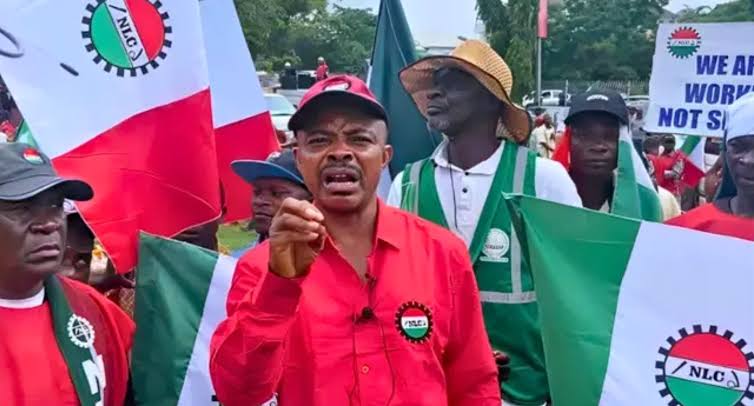
The Nigeria Labour Congress (NLC) has rejected suggestions that a new national minimum wage of N100,000 would be sufficient for Nigerian workers, arguing that the country’s harsh economic realities require a much higher wage benchmark.
The labour union said workers across the country are battling rising living costs, inflation, soaring energy prices and the continued depreciation of the naira, making the proposed figure inadequate to meet basic needs.
Speaking on the issue, NLC spokesperson, Benson Upah, said while the willingness of state governors to review workers’ salaries was welcome, the amount being considered falls far short of what Nigerians require to maintain a decent standard of living.
His remarks came after Chairman of the Nigeria Governors’ Forum and Governor of Kwara State, AbdulRahman AbdulRazaq, revealed that governors were considering a N100,000 minimum wage proposal.
The governor made the disclosure during the Sallah visit to President Bola Tinubu in Lagos. He explained that consultations were ongoing between state governments, the Federal Government and organised labour to arrive at a wage structure that would improve workers’ welfare without placing excessive pressure on government finances.
However, labour leaders insist that the realities facing workers today demand more than a modest salary increase.
According to Upah, the value of wages has been severely eroded by inflation and the sharp increase in the cost of essential goods and services. He noted that food prices, transportation costs, electricity tariffs and fuel expenses have continued to rise, leaving many workers struggling to support their families.
“We consider it thoughtful of the Kwara State Governor for proposing this, but certainly, N100,000 falls far below or behind the realistic figure,” he said.
The labour spokesman argued that if current economic conditions remain unchanged, a living wage that truly reflects the realities faced by Nigerian workers should be around N1 million.
“Given the realities around the exchange rate, inflation, raised tariffs, surge in the pump price of petrol and associated costs, decline in the purchasing power of the average worker, effects of the new regime of taxes on our cost of living, the realistic figure, subject to status quo maintenance, would be N1m,” he stated.
Upah further maintained that governments now have greater financial capacity to support improved salaries due to increased revenues being shared among federal, state and local governments.
“In light of the earnings by governments, this should not be a big issue.
“Check what is being shared at FAAC. The windfall from the Middle East war has put over N5tn in the treasury. Though this is temporary, it is nonetheless very good for governments,” he added.
The NLC official stressed that workers remain the backbone of national development and should be adequately rewarded to drive productivity and economic growth.
“Finally, please note that the greatest asset of any nation is its workforce,” he said.
The debate over wages has remained a major issue since the Federal Government removed fuel subsidies and allowed the naira to float against foreign currencies. Both policies triggered significant increases in the prices of goods and services across the country.
In July 2024, the Federal Government approved a new national minimum wage of N70,000 following months of negotiations with organised labour. The agreement replaced the N30,000 minimum wage that had been in effect since 2019.
Despite the increase, labour unions have consistently argued that the current wage no longer reflects the realities facing workers, as inflation continues to reduce purchasing power.
Many employees, particularly those in the public sector, have repeatedly complained that their salaries can no longer cover transportation, feeding, housing and other essential expenses.
As discussions on workers’ welfare continue, the Nigeria Governors’ Forum is yet to formally submit any fresh minimum wage proposal to the Federal Government or organised labour for consideration.