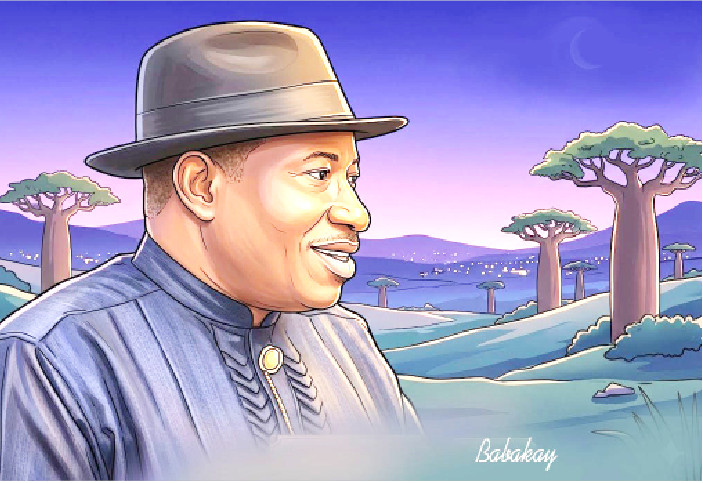
If Dr Goodluck Jonathan were my brother, I would find a quiet place to have a heart-to-heart fraternal talk with him.
Don’t Run
“My dear brother, God has been so kind to you that He could be accused of being partial. Imagine, in a country of 200 million people, He picked you from the stable and enthroned you above everybody else. Deputy Governor, Governor, Vice President, and President. You ruled Nigeria for six whole years! You were not perfect, to say the least, but the whole nation saluted you when you conceded defeat in 2015. We were all proud of you. The world took notice and elevated you to the status of a global statesman. Now, some political merchants are baiting you to come out of retirement and contest the 2027 presidential elections. They’ve paid for your nomination forms and declared you a consensus candidate.
“Having spent the last decade acting as a highly respected ECOWAS statesman, leading international election observation missions, and mediating complex political crises across Africa, it would be demeaning of you to return to the highly divisive, do-or-die arena of a Nigerian presidential campaign where your hard-earned reputation as an objective, peaceful elder statesman will be dragged through the mud of partisan personal attacks and vicious lampooning. Please, don’t demystify yourself. Don’t go down in history as a reed that can be carried hither and thither by the lagoon.”
It would be entirely up to him to accept or reject my counsel, but I would have satisfied myself that I have given him the benefit of my thoughts on why he should run away from those pressurising him to run.
The silver-tongued Prof. Jerry Gana, one of the founding fathers of the Peoples’ Democratic Party, PDP, made a compelling case for the return of President Jonathan to partisan politics. One of the considerations of the party’s political engineers is the fact that choosing Jonathan guarantees that the presidency will automatically open up and rotate to another region (specifically back to the North) by 2031, preventing a new candidate from locking down the position for a full eight years.
Strategists
Gana and his fellow PDP strategists are capitalising on what they view as a growing public nostalgia for the economic conditions of the Jonathan era (2010–2015). With the country currently navigating intense economic pressures, rising food costs, and high fuel prices, the PDP plans to frame Jonathan’s previous tenure as a period of milk and honey. The ‘Bring Back Jonathan’ movement represents a deliberate effort by the PDP to present a familiar, steady hand to an electorate weary of economic uncertainty.
In the same vein, the younger generation of PDP loyalists, represented by the party’s governorship candidate in Delta State, Hon. Benedict Etanabene, who currently represents the Okpe/Sapele/Uvwie Federal Constituency of Delta State in the House of Representatives, has urged former President Goodluck Jonathan to accept calls to contest the 2027 presidential election.
Etanabene noted that developed democracies sometimes recalled experienced leaders during national emergencies. He cited the political trajectory of Donald Trump in the United States and John Mahama in Ghana as worthy precedents. “In the US, Trump was there before now. He left; they brought him back. They voted for him. The Ghanaian president was there before. He came back; they voted for him. If we have a problem and we need somebody to fix it, we look for people who have the capacity to do it; we don’t discourage them from coming,” he said.
However, considering the highly transactional nature of Nigerian politics, Jonathan’s entry into the race can easily trigger a massive tribal backlash from ‘power-preneurs’ (political entrepreneurs who buy and sell influence and power). What will Jonathan say if Peter Obi’s supporters in the southeastern states accuse him of trying to dilute Obi’s votes to give advantage to Tinubu?
Many analysts see Jonathan’s tenure as a mixed bag: a period marked by a highly commendable commitment to democratic principles and civil liberties but fundamentally marred by institutional weakness, economic mismanagement, and corruption. Nevertheless, he exited in a blaze of glory for conceding defeat when he could have set the country on fire. He is now an international statesman and a role model in his own right.
Ill-Advised
We must now ask: what kind of reductionist ambition will make Goodluck Jonathan bring down his political gloves from the rafters and enter the ring against, for example, a former protégé like Senator Seriake Dickson, the national leader of Obi’s party, the Nigeria Democratic Congress, NDC?
Or, suppose APC stalwarts accuse him of having been sponsored to take away the South-South votes promised to Tinubu by the region’s governors, who are all now members of the APC? This is not to say that Jonathan has that much influence in the region anymore, but when the daredevil fib-spinners of the parties descend on him, he will be lucky if he’s still recognisable at the end. If Jonathan contests and loses, he would have politically castrated himself.
Political strategists across the major party lines are mostly AGIP (Any Government In Power). A Jonathan presidency would trigger an aggressive, messy battle for succession by presidential aspirants from the North who hope to succeed him, almost from the day he is sworn in, crippling governance and activating internal warfare.
Admittedly, the Peoples Democratic Party (PDP) or potential coalitions looking to challenge the ruling All Progressives Congress (APC) would be happy that a Jonathan with 100% brand recognition across the 36 states is in their corner. But what mileage can that achieve?
Political Math
When the governing party, APC, was in opposition, it was able to topple the PDP from its high pedestal through a twin strategy of factionalising the party and uniting anti-PDP elements across four parties. The most straightforward path to defeating an incumbent in Nigeria is through a completely unified opposition front. Sadly, in the present circumstances, Nigeria’s opposition is fragmented. Imagine if Jonathan, Atiku, Obi, Kwankwaso, Duke, Adebayo, and (yes) Sowore were in the same party!
The NDC lacks the established nationwide party structures of the APC. But Atiku is solid nationally with deep-rooted political structures and immense financial backing. It must be noted, though, that his traditional opposition apparatus is splintered, and he’s being forced by circumstances to build up new party momentum from scratch while simultaneously competing with Obi, Kwankwaso, and Tinubu for northern votes. As the most experienced presidential candidate among the lot, Atiku is formidable.
On his own part, Tinubu commands a deeply entrenched political machine, backed by a vast network of 31 APC governors across the states. The ultimate test for his campaign will be the public perception of the economy, security, and inflation over the coming months. If economic frustration peaks and insecurity skyrockets, grassroots momentum could override institutional advantages. Nevertheless, all those in the game acknowledge that Tinubu was formidable enough without power and redoubtably so as an incumbent president, even as they wisely note that no man is unbeatable.
In 2023, Tinubu won with roughly 36.6% of the vote because the opposition was split. If Atiku, Obi, and other notable presidential candidates remain on separate tickets, they risk repeating history by dividing the 60%+ pool of voters looking for change.
President Jonathan is best advised to stay out of the fray!
We’ve got the edge. Get real-time reports, breaking scoops, and exclusive angles delivered straight to your phone. Don’t settle for stale news. Join THISTIMES on WhatsApp for 24/7 updates →
Join Our WhatsApp Channel