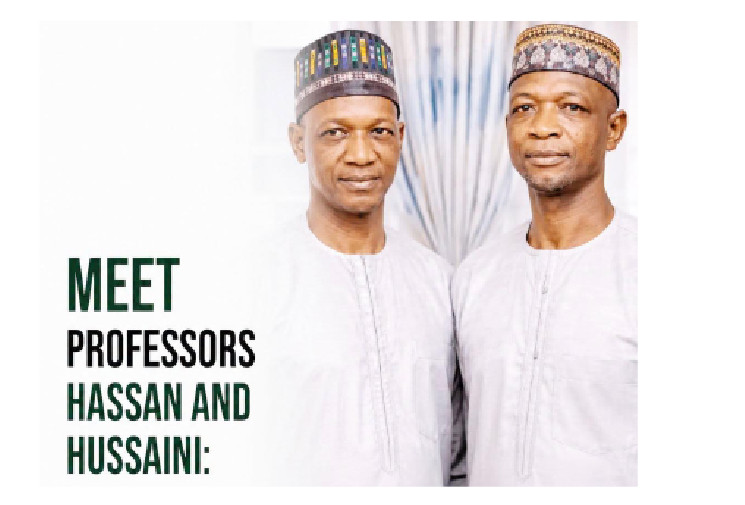
Twin Professors Hassan Ishaq Ibrahim and Hussaini Yusuf Ibrahim are identical twins whose lives mirror each other in extraordinary ways. From education to career progression, marriage, and academic milestones, they have remained inseparable. Both are Professors of Agricultural Economics at the Federal University Dutsin-Ma (FUDMA) in Katsina State. In this interview with GODWIN ENNA, they share the story behind their remarkable journey of shared ambition, discipline, and destiny.
Can you briefly introduce yourselves and share what makes your journey as identical twins in academia unique?
Prof. Hassan Ishak: We are identical twin brothers from Kaduna State. We are both Professors of Agricultural Economics at the Federal University Dutsin-Ma (FUDMA), Katsina State. Our academic journey has been largely parallel, as we studied together through our Bachelor’s and Master’s degrees at Ahmadu Bello University, Zaria, and later obtained our PhDs from the University of Ilorin. Over the years, we have also shared similar professional experiences, including teaching, research, and administrative responsibilities within the university system. What makes our journey unique is not only our academic progression but the fact that we have moved through almost every stage of life side by side.
Prof. Husseini Yusuf: To add to what my brother has said, our lives have been closely intertwined since childhood. We grew up together, studied together, married on the same day, and even have the same number of children—four boys and one girl each. In our professional careers, we have continued to follow similar paths, including working in the same department and delivering our inaugural lectures on the same day. It is this unusual alignment in both our personal and academic lives that makes our story quite remarkable.
Could you please share your current responsibilities at the university?
Prof. Hassan Ishaq: I currently serve as the general manager of the University Consultancy Services, also known as FUDMA Consultancy. In addition to this administrative role, I am actively involved in teaching, research, and community service, which remain core components of my academic career.
Prof. Husseini Yusuf: I currently serve as the director of the University Quality Assurance Directorate, overseeing quality assurance across the university system. I also continue to engage in teaching, research, and other academic responsibilities that are part of my role as a lecturer and professor.
Can you take us back to your early childhood as twins and explain how it shaped your awareness of your uniqueness?
Prof. Hassan Ishak: Initially, life was completely normal. We saw ourselves as every other child growing up and never imagined there was anything particularly unique about us. However, at some point, we began to notice children following us wherever we went. They would point at us and say in Hausa, “’ Yan gida aya masu kama da juna,” meaning people from the same house who look exactly alike.
That was the first time we realised that people saw something special in us that we had never noticed before.
By the time we reached secondary school, around the age of twelve, our awareness deepened, and we began to understand what it meant to be twins. We gradually realised that being twins attracted significant attention, something we had never been prepared for as we grew up.
Prof. Husseini Yusuf: We truly grew up like any other child. It was the people around us who made us aware that we were twins. As my brother explained, people constantly said we looked exactly alike. Interestingly, I did not even notice the resemblance myself, but others kept pointing it out to me.
Whenever we walked around town, people would stop us to confirm whether we were twins. Some were so fascinated that they even gave us gifts just because we were twins. Over time, those experiences made us realise the attention that came with our identity.
Even today, I still feel a sense of curiosity whenever I see parents with twins. I often stop to ask their names and whether they are twins. Perhaps it is because I naturally identify with them.
Did you ever imagine that your lives would attract such public attention and media interest?
Prof. Hassan Ishak: Never. We were completely unprepared for the level of attention that came with being twins. In fact, we never imagined people would invite us to interviews like this. This is our third interview. None of them was planned. At that young age, we wanted quiet lives. However, wherever we went, people recognised us. In school, students would ask, “Who is Hassan? Who is Husseini?” Some even argued among themselves when they confused us.
Attention was never something we desired, but there was nothing we could do about it. Even now, we still find ourselves in the same situation. We have tried to live quietly, but Almighty Allah has His own plan.
What influenced your decision to pursue teaching as a profession?
Prof. Hassan Ishak: My passion for teaching began in Primary Six at Capital School, Kaduna. My teacher would often ask me to stay behind at break time to help classmates who did not understand Mathematics. While others went out to play, I stayed behind to explain the lessons. That experience planted the seed of teaching in me.
Later, in my third year at university, there was a long strike that lasted almost a year. Around the same time, Ahmadu Bello University was also closed. I was at home with nothing meaningful to do.
I visited a nearby school and told the head teacher I wanted to teach. She asked about my qualifications, and I explained that I was a 300-level student with a passion for teaching. She gave me the opportunity, and I taught there throughout the strike.
By the time schools reopened, they did not want me to leave, but I had to return to complete my studies. Even after earning my Bachelor’s and Master’s degrees, I continued teaching because it had already become my passion. My Primary Six teacher had ignited that path.
Did your brother influence your decision to become a lecturer?
Prof. Husseini Yusuf: Our experiences were quite similar. Before university, I had already begun teaching our younger siblings to read. Interestingly, I later realised I was applying what is now known as phonics.
My background in Arabic education helped me understand how sounds are formed through vowels and consonants, which I applied in teaching English reading. I also noticed at school that I often thought I could explain lessons more simply than my teachers. I would imagine how I would teach if I were the lecturer.
Those thoughts stayed with me and ultimately shaped my decision to pursue academia. I wanted to make learning simpler and more enjoyable for students.
Do twins always think and act alike in decisions and opinions?
Prof. Husseini Yusuf: Not at all. Many people assume twins think alike, but that is not true. We often disagree. For example, I may like a musician he dislikes, or choose a colour he dislikes.
Even professionally, we sometimes find ourselves in situations where one of us supervises the other. At different times, I have been his Head of Department, and he has been mine.
We openly challenge each other in academic meetings and seminars. If I disagree with him, I say so, and he does the same. But once the meeting ends, we return home together as brothers. Professional disagreements never affect our relationship.
What has kept both of you together throughout your lives?
Prof. Hassan Ishak: Our late father deserves much of the credit. From childhood, he ensured we attended the same school, stayed in the same class, shared the same room, and even studied the same course.
He never forced us into a particular course but insisted that whatever we chose be the same. The only time we were separated was when I moved to Dutsin-Ma while my brother stayed in Dutse. Our father was uncomfortable with the arrangement, and within two months, my brother joined me.
Even during NYSC, he ensured we served in the same organisation, namely Union Bank in Maiduguri. Looking back, he realised that keeping us together would become our strength.
Have being twins opened professional or academic opportunities for you?
Prof. Hassan Ishak: Absolutely. For example, when we went to Thailand for our Master’s degree, we initially had no hostel accommodation. Once they discovered we were twins, they gave us a single room.
During PhD registration at the University of Ilorin, officials also fast-tracked our registration once they realised we were twins.
Prof. Husseini Yusuf: These experiences continue to this day. People are often eager to help us once they realise we are twins. Some even ask for prayers to have twins of their own. Our father always believed staying together would open doors for us, and it truly has.
What is your most significant joint academic achievement?
Prof. Hassan Ishak: One of my proudest achievements is completing our Master’s degree together. We started the programme on the same day, conducted research together, defended before the same external examiner, and graduated together. That remains a major milestone in our academic journey.
How has your bond influenced your families and children?
Prof. Husseini Yusuf: We are both married, and although our wives are not related, they come from the same town and understand our bond.
Interestingly, our children have also developed the same closeness. My daughter and my brother’s daughter insist on wearing identical outfits to events such as Sallah, weddings, or other family celebrations.
For example, if my wife wants to buy clothes for our daughter, she immediately asks, “What about Nana?” Likewise, my brother’s daughter asks, “What about Jidda?” They always want to dress alike.
The boys are equally close. Whenever they meet, they naturally pair up and start playing together.
Our children attend the schoolame school, communicate regularly, and visit each other at weekends. Sometimes they even plan visits themselves if we are delayed. There has never been a serious misunderstanding among them. Their relationship mirrors ours.
What was your relationship like growing up?
Our relationship has always been extremely close. We were inseparable as children and played together constantly. We never experienced rivalry or serious disagreement. Even today, that bond remains unbroken.
How did both of you eventually become lecturers at the same university?
Prof. Husseini Yusuf: After our Master’s degrees, we worked on different development projects, one with the World Bank and the other with the African Development Bank, while pursuing our PhDs.
A mentor, Professor Shehu Abdulrahman, advised us to leave the projects and join academia. We consulted our parents, who supported the idea. We applied, attended interviews, and were both employed as lecturers in the same department.
Prof. Hassan Ishak: We later served briefly at different universities, but in 2014, through an invitation facilitated by the Vice-Chancellor of FUDMA, we were reunited and have remained together since. We worked together for about eight years before the establishment of new federal universities. One of us secured an appointment at the Federal University, Dutse, while the other joined the Federal University, Dutsin-Ma.
Interestingly, shortly after he resumed at Dutse, the then Vice-Chancellor of Dutsin-Ma, Professor Armiya Bichi, learnt that I had an identical twin who was also an economist. Through one of our former students, he invited him to apply to Dutsin-Ma.
Although he had just completed his documentation at Dutse, he eventually applied, was appointed within two months, resigned, and joined Dutsin-Ma in 2014. Since then, we have remained in the same department, progressing through the academic ranks until we were both promoted to Professor on October 1, 2018.
Was academia always your dream?
Prof. Husseini Yusuf: Yes. We always wanted to teach at the institution where we studied, but we were not employed there despite our applications. Eventually, mentorship opened the door for us at Nasarawa State University, which shaped our academic journey.
What challenges have you faced as twins in the same profession?
Prof. Hassan Ishak: People often confuse our identities, which can lead to misunderstandings. It usually takes an explanation to restore clarity.
Prof. Husseini Yusuf: We also ensure we do not compete for the same leadership positions. One steps aside by mutual agreement.
Have there been humorous incidents due to your resemblance?
Prof. Hassan Ishak: A colleague once thought one of us kept changing clothes every few minutes and assumed he had mental health issues before realising we were twins. We all laughed about it.
Do students still confuse you?
Prof. Husseini Yusuf: Yes, especially new students. Over time, they learn to distinguish us.
Prof. Hassan Ishak: At one point, students even identified us using our vehicle plate numbers.
How do you support each other professionally?
Prof. Husseini Yusuf: We collaborate on research, publications, and conferences. We have attended international conferences together and are co-authoring a book on Impact Evaluation.
Prof. Hassan Ishak: We also cover for each other in lectures and academic duties as needed.
What advice do you have for young people?
Prof. Hassan Ishak: Stay focused and disciplined, and trust God. Success requires perseverance and hard work.
Prof. Husseini Yusuf: Do not be discouraged by challenges. For twins, especially, protect your bond and never let external influences divide you.
We’ve got the edge. Get real-time reports, breaking scoops, and exclusive angles delivered straight to your phone. Don’t settle for stale news. Join THISTIMES on WhatsApp for 24/7 updates →
Join Our WhatsApp Channel