Describe business as lifeline, say they employ workers
By AZA MSUE, Makurdi; ENNA GODWIN, Katsina; NICHOLAS DEKERA; ACHOR ABIMAJE, Jos; ABU NMODU, Minna; AHMED TAHIR, Lafia; and LONGTONG YAKUBU, BUKOLA ARO-LAMBO and BUKOLA ARO-LAMBO, Lagos
The nationwide debate sparked by First Lady, Senator Oluremi Tinubu’s advice that Nigerians should embrace indigenous small-scale businesses such as akara (bean cake), corn, and kuli-kuli (groundnut cake) has continued to generate widespread public conversation across the country.
Her remarks, made against the backdrop of rising food prices, unemployment, and economic hardship, have become more than a political talking point. They have triggered a deeper reflection on informal entrepreneurship and the survival strategies of millions of Nigerians.
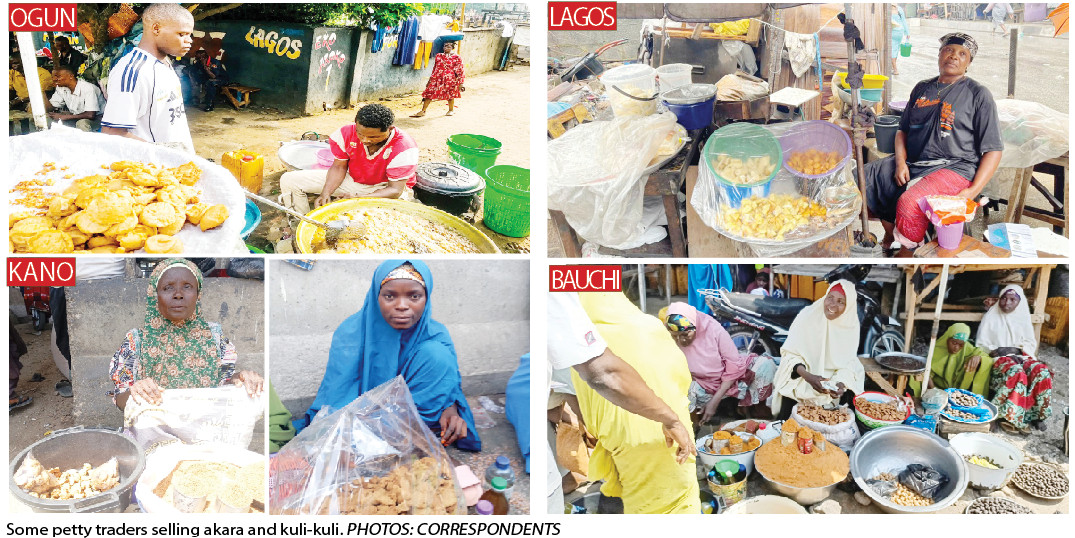
While critics and supporters remain sharply divided over the intent and implications of the statement, findings by LEADERSHIP Weekend across seven states reveal a consistent reality: akara and kuli-kuli businesses are not symbolic side hustles, but central survival systems for thousands of households.
Behind the frying pans, grinding stones, and sacks of groundnuts lies an informal economy that has quietly financed education, built houses, sustained families, and provided employment for decades in communities where formal opportunities remain limited.
From Benue to Katsina, Zamfara to Plateau, Niger to Nasarawa and Kano, traders described a common experience shaped by resilience in the face of rising input costs, insecurity, unstable electricity, and limited access to affordable credit.
Across all locations, producers and sellers agreed on one point: if properly supported with soft loans, improved processing equipment, and stable energy supply, kuli-kuli and akara production could become a major job-creation engine in Nigeria’s informal sector.
“Kuli-kuli trained my children through school”
At Katsina-Ala Market in Katsina-Ala Local Government Area of Benue State, Amina Sani, a Jigawa State indigene, has spent the last 10 years in kuli-kuli trading.
She said the business has been her family’s lifeline, funding the secondary education of her two sons, both of whom have completed their SSCE and are awaiting admission into tertiary institutions.
“Kuli-kuli business is for patient people,” she said. “Daily sales depend on location and customers’ demand. I make between N2,000 and N3,000 on a normal day.”
She explained that earnings vary, but consistency keeps the business alive.
“Sometimes I make up to N5,000 in a day, but not regularly. I combine kuli-kuli with selling groundnut oil and vegetables. I use proceeds from all of them to train my children and pay rent.”
For 13-year-old Ibrahim Idris, the business has also become a means of survival and hope.
“I live with my parents in Hausa Quarters. I help them sell kuli-kuli and other items. We feed and pay rent from the business,” he said.
He added that schooling is still part of the family plan. “Sometimes we buy from suppliers, other times my mother produces it.”
Another trader, Mary Onoja, described the trade as steady but slow.
“You cannot make quick millions from kuli-kuli. It is a slow-and-steady business. We use proceeds for feeding and basic needs. Like every business, it has challenges,” she said.
“I employed 15 workers through kuli-kuli”
In Katsina State, Alhaji Bishir Rahamawa, a veteran producer with over 40 years in the business, said kuli-kuli has defined his entire life.
He inherited the trade from his father and has remained in it ever since.
“I have eaten, married, educated my children and taken care of my family through this business. I don’t know any other business apart from kuli-kuli production,” he said.
Today, his processing centre employs more than 15 workers involved in frying, grinding, oil extraction, and packaging.
However, he said rising energy costs threaten profitability.
“I spend about N40,000 daily on gas due to erratic electricity supply,” he said.
A trader, Amina Ya’u, said the business sustains her household needs.
“It provides food, clothing, and supports my children’s needs,” she said.
“We survive through credit and low margins”
In Zamfara State, traders said insecurity and inflation have made kuli-kuli production more difficult.
Fatima Mohammed, who sells in Gusau, said groundnut prices have risen sharply.
“A big measure now costs about N2,000. Farming is no longer easy because of insecurity,” she said.
She added that many traders now operate on credit.
“We collect groundnuts on credit, produce kuli-kuli, sell, and repay suppliers. My monthly profit is N10,000 to N13,000,” she said.
Another trader, Hadiza Dosara, said she diversified into peanuts to survive.
“Kuli-kuli is not as profitable as people think. I make N28,000 to N35,000 monthly. Without my husband’s farm produce, I wouldn’t survive,” she said.
She also noted seasonal declines.
“Sales are usually very poor during Ramadan,” she added.
“Men and women now depend on kuli-kuli”
In Jos, Plateau State, traders said kuli-kuli is now a shared livelihood for both men and women.
Usman Bello, 59, said he entered the business after losing his provision store to fire.
“I stayed at home doing nothing until my sister advised me to start kuli-kuli. Today, I can pay my children’s school fees,” he said.
He said startup capital ranges between N150,000 and N250,000, depending on the season.
“I earn N30,000 to N40,000 monthly,” he said.
He called for government support through interest-free loans.
Adamu Shuaibu, 29, said over 20 men are now in the business in his market.
“I make N25,000 to N30,000 monthly. It is not only for women,” he said.
Isah Ahmed, speaking on behalf of his wife, said wholesale trading is also viable.
“She earns N40,000 to N50,000 monthly supplying retailers,” he said.
“A survival economy built on groundnuts”
In Niger State, widely regarded as a kuli-kuli production hub, traders said the business remains a household backbone.
Fati Jibrin Banma said: “When we process about 30 mudus of groundnuts, we make N10,000 to N15,000 profit.”
Gambo Mohammed said earnings vary daily.
“I make N3,000 to N4,000 on a good day; sometimes losses occur,” he said.
Hadiza Musa said that despite modest returns, the trade is dependable.
“I make about N5,000 from 10 mudus. I also supply Abuja and Lagos. It is sustainable,” she said.
“It Builds Homes And Keeps Youths Engaged”
In Lafia, Nasarawa State, traders said kuli-kuli helps families survive and keeps youths engaged.
Malama Zainab Musa, a 30-year veteran of the trade, said:
“I pay school fees, rent and feed my family through kuli-kuli.”
She said she started small through credit-based purchases.
“I started by collecting groundnuts on credit, frying and selling, then saving gradually,” she said.
Kuli-Kuli Trade Sustains Families, Funds Education
For many traders at Yan-Kura Market in Kano, the humble kuli-kuli—a crunchy snack made from groundnuts—has grown beyond a traditional delicacy into a dependable source of livelihood, funding education, supporting households, and creating employment opportunities.
Despite economic challenges, traders say they have built sustainable businesses around the sale of the snack, with some earning thousands of naira in daily profits, sustaining families and keeping small enterprises afloat.
Khadijat Ibrahim, who has been in the business for about eight years, said she spends about N20,000 daily on kuli-kuli and often sells out before the close of business. According to her, she earns an average daily profit of about N5,000, which she invests in a sweets business, while the rest supports her parents.
Eighteen-year-old Maryam Yusufa, who has been in the trade for seven years, said she learnt the business from her mother and now sells both kuli-kuli and groundnuts. She explained that she takes goods worth between N10,000 and N15,000 to the market daily, making a profit of as much as N3,000 on every N10,000 worth sold.
Maryam added that the business has enabled her to combine trading with formal and Islamic education while also supporting her family’s welfare.
“The business has enabled me to combine trading with formal and Islamic education while contributing to my family’s welfare,” she said, urging unemployed youths to embrace small-scale businesses rather than remain idle.
For 65-year-old Aisha Dan-Jummai, who has traded in kuli-kuli for 25 years, the business has transformed her family’s fortunes. She said proceeds from the trade have enabled her to feed her family, support relatives, sponsor her 16-year-old daughter’s education, and marry off three of her children.
She also revealed that she trained her 25-year-old son in the business, noting that he has been trading independently for about seven years.
“On good market days, I record sales of up to N40,000 and earn about N10,000 in profit,” she said, underscoring the enduring economic value of the trade in Kano.
How We Built Houses, Trained Graduates – Akara Sellers
In the early hours of the morning, long before dawn breaks and while many are still asleep, Mrs Ashe Ojomo is already awake, peeling basins of beans and preparing ingredients for her daily akara business.
A trader who has raised three graduates over 22 years, Ojomo, originally from Kogi State, sells akara at a busy bus stop in the Iyana Ipaja area of Lagos.
A similar routine defines the life of Madam Chibuzor, who operates daily except weekends. Her customers, many of them office workers on Lagos Island, queue as early as 6:30 a.m. to buy akara with bread and fried yams near the Nigerian Exchange in the CMS area.
Having spent more than 24 years in the business, Chibuzor said her success cannot be measured only by time spent behind the frying pan.
Despite losing her husband nearly four years ago, she has kept the business alive.
“I bless God because He did not leave me alone. I have achieved many good things that I don’t even know where to start,” she said.
She recalled how her journey began.
“I started by hustling. My husband’s junior brother’s girlfriend used to sell akara here on the Island while I was doing my own business at Alapere. She later left the place for me. The arrangement was that she bought the ingredients while I sold, and we shared the profit—two parts for me, one part for her. That was how everything started.”
From that arrangement, she built a stable livelihood that now supports her family.
“I have sent two of my children to school through this business. My first daughter graduated from the National Open University in Abeokuta, while my last daughter is at Lagos State University.”
She also disclosed that she and her late husband built a house in Ikorodu before his passing.
“We built our own house in Ikorodu, Lagos, where I live now. I may not have bought a car, but I have a house, and I thank God.”
For her, contentment has been key.
“I don’t chase too much in life. I live one day at a time. I am content with my daily bread.”
Still, she insists the work is not easy. She wakes as early as 3 a.m., preparing food until around 7 or 8 a.m. before sales begin.
“Selling akara is not a lazy person’s work. You must be determined,” she said.
She also noted rising costs.
“To grind one derica now costs about N700. Beans, pepper and oil are very expensive. Before, I could rent a shop, but now profit cannot even cover rent.”
Although she records daily sales of N60,000–N80,000, she explained that turnover is often mistaken for profit.
“I gather all the money and use it to restock every week. What remains is what I use for myself and my children.”
Despite challenges, she said the business has given her dignity and achievement:
“I am a graduate, and I have trained three graduates through this business. I have built houses in Lagos and my hometown.”
Challenges in the Trade
Not all experiences are positive.
Ifeanyi, an akara seller in Sango Ota, Ogun State, said rising costs and harassment from authorities make the business difficult.
“Police and KAI officials (a quasi-security outfit) come and seize our goods. Sometimes we lose all we made in a week,” he said.
He added that although he has not built a house or bought a car, the business still sustains him.
“At least I am getting my daily bread and paying my children’s school fees and rent.”
Similarly, Shakirat, a single mother who started with one tomato tin measure of beans and five litres of oil, said she has survived through the business despite inflation.
“Beans that used to be N40,000 now cost over N90,000. Gas and oil prices keep rising, but we thank God,” she said.
She noted that subsidy removal worsened costs but said the business remains her only lifeline.
Across Nigeria, akara and kuli-kuli businesses remain deeply embedded in the informal economy, serving as survival engines for millions of households.
While profits are often modest and inconsistent, traders consistently report that the business has enabled them to build homes, educate children, employ workers, and sustain families through economic hardship.
As one trader summed it up, “It may not make us rich overnight, but it keeps us alive.”
A 30-year-old man who simply wants to be identified as David and hails from Yola, Adamawa State, explained that his search for better opportunities led him to venture into the akara and bread business, which has been his source of livelihood.
According to him, “Every year since I arrived in 2019, I have always made it a point to travel back home to see my family, no matter how tough things were. But this year is different. For the first time, I have spent a whole year in Lagos without going back to Yola. It has not been easy, especially as the firstborn”
At the Berger Bus stop, located just at the busy point of entry into Lagos, David led a team of four young men, all from his state of Adamawa, at this akara spot.
He said, “Although I am in charge of the day-to-day work and coordinate the boys, we still have a female boss who owns the business and used to be the one making the akara and selling directly to customers before handing over much of the responsibility to us. Working here has taught me discipline, patience and how to deal with different kinds of people every day.
He revealed that selling akara may look like a small business to some people, but he has been able to feed himself through it. in a big city like Lagos.
David further said, “As the firstborn in my family, since my younger siblings are not here, I have to fend for myself while also thinking of how to support them back home.”
While being grateful for the business, he revealed, I am grateful because this business has given me hope for the future. With the income I have been able to save, I am preparing for the next step in my life. By the end of this year, by God’s grace, I plan to get married, and I believe this hustle is helping me build the foundation for it.”
We’ve got the edge. Get real-time reports, breaking scoops, and exclusive angles delivered straight to your phone. Don’t settle for stale news. Join THISTIMES on WhatsApp for 24/7 updates →
Join Our WhatsApp Channel