Families are expected to have respect for human life. But when a family is accused of collaborating to commit kidnapping, it raises troubling questions about the changing face of organised crime. The arrest of a father and his three sons in Ondo State has brought those concerns into sharp focus. DAMILOLA ORIGBEMISUYI reports.
Over the years, kidnapping has evolved into one of Nigeria’s most persistent security threats, turning what were once routine activities into risky ventures for many citizens. From highways to rural communities and even urban centres, the menace has continued to spread, leaving families traumatised, disrupting livelihoods and undermining public confidence in security.
Against this backdrop, the recent arrest by the Ondo State Security Network Agency, also known as Amotekun Corps, of a father and his three sons over an alleged kidnapping in Ondo State has once again drawn attention to the changing face of organised crime in Nigeria, with security experts warning that criminal networks are becoming increasingly sophisticated and, in some cases, deeply rooted within family structures.
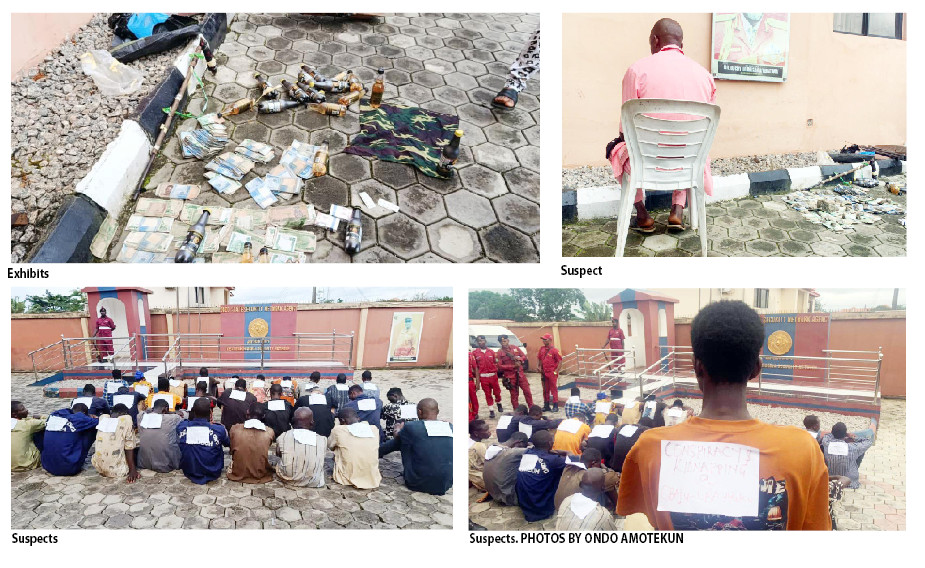
The suspects were among 28 people paraded by the Amotekun Corps at its headquarters in Akure, the state capital, after a series of operations across the state.
While others were arrested for offences ranging from armed banditry and robbery to rape, cultism, stealing and breach of peace, it was the alleged involvement of a father and three of his sons in a kidnapping syndicate that stood out.
Parading the suspects, the Commander of the Amotekun Corps in Ondo, Akogun Adetunji Adeleye, disclosed that the operation was the culmination of months of meticulous intelligence gathering and surveillance.
According to him, one of the principal suspects had been on the Corps’ watch list since 2024 due to alleged kidnapping activities in the Ondo North Senatorial District.
“There is a particular suspect we have been trailing since 2024 for kidnapping activities in the Northern Senatorial District. I’m glad to let you know that the long arm of the law finally caught up with him during the operation we carried out,” Adeleye said.
He explained that intelligence gathered over several months eventually enabled operatives to trace the suspects to their hideout during a coordinated operation that also resulted in the rescue of a kidnapped victim.
According to the commander, investigators were surprised to discover that those allegedly responsible for the abduction were members of the same family.
The suspects were identified as a 56-year-old man, alongside his sons names witheld.
Adeleye alleged that the family used cattle-rearing as a cover while coordinating kidnapping operations around Oba-Akoko and adjoining communities. “We found a family, a father and three sons, directly involved,” he said.
He further revealed that the eldest son had previously evaded security operations and remained outside Ondo State for nearly two years before recently returning to coordinate another kidnapping operation.
Although the allegations remain subject to judicial determination, the development has already sparked widespread public concern because it presents an unusual picture of alleged criminality involving multiple members of a single household.
The rescue operation, Adeleye explained, was anything but routine. According to him, the suspects resisted arrest and allegedly attacked Amotekun operatives. Despite the confrontation, the officers overpowered them, rescued the victim alive, and arrested the suspects.
The operation also resulted in significant recoveries. Adeleye disclosed that more than 75 per cent of the ransom paid by the victim’s family was recovered from the kidnappers’ hideout. Operatives also recovered alcoholic drinks, drugs, cigarettes, and materials allegedly used to blindfold the victim during captivity.
However, the commander declined to disclose the exact amount recovered. “The family paid the ransom themselves. Amotekun is not interested in how much was paid,” he said. He explained that the recovered funds had already been returned to members of the victim’s family because they were theirs.
Behind the successful rescue, however, lay the painful story of a young man whose ordeal illustrates the trauma thousands of Nigerian families continue to endure as kidnapping spreads across the country.
For the victim, Samuel Oyebade, the day began like every other. He was travelling on his motorcycle to Oba-Akoko, a community in the Akoko South West Local Government Area of the state, when a mechanical fault forced him to stop along the road to contact one of his employers.
Within moments, four armed men emerged from the bush. “They were four, and I was alone. They had guns, cutlasses and sticks. They began beating me immediately. They struck me with cutlasses on my head, body and hands before taking me into the bush,” Oyebade recalled.
The attackers confiscated his mobile phone, removed the SIM card and marched him deep into the forest, completely cutting him off from communication with the outside world.
Unbeknownst to him, his family had already begun the agonising process of negotiating for his freedom. Like many Nigerian families confronted with the nightmare of kidnapping, they found themselves torn between the fear of losing a loved one and the uncertainty of whether involving security agencies would worsen the situation.
According to Oyebade, his abductors initially demanded N40 million, then reduced the ransom to N2 million, and finally accepted N1.6 million.
Believing the payment offered the only realistic chance of saving his life, his relatives struggled to raise the money. “My brother managed to raise the N1.6 million and took it to them,” he recounted.
The kidnappers also requested drinks along with the ransom, and the family complied with every demand, hoping the payment would secure his release. Sadly, the abductors reneged on their promise.
Despite collecting the money and other items, they refused to release the victim and warned his family not to report the incident to security agencies. Realising they had been deceived, the family eventually contacted the Amotekun Corps.
That decision proved decisive. According to Oyebade, his brother led Amotekun operatives to the precise location where the ransom had been delivered.
“My brother took Amotekun to where he had dropped the ransom. They stood up and said, ‘Let’s go.’ Before we knew what was happening, the Amotekun people opened fire, and I was rescued,” he said. The rescue brought an end to days of physical torture and uncertainty.
During captivity, Oyebade sustained severe machete and knife injuries to his head and other parts of his body, and was rushed to the hospital immediately after the operation for treatment.
However, beyond the arrests and the successful rescue, the case raised deeper questions about the evolving nature of organised crime in Nigeria.
How does an entire family allegedly become involved in kidnapping?
For experts, organised crime often flourishes where poverty, greed, weak social values and the lure of quick financial gain intersect.
Yet allegations of parents and children working together in violent criminal enterprises suggest a disturbing dimension that extends beyond economic hardship.
When allegations emerge that members of the same household allegedly collaborated in kidnapping, they challenge long-held assumptions about the family as a moral foundation of society.
Although the suspects remain innocent until proven guilty by a competent court of law, the allegations have nonetheless raised concerns because they appear to show how criminal organisations may exploit relationships built on trust, loyalty and kinship.
For Oyebade, those broader debates remained secondary. What mattered most was that he survived. He endured physical torture, watched his family exhaust its resources in a desperate bid to save his life, and experienced the uncertainty that accompanies captivity.
His ordeal also underscored an uncomfortable reality facing many Nigerians: paying ransom does not always guarantee freedom. Despite meeting all his abductors’ demands, he remained in captivity until security operatives intervened.
As kidnapping continues to threaten communities across Nigeria, his rescue offers both hope and a warning. Hope, because determined intelligence gathering, prompt security intervention and cooperation between residents and security agencies can still save lives.
Warning, because criminal groups continue to evolve, becoming increasingly organised and, according to investigators in this case, allegedly drawing strength even from family ties.
Speaking on this issue, the state commander of Amotekun has declared that there will be no hiding place for criminals, whether in forests or urban communities.
”There is no hiding place again, whether in the forests or in the towns. The Amotekun Corps has been strategically positioned across the state to ensure that commuters and residents can go about their activities unmolested,” he declared.
Whether that assurance ultimately translates into lasting security will depend on sustained intelligence-gathering, stronger collaboration among security agencies and continued public support.
For now, the rescue of Samuel Oyebade is far more than another successful anti-kidnapping operation. It exposes the painful reality that paying ransom does not always guarantee freedom, underscoring the importance of timely security intervention.
If the allegations against the suspects are ultimately proven in court, the case will stand as one of the most disturbing illustrations of how organised crime can penetrate even the institution traditionally regarded as society’s first school of values, the family. If not, it will still serve as a reminder of the need for thorough investigations and respect for due process.
In either case, one lesson remains unmistakable: as kidnapping networks become more organised and harder to detect, defeating them will require more than guns and arrests. It will demand vigilant communities, credible intelligence, unwavering public cooperation, and a justice system capable of ensuring that crime never finds refuge, whether in the forest, the city, or, most disturbingly, within the walls of a family home.
We’ve got the edge. Get real-time reports, breaking scoops, and exclusive angles delivered straight to your phone. Don’t settle for stale news. Join THISTIMES on WhatsApp for 24/7 updates →
Join Our WhatsApp Channel