Beyond the food, laughter and jokes at his own table, Thursday’s inaugural Presidential Press Corps Dinner at the State House revealed something about power, the press and the public mood. writes JONATHAN NDA-ISAIAH.
For once, the State House did not call journalists for a briefing or a press conference to explain a policy. On Thursday night, it was an evening of jollof, awards, laughter, and bonding.
The inaugural Presidential Press Corps Dinner, organised in conjunction with the press corps, was, by every account, an unusual gathering. President Bola Tinubu had hosted newspaper proprietors. The president had dined with the Nigerian Guild of Editors. He had, on occasion, granted audience to selected media executives during media chats. But an evening dedicated squarely to the State House Press Corps, the men and women who trail the presidency from Aso Rock to New York, who arrive at the Villa early in the morning, leave late at night, and write “sources say” when nobody official will go on record, had never happened. Until Thursday. It is worth pausing to consider who exactly was being honoured.
The State House Press Corps is no beat for the faint-hearted or the clock-watchers. These are reporters who wait out state functions that run three hours behind schedule, trail motorcades wherever the President’s itinerary takes them, and still file copy well past midnight when a Presidential statement drops at 11 pm.
Long after the Villa’s lights dim and the aides have gone home, the press corps is often still awake, refreshing inboxes, chasing confirmations, and turning press releases into stories citizens can actually use. A dinner does not erase those late nights. But it was perhaps the closest acknowledgement that the grind is seen.
There is symbolism in that “first” that deserves more attention than it will likely receive. A dinner modelled on the White House Correspondents’ Dinner is, on its surface, an American import stitched onto a Nigerian evening. But it is also, whether by design or accident, an acknowledgment that the press corps is not simply a nuisance to be tolerated between photo-ops. It is an institution. As any student of governance will tell you, institutions get dinners.
Seyi Law’s presence was a masterstroke, or at least a merciful one. Any gathering that brings together politicians, journalists, and free food for several hours needs a professional to manage the tension, and a comedian is cheaper than a crisis communications team. By all accounts, the room responded with laughter, the collective exhale you get when people who spend their working lives suspicious of each other are, for one night, just people at a party.
Then came the moment that will likely outlive the speeches, the awards and even the after-dinner mints: President Tinubu, mid-address, referred to his wife as “Iya Alakara.”
For the uninitiated, this was not a random endearment. It was a callback, and a rather bold one, to the controversy that trailed Senator Oluremi Tinubu’s earlier remarks, in which she cited akara, roasted corn, and kuli-kuli sellers as examples of the small entrepreneurs her husband’s government was supposedly empowering. Nigerians on social media, never an audience known for mercy, had a field day. “Iya Alakara” became a meme before the week was out, deployed both affectionately and acidly depending on which side of the economic argument one stood.
For the President to resurrect the nickname himself was a case of supreme confidence. It drew laughter in the hall, which suggests the joke landed as intended, self-deprecating, disarming, and just self-aware enough to suggest the Villa reads its own headlines more closely than it lets on.
It also confirmed something political watchers have long suspected: this administration pays attention to the memes. The President’s aside about reading Segun Adeniyi’s column “often” reinforced the point. Politicians who claim not to read the papers are usually the ones who have committed entire paragraphs to memory. Tinubu, evidently, is not in that category.
Once the comedy segment ended and the President reached his prepared remarks, the tone shifted, as it always does, to the familiar terrain of security, the economy, and media responsibility. There was the now-standard warning against journalism that amplifies “terrorists and kidnappers,” framed as a partnership rather than as pressure. There was the defence of the Cybercrimes Act as a shield for citizens rather than a leash on reporters, an argument that will convince exactly those who already believed it, and a few others. There was the economic scorecard: reserves above $50 billion, stabilising revenues, returning investor confidence, and a “dark tunnel” supposedly behind the country.
None of this is new territory. Every administration insists it inherited darkness and is now delivering dawn; the metaphors change, but the structure of the claim rarely does. What was different on Thursday was the setting in which these familiar arguments were delivered, not from behind a podium at a policy retreat, but between courses, to an audience that had spent three years covering the very policies being defended. There is something almost intimate about being lobbied at dinner.
Still, the President’s line about journalism choosing “fact over falsehood, substance over sensation and credibility over clickbait” will be quoted approvingly by government spokespeople for months and quietly interrogated by the same press corps every time a government claim doesn’t survive contact with verification. That tension between the media as partner and the media as scrutineer was the real subtext of the evening, dressed up in agbada and laughter.
The guest list read like an abridged cabinet meeting, with better catering. The Secretary to the Government of the Federation, Senator George Akume; the Chief of Staff, Femi Gbajabiamila; Zamafara State Governor, Dauda Lawal; Ministers of Finance, Education, Health, Agriculture, and Information; and the Head of Service of the Federation, Mrs Didi Esther Walson-Jack.
Information Minister Mohammed Idris used his moment to reprise the government’s now-familiar call for restraint in security reporting, while also flagging the UNESCO-backed media literacy institute and the Free TV platform as evidence that the administration is investing in the industry it was simultaneously cautioning.
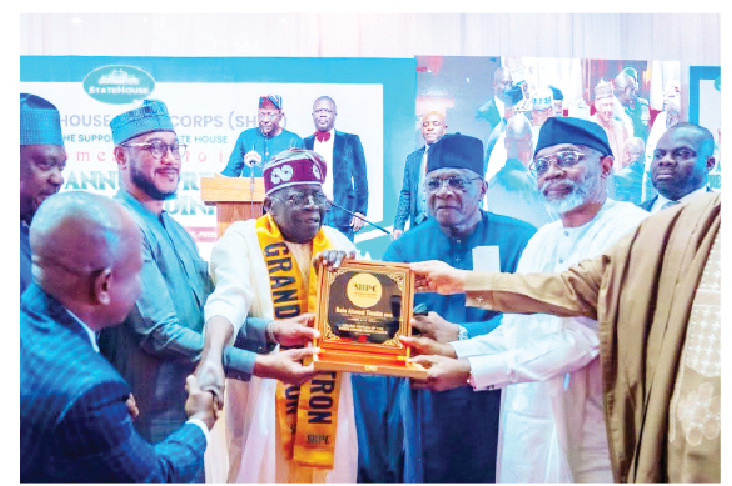
The award list, too, told its own story. Segun Adeniyi’s recognition as the first special adviser to double as presidential spokesman is a nod to a career that predates the current administration by years. Felix Onuah’s honour as the longest-serving State House correspondent is the kind of recognition that arrives, fittingly, decades into a beat that burns out most reporters far sooner. And the posthumous award to the late Baba Ladan Abubakar was a quiet reminder that press corps work, unglamorous as it often is, exacts its own toll over time.
Chairman Emmanuel Anule’s appeal for the dinner to become an annual fixture was timely and the most reasonable. Institutionalised engagement, done properly, gives both sides something to work with: a predictable forum rather than ad hoc access, a relationship rather than a transaction. It is also, quietly, a request on behalf of a corps that rarely asks the Villa for anything beyond information.
Whether Thursday becomes tradition or a one-off flourish will depend less on the warmth of one evening and more on how both sides behave the next time a story breaks that nobody in the Villa wants told and on whether the reporters who stayed up past midnight for this administration continue to get the access their diligence has earned.
By Friday, the dinner will be a memory, the “Iya Alakara” clips will still be circulating, and the press corps will be back to its usual business. Ultimately, that is the honest measure of Thursday’s goodwill: not the laughter in the room, but whether the partnership language survives the first uncomfortable headline.
For one night, State House and its chroniclers sat at the same table, shared the same jokes and meal, a small, welcome courtesy for reporters more used to receiving statements at midnight than to invitations to dinner. If Thursday is any indication, the relationship between government and press in Nigeria can be more than statements, denials and the occasional threat of a lawsuit. It can also be jollof, laughter, and a genuine word of thanks, once in a while. On the strength of Thursday night, that is an experiment worth repeating.
We’ve got the edge. Get real-time reports, breaking scoops, and exclusive angles delivered straight to your phone. Don’t settle for stale news. Join THISTIMES on WhatsApp for 24/7 updates →
Join Our WhatsApp Channel