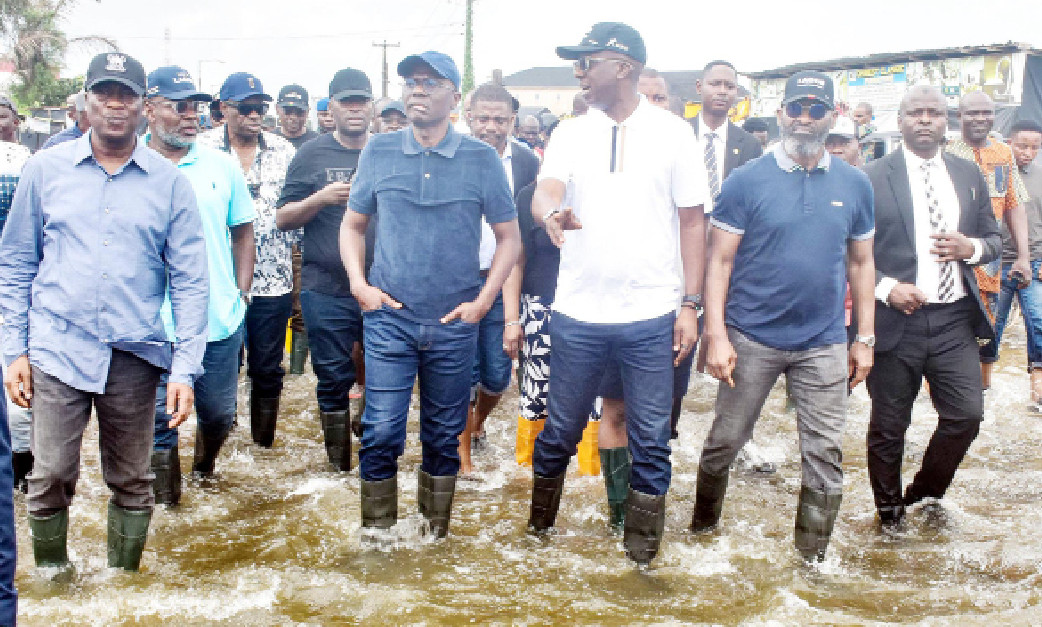
Amid flooding that submerged roads and homes in different parts of Lagos State, Governor Babajide Sanwo-Olu, has inspected flood-ravaged communities and blamed the problem on blocked waterways and human errors.
The governor, who ordered immediate drainage and dredging interventions in communities ravaged by recent flooding, blamed the disaster on a combination of climate change and human encroachment on natural waterways.
The governor, who led a high-powered delegation on an inspection of affected communities, assured the residents that the state government would accelerate drainage expansion, excavation and relief efforts to mitigate the impact of the flooding.
Sanwo-Olu visited Ogombo, Monastery Road in Sangotedo, Chevron Drive, Ajiran in Eti-Osa Local Government Area, as well as Gbetu-Olorunkemi Road in Awoyaya, Ibeju-Lekki, where he assessed the extent of the damage caused by weeks of torrential rainfall.
He was accompanied by Deputy Governor Dr Obafemi Hamzat, Secretary to the State Government, Mrs Abimbola Salu-Hundeyin, and commissioners and other members of the State Executive Council.
Addressing journalists while standing in floodwaters at Awoyaya, the governor said the visit was aimed at obtaining first-hand information on the situation and identifying both immediate and long-term solutions.
“What we are being very intentional about is ensuring that water flows through its natural channels because Lagos is surrounded by water and several tributaries,” he said.
Sanwo-Olu explained that while the state had experienced unusually heavy rainfall over the past three to four weeks, indiscriminate developments, blocked drainage systems and encroachment on wetlands had significantly worsened flooding across several communities.
“In all the places we visited today, there is a natural occurrence, and there is also a human factor. Over the years, developments have come to meet natural bodies of water, while in some places people have illegally restricted the natural flow of waterways,” he said.
According to the governor, many of the affected channels have existed for decades and were originally designed by nature to convey stormwater into the Lagos Lagoon, but increasing urbanisation has reduced their capacity.
He announced that the government would intensify dredging, excavation and the clearing of blocked drainage channels to restore the free flow of water.
“We need to come regularly to excavate and clear these channels so there will be a free flow of water. Once the waterways are maintained, the water will eventually find its way into the lagoon,” he stated.
Describing flooding as one of the visible impacts of climate change, Sanwo-Olu said many countries were currently battling more intense rainfall and extreme weather.
“The volume of water recorded in the last three to four weeks is largely due to natural causes.
Climate change is real, and we are seeing heavier rainfall worldwide. We cannot stop the rain, but we can continue to improve our infrastructure to manage it,” he said.
Using the analogy of a household sink clogged with refuse, the governor stressed that clogged drainage systems would inevitably result in flooding.
“If your kitchen sink is blocked with waste, water will not flow freely. The same thing happens when our drainage channels are filled with refuse or other materials. It is our responsibility to remove those obstructions,” he added.
He called on residents to support government efforts by keeping drainage channels free of refuse and complying with environmental regulations, stressing that tackling flooding requires collective responsibility.
“We all have a role to play. Government will continue to provide infrastructure, residents must act responsibly, and the media must continue to educate the public,” he said.
We’ve got the edge. Get real-time reports, breaking scoops, and exclusive angles delivered straight to your phone. Don’t settle for stale news. Join THISTIMES on WhatsApp for 24/7 updates →
Join Our WhatsApp Channel