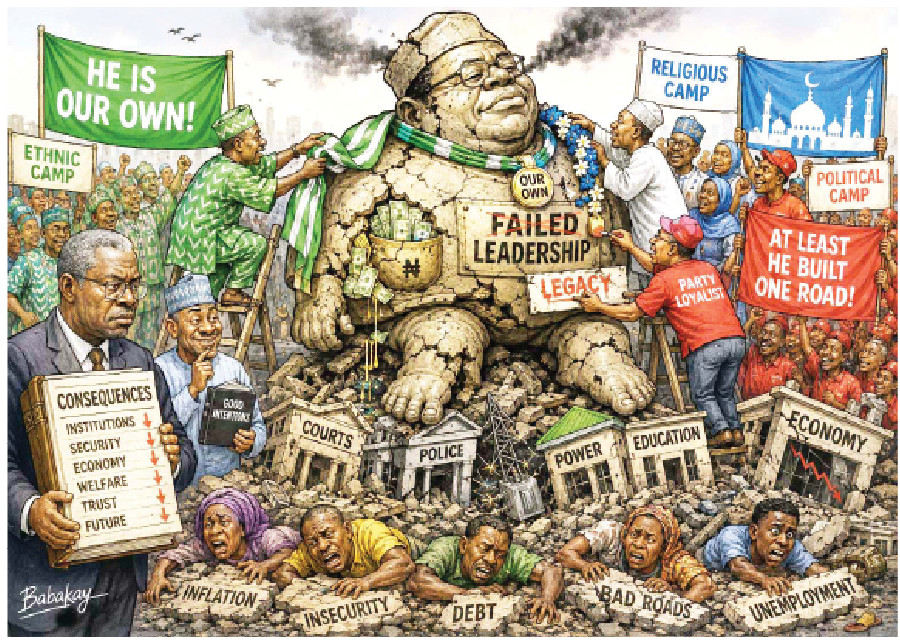
When Emperor Nero died in AD 68, Rome was not short of people who remembered him fondly. Those who benefited from his generosity, public entertainment, and personal favour mourned his passing. Yet the historian Tacitus did not judge Nero through the tears of his admirers. He judged him through the condition of Rome after his reign. This is the uncomfortable burden of history: while ordinary people often remember leaders through personal experiences, privileges, and emotions, historians judge leaders through consequences, institutions, and the future they created. Nigeria has struggled with this distinction for decades.
Our greatest political tragedy may not simply be poor leadership; it is our inability to objectively assess leadership. We rarely evaluate leaders through universal standards of governance. Instead, we often view them through primordial lenses: ethnicity, religion, region, political affiliation, or personal benefit. A leader from our ethnic group is defended even when evidence suggests failure, while a leader from another group is condemned regardless of achievements. We have transformed leadership assessment into identity warfare rather than a rational examination of state performance.
This is why Nigeria repeatedly celebrates mediocrity and struggles to learn from history. We often ask, “Is he our son or daughter?” before asking, “Did he or she strengthen the country?” We ask, “Is he or she from our region?” before asking, “Did institutions improve under him or her?” In doing so, we confuse belonging with competence and loyalty with performance. A country that evaluates leaders through primordial emotions will continue to reproduce the same governance failures.
Beyond Good Intentions
Leadership scholars have long established that a leader’s success cannot be measured by intentions alone. Max Weber’s distinction between the ethic of conviction and the ethic of responsibility remains relevant. The ethic of conviction concerns what a leader believes and intends. The ethic of responsibility concerns what those intentions produce in society. Public office demands the second because citizens experience outcomes, not private intentions.
A successful leader is not necessarily one who does everything perfectly. Such leaders do not exist. A successful leader is one who strengthens institutions, expands state capacity, improves citizens’ welfare, manages crises effectively, and leaves the country better positioned for future challenges. A failed leader is not someone who achieved nothing. Many failed leaders-built roads, introduced policies, and completed projects. Failure occurs when the overall balance sheet of leadership shows that the state became weaker, institutions became less effective, and citizens lost confidence in government.
This is where Nigerians must mature in our assessment of leaders. A president can build airports and still fail to improve security. A governor can construct flyovers and still weaken education. A minister can launch programmes and still leave institutions dysfunctional. Governance is not a photo opportunity where ribbon-cutting ceremonies become evidence of transformation. The state is not judged by ceremonies; it is judged by capacity and outcomes.
The Roman philosopher Seneca warned that appearances often deceive those who refuse deeper examination. Nigeria must stop confusing visibility with progress. A building is visible. Institutional decay is not. A new road is visible. A weakened justice system is not. A government announcement is visible. Declining public trust is not.
The Politics of Selective Memory
History teaches that leadership assessment requires intellectual honesty. Napoleon Bonaparte modernised France through administrative reforms that influenced generations, yet his ambition also produced devastating wars. Peter the Great transformed Russia’s military and bureaucracy, but his reforms came with immense human costs. Franklin Roosevelt rescued America from economic depression, yet historians still debate aspects of his presidency. Great leaders are rarely completely successful or completely failures.
Nigeria must therefore abandon the childish idea that recognising a leader’s failure means denying every achievement they recorded. That is not serious analysis. A student who performs excellently in two subjects but fails seven others cannot be described as an outstanding student simply because some answers were brilliant. The total performance matters.
This explains why debates around leaders such as Goodluck Jonathan, Muhammadu Buhari, Olusegun Obasanjo, and others often become emotionally charged. Jonathan deserves recognition for conceding defeat in 2015, an important democratic precedent. His administration also recorded economic reforms and telecommunications expansion. However, historians must also confront the security deterioration during his tenure, corruption controversies, and the inability to translate economic growth into broad-based development.
Similarly, Buhari’s supporters are correct to highlight infrastructure projects, the Treasury Single Account, and his personal reputation for discipline. However, historians must also examine worsening insecurity, economic difficulties, institutional weaknesses, and corruption allegations involving senior officials under his administration. The purpose of history is not to attack leaders. It is to understand consequences.
The Institution Problem
The deeper Nigerian problem is not merely that we have had imperfect leaders. Every country has imperfect leaders. The problem is that our institutions remain too weak to restrain failure and too dependent on personalities to sustain success.
Countries that developed did not do so because they always produced exceptional leaders. They developed because institutions became stronger than individuals. Singapore under Lee Kuan Yew succeeded not merely because of his personal brilliance but because he built systems that survived beyond him. Britain endured political disagreements because institutions constrained individual ambition. The United States survived controversial presidents because constitutional structures remained resilient.
Nigeria often chooses the opposite path. We search for messiahs instead of building systems. We celebrate politicians for “facilitating” opportunities that should be guaranteed through transparent institutions. We praise public officials for performing duties already assigned to the state. It is almost as if citizens are expected to thank politicians for allowing government to function.
This is the dangerous normalisation of dysfunction. When political connections become the gateway to employment, contracts, education, or justice, citizenship is replaced by patronage. The question is not whether individuals who benefit are deserving. The question is whether the process itself strengthens or weakens the republic.
A New Way to Judge Power
Nigeria urgently requires a new culture of leadership assessment, one that moves beyond emotions, ethnic loyalties, political affiliations, and personal sentiments. Economists distinguish between ex-ante and ex-post evaluation, a framework Nigeria must apply to political leadership. Ex-ante assessment examines expectations before a policy or administration begins, while ex-post evaluation measures actual outcomes after implementation.
Before electing leaders, Nigerians must critically assess competence, character, policy understanding, and institutional vision. After leaders leave office, their performance must be evaluated objectively through measurable indicators such as security outcomes, economic performance, poverty reduction, employment creation, institutional strength, corruption levels, and citizens’ welfare.
This requires abandoning the dangerous habit of defending failure because a leader belongs to our ethnic group, religion, or region. A successful leader from another part of Nigeria deserves recognition, just as a failed leader from our own community deserves honest criticism. National progress begins when truth becomes more important than identity.
Nigeria does not need perfect leaders; it needs citizens capable of recognising effective leadership and rejecting failure regardless of where it originates. This is because history does not judge leaders by how much they were loved or celebrated. It asks one enduring question: Was the nation stronger when the leader left than when the leader arrived?
We’ve got the edge. Get real-time reports, breaking scoops, and exclusive angles delivered straight to your phone. Don’t settle for stale news. Join THISTIMES on WhatsApp for 24/7 updates →
Join Our WhatsApp Channel