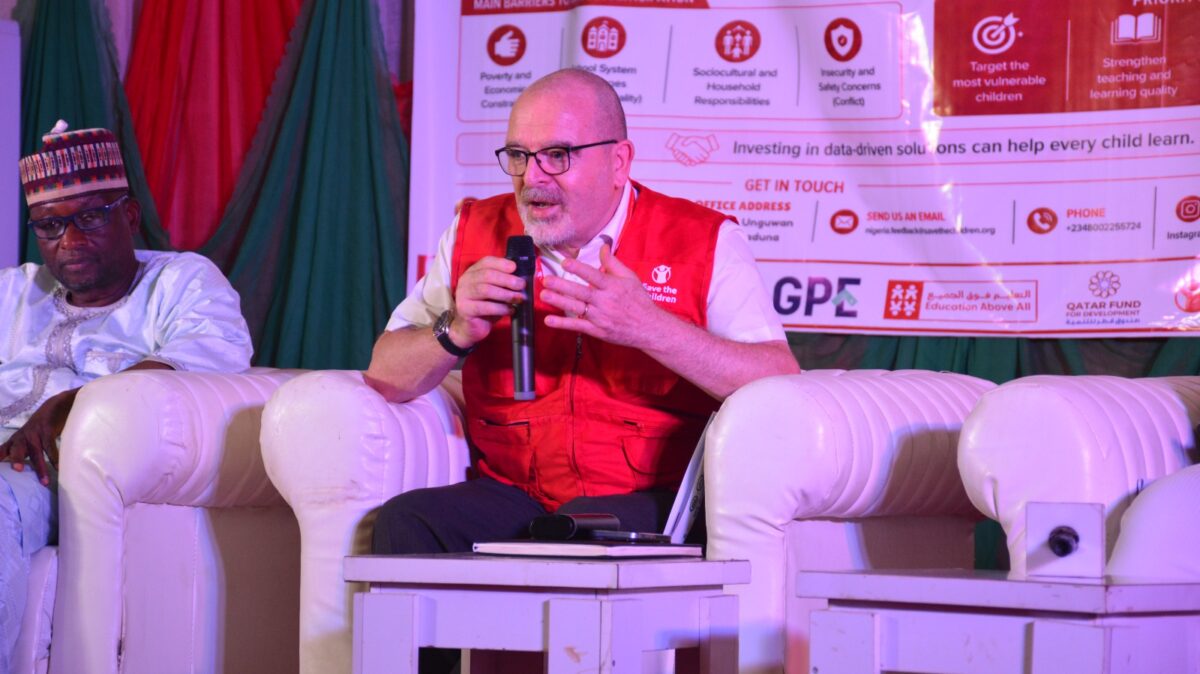
Save the Children International has said sustained collaboration among the Kaduna State Government, development partners and communities is key to returning 100,000 out-of-school children to classrooms under the Reaching Out-of-School Children (ROOSC) Project.
The Country Director of Save the Children International in Nigeria, Duncan Harvey, stated this during a press conference in Kaduna ahead of the public presentation of the Kaduna State Out-of-School Children Mapping Report.
Harvey said the organisation remains optimistic that through sustained collaboration among the Kaduna State Government, development partners and communities, more out-of-school children would be enrolled, retained in school and supported to complete their education.
He noted that Save the Children is implementing the ROOSC Project alongside the Kaduna State Government, UNICEF, the Project Management Unit (PMU) and other partners, with each institution playing complementary roles, including school construction, teacher training, community mobilisation and child protection.
According to him, the mapping exercise represents a major milestone in addressing the out-of-school children challenge as it provides detailed information on where affected children are located and the factors responsible for keeping them out of school.
Harvey described the exercise as a landmark achievement, saying the data would enable government and development partners to design and implement evidence-based interventions capable of delivering lasting results.
Also speaking, the Kaduna State Statistician-General, Dr. Bukar Baba Alhaji, disclosed that the mapping exercise identified 187,719 out-of-school children after covering 363,319 households across the state’s 23 local government areas.
He explained that the exercise adopted a geospatial mapping approach rather than a population census, using digital data collection and grid-based sampling to identify communities with high concentrations of out-of-school children before conducting household visits.
According to him, Kubau Local Government Area recorded the highest number of out-of-school children with 25,106, followed by Giwa (16,257), Makarfi (12,642), Soba and Igabi (11,984).
Dr. Alhaji attributed the high number of out-of-school children in the affected local government areas to poverty, insecurity and socio-economic pressures, which force many children, particularly boys, into farming, hawking and other economic activities instead of attending school.
He added that the report showed that 64.6 per cent of the mapped children were between the ages of six and 11 years, while 60.2 per cent had never enrolled in school and 39.8 per cent had dropped out after enrolment.
Earlier, the Director of Planning, Kaduna State Ministry of Education, Baba Lawal, said the exercise was undertaken not only to determine the number of out-of-school children but also to identify their locations and the reasons they are not attending school.
Lawal said the findings would enable the government and its partners to design targeted interventions tailored to the peculiar needs of different communities while ensuring that children who return to school remain enrolled.
On his part, the ROOSC Project Coordinator, Ezra Angai, said the mapping report has provided the state with credible data to guide future investments and interventions aimed at reducing the number of out-of-school children.
Angai added that through the Reaching Out-of-School Children Project, implemented in partnership with the Education Above All Foundation, Kuwait Fund, Qatar Fund for Development, Islamic Development Bank and the Global Partnership for Education, Save the Children remains committed to working alongside the Kaduna State Government to improve access to quality education for out-of-school children.
He said the project goes beyond enrolment by investing in school infrastructure, teacher development, community engagement, inclusive education and social support mechanisms to encourage children to remain in school.
He further said the project will construct 102 new schools, renovate 170 existing schools and establish learning centres across the state. He added that 42 schools, including 16 new ones, are currently under construction, while procurement has commenced for an additional 30 new schools and 60 renovation projects.
Angai added that a monitoring system has also been established to track children after enrolment, identify those at risk of dropping out and provide timely interventions to keep them in school.
We’ve got the edge. Get real-time reports, breaking scoops, and exclusive angles delivered straight to your phone. Don’t settle for stale news. Join THISTIMES on WhatsApp for 24/7 updates →
Join Our WhatsApp Channel