BY RICHARD NDOMA, Calabar; AZA MSUE, Kaduna; FELIX IGBEKOYI, Asaba and INIOBONG EKPONTA, Uyo
Across Nigeria’s flood-prone cities, blocked drains and indiscriminate waste dumping have been blamed for worsening the country’s flood crisis, with the environmental challenge linked to loss of lives, widespread flooding and the collapse of structures weakened by prolonged exposure to water since the rainy season began.
LEADERSHIP Sunday gathered that in several affected communities, whenever rainfall begins, some residents rush out with bags of refuse and empty their waste bins directly into drainage channels, waterways and gutters, turning critical flood-control systems into dumping sites and worsening the free flow of storm water.
Our correspondents report that from densely populated urban centres in Cross River, Akwa Ibom, Lagos, Abia and others, to major highways, drainage channels designed to carry storm water have increasingly become temporary refuse sites.
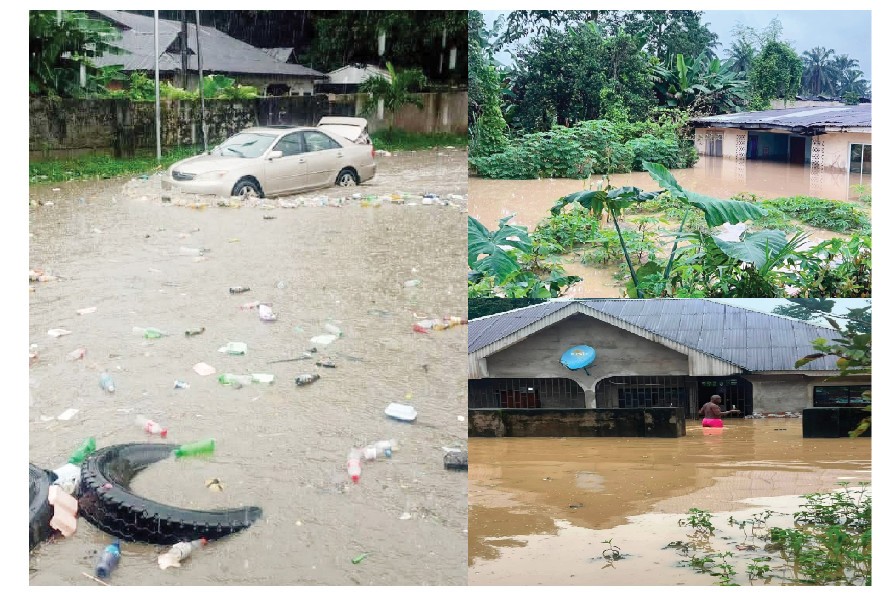
When LEADERSHIP Weekend correspondents visited some affected flood sites, they observed that plastic waste, household garbage, discarded furniture and other debris had accumulated in drainage channels and waterways, obstructing the free flow of water and worsening flooding whenever heavy rains occurred.
In some areas, floodwaters remained stagnant long after rainfall had stopped, with residents attributing the prolonged flooding to blocked drainage systems that only became passable after the debris are removed
An investigation across parts of Cross River, Lagos, Akwa Ibom, Abia, the Federal Capital Territory and other flood-prone areas revealed how gaps in waste management systems and environmental enforcement are worsening the impact of flooding on communities, businesses and road users.
Residents in affected communities told our correspondents that the problem becomes more severe during rainfall because some people deliberately empty their waste into drains immediately it starts raining, believing that floodwater will wash the refuse away.
But instead of disappearing, the waste settles in drainage channels, blocks water passages and forces floodwater back into streets, homes and businesses.
Roads Becoming Refuse Dumps:
Beyond residential areas, major roads and city centres in Cross River, Plateau, Akwa Ibom, Delta and even in the Federal Capital Territory, are increasingly feeling the impact of poor waste management.
In parts of Abuja, including the Gwagwalada axis, residents and commuters have raised concerns over blocked drainage channels and areas where refuse accumulation has affected movement. Along the Nyanya-Karu corridor, heavy human and vehicular activities combined with poor waste disposal have continued to challenge drainage management.
In Imo State, sections of the Orji-Okigwe and Aba Road have also witnessed complaints over refuse heaps and environmental challenges, with commuters sometimes forced to navigate around waste and flooded portions of the road during heavy rainfall.
Across several cities, pedestrians and motorists have struggled to pass through areas where refuse has overwhelmed drainage systems, turning what should be public infrastructure into environmental hazards.
Failed Waste Management Systems:
While residents have been accused of indiscriminate dumping, some stakeholders argue that inadequate waste collection systems have also contributed to the problem.
In some states, waste management contractors initially engaged by governments to evacuate refuse have reportedly withdrawn their services after disputes over payment, leaving communities without regular waste collection.
Environmental experts say the failure to maintain consistent waste evacuation systems creates a vacuum that encourages residents to seek alternative disposal methods, including dumping in drainage channels and waterways.
They, however, insist that citizens cannot be excused from environmental responsibilities, stressing that indiscriminate dumping remains a major threat to public safety.
Laws Without Enforcement:
Environmental experts told LEADERSHIP Sunday that Nigeria has various environmental regulations prohibiting dumping of waste in unauthorised locations, yet enforcement remains a major concern.
These experts say governments must move beyond emergency flood responses and address the root causes through stronger monitoring, improved waste collection infrastructure, prosecution of offenders and better urban planning.
Residents interviewed in some affected states accused authorities of weak enforcement, arguing that public sensitisation campaigns would have limited impact without strict penalties for environmental offenders.
However, some residents in Calabar, Aba and two other states, who spoke on condition of anonymity, admitted that indiscriminate waste disposal contributes to the flooding challenge and pledged to change their practices. They, however, blamed the situation partly on the high cost of engaging private waste collectors, popularly known in some communities as *mai shara* (waste collectors).
According to them, some self-appointed waste disposal agents also worsen the problem by dumping collected refuse along major roads, gullies and drainage channels after being paid by households, making some residents question the value of the services they receive.
A resident of Nyanya, Mrs Njideka Okiki, told LEADERSHIP Sunday that she could not afford to spend N600 weekly on refuse disposal.
“Even the ‘Mai Shara’ we patronise still dump the waste on the roadside,” she said.
She, however, expressed relief that schools were on vacation, saying it reduced the risk of children being swept away by floodwaters.
Okiki recalled that two years ago, a former neighbour died after floodwaters swept away the motorcycle on which her police officer husband was giving her a ride to Nyanya Market. Her body was later recovered in Masaka.
Flood victims count losses
For communities already affected by floods, the debate is not theoretical.
Families have lost homes, businesses and personal belongings, while some residents have been displaced after floodwaters invaded their communities.
In Cross River, Calabar, the state capital, is choking under heaps of indiscriminate waste, with major drainage channels blocked ahead of the peak of the rainy season.
A field assessment by our correspondent revealed that key drainage channels linking Mayne Avenue, William George Street and Atimbo Road by Edimotop Junction have been turned into illegal dumpsites, obstructing the movement of stormwater.
At William George Street by White House Street in Calabar South, the drainage channel, which links Hart Street and Elijah Henshaw Street to the Mayne Avenue channel, is filled with plastic waste, household refuse and construction debris, forcing floodwaters into adjoining streets and homes during heavy rainfall.
A similar situation exists at Mayne Avenue by Pin Margaret Street, where investigations showed that refuse dumped mostly at night has blocked water channels, causing flooding around the junction and putting pressure on the culvert linking the roads.
Along Atimbo Road near Edim-otop Junction, an open gutter that drains towards Odamba community and empties into the Calabar River has also been overtaken by plastic containers and domestic waste, leaving residents vulnerable to recurring flooding.
A resident of William George Street, Mr Donatus Ibiang, said blocked drains had made flooding a regular occurrence in the area.
“During heavy rains, water cannot flow because the drainage is blocked. Flood enters our houses with foul smell, increasing mosquito bites. We have complained several times, but they still come to dump at night,” he said.
Mrs Susan Ukpong, a resident of Calabar South, said she had been rendered homeless by the flood.
“I am homeless as we speak. My husband was on night duty while I went to bed with my three children, aged 13, 10 and 14. I never knew that the drainage system behind the Cross River State University of Science and Technology in Ekpo Abasi had overflowed until water suddenly entered our compound.
“I noticed my bed was floating. At first, I thought I was dreaming until I felt the cold water inside my self-contained apartment. I quickly lifted my baby and tied the child on my back, carried another child on my shoulder, placed the eldest on the table, and raised an alarm for help,” she said.
In another tragic incident in Calabar South, a one-year-old girl lost her life after floodwaters swept into her family’s apartment along Mayne Avenue, off Atu Street. Residents said the heavy rainfall, which began in the early hours of the day, caused water levels to rise rapidly, leaving the family unable to rescue the child before the room was submerged.
Attempts to speak with the child’s parents to obtain further details of the incident proved unsuccessful, as they were not available for comments at the time of filing this report.
Environmental expert Mr Ken Erom blamed the persistence of the practice on inadequate waste collection systems, poor access to disposal points and weak enforcement of environmental regulations.
He said although agencies including the Calabar Urban Development Authority (CUDA) and the Ministry of Environment have regulations in place, enforcement remains a challenge, particularly against night-time dumping.
The executive secretary of CUDA, Dr Effiong Ayi, however, said the authority would intensify efforts to expand and clear drainage channels to reduce flooding caused by blocked waterways.
Other stakeholders are calling for improved waste collection, accessible disposal points, stronger monitoring, community surveillance and regular desilting of drainage channels to address the growing environmental threat.
Slippery Conditions Prevent Trucks From Reaching Dump Sites, Delay Evacuation Efforts
Worried by the growing practice of indiscriminate waste disposal in parts of Asaba, the Delta State Capital Territory Development Agency (DSCTDA), ministry of Environment, environmental task force and Waste Management Board have vowed to intensify efforts to curb the trend.
However, some residents blamed the situation on poor waste evacuation. Mrs Esther Orite, a corn seller along Okpanam Road, said waste managers had stopped coming regularly to remove refuse, forcing some residents to dump garbage in gutters and road medians whenever it rains.
A member of the Environmental Task Force and Waste Management Board, who declined to give his name, said the agency was facing challenges with access to the waste disposal site during the rainy season, as slippery conditions often prevent trucks from reaching the dump area.
The director general of DSCTDA, Chief Patrick Ukah, said the agency had issued abatement notices to defaulting individuals, facility owners, landlords, tenants and occupants, while the head of Environment, Mr Isaac Nwosu, urged residents to comply with environmental laws. Ukah also highlighted the ongoing flood control project at Ogbeilo/Ugbomanta Streets, with a discharge drain through Ogbeogonogo Market to Otuogwu Bay, as part of measures to tackle flooding in Asaba.
Akwa Ibom Threatens Jail Terms, Sets Up Emergency Sanitation Courts
Following the devastating floods that displaced residents and destroyed properties in Uyo, Itu, Eket, Essien Udim and other parts of Akwa Ibom State, Governor Umo Eno has established an emergency sanitation court with powers to impose jail terms on environmental offenders.
The governor announced that full environmental sanitation would commence from Saturday, July 25, 2026, between 7:00am and 10:00am, with restrictions on movement to allow residents clear refuse, desilt gutters and open blocked waterways.
The decision followed complaints from flood victims, including Effiong Bassey, a Uyo resident who said his house and belongings were swept away by floodwaters, leaving him homeless and seeking shelter in a church.
Several displaced residents have also relocated to relatives’ homes in neighbouring local government areas, including Abak, Ibesikpo Asutan and Uruan.
To address the recurring flood challenge, Governor Eno directed the State Emergency Management Agency (SEMA) to coordinate the evacuation of waste and desilting of drainage channels.
He also ordered the evacuation of residents from some affected areas, directed the revocation of Certificates of Occupancy for buildings obstructing flood channels and promised compensation for affected property owners.
The governor warned that residents must cooperate with government efforts, adding that the sanitation court would ensure offenders face penalties, including possible jail terms and compulsory environmental cleanup assignments.
Also, Kaduna, one of the country’s flood-prone states, is still battling indiscriminate refuse dumping on major roads, drainage channels and waterways despite government efforts to curb the menace.
When our correspondent visited flashpoints in the metropolis, including Sabon Tasha, Television Garage, Kigo, Kabala Doki and the Kaduna River bank, heaps of refuse were seen dumped along roadsides and in drainages.
Residents blamed the situation on the long distance to designated waste collection points.
A resident of Ungwan Sunday in Chikun local government area, Bulus Gambo, said, “In my area, people mostly dump refuse beside Sabon Tasha Bridge. I don’t like walking long distances to dispose of waste at designated collection points.”
Another resident, Suleiman Garba, said establishing waste collection centres at strategic locations would reduce indiscriminate dumping and prevent blockage of waterways and drainages, thereby reducing flooding.
Kaduna State Governor, Uba Sani, in January 2026 launched Operation TSAFTA, an environmental initiative to strengthen public health and sanitation across the state.
He described the initiative as a practical response to the environmental pressures of population growth, urban expansion and economic activities.
The incident, LEADERSHIP Sunday learnt left residents counting their losses, with several households reporting damage to personal belongings, documents and business items. Community members blamed the recurring flooding on poor drainage systems and called for urgent intervention to prevent further tragedies.
Emergency agencies and government authorities have repeatedly responded with relief efforts, but stakeholders warn that temporary interventions will not solve a crisis caused by years of environmental neglect.
Experts’ Warning
Experts say climate change may be increasing rainfall intensity, but human activities such as blocking waterways and destroying natural drainage routes are making the impact more devastating.
They called for urgent collaboration between federal and state governments, waste management agencies, traditional institutions, community leaders and residents to prevent avoidable disasters.
They recommended regular evacuation of waste, expansion of drainage infrastructure, enforcement of environmental laws and sustained public education.
Flood victims appealed to the authorities to act swiftly, warning that the rains have exposed Nigeria’s vulnerabilities. They expressed concern that unless blocked drains and neglected waterways are cleared, more preventable tragedies could occur.
We’ve got the edge. Get real-time reports, breaking scoops, and exclusive angles delivered straight to your phone. Don’t settle for stale news. Join THISTIMES on WhatsApp for 24/7 updates →
Join Our WhatsApp Channel