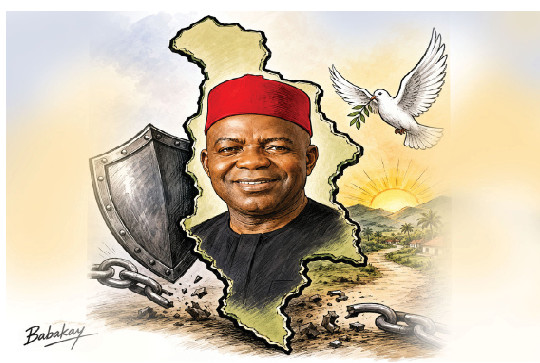
I was in Umuahia in Abia State these past few days for the first time. I experienced something different and unique. The people, the weather, and the food were pleasant. But what took me there was beyond these. It was the security of the South East region. What were the issues, and what were the best ways of addressing the security situation in the region? The maiden South East Regional Security Summit, organized by the Ministry of Defence in collaboration with the Office of the Senior Special Assistant to the President on Community Engagement (South East), provided a platform for this conversation, and the International Conference Centre in Umuahia came to life with the array of A-list guests that graced the occasion with their accoutrements, experiences, and commitment.
I think South Easterners are genuinely interested in addressing the security situation in the region. Mention a heavyweight name in the five states in the region within the security and political class, and I will tell you he or she was present at the summit. Yes, it was called a summit. But in my estimation, it was beyond a summit. It was a gathering of a people who felt that enough was enough and that the solution to the security challenges in the region was local, and therefore the solution was also local. This necessitated the theme “Collaborative Approaches to Strengthening Regional Security and Stability” and, indeed, at the end of the summit, the anthem was the “Whole of Society Approach” to achieving sustainable peace and prosperity in the South East region.
The Abia Advantage
Who was responsible for the upsurge in insecurity in the region? What was the response of the authorities? And how did things fall apart? General Ike Nwachukwu gave an idea in his address. He said: “Security is not simply the absence of violence. It is the presence of justice, trust, opportunity, and legitimate authority. When these pillars weaken, insecurity begins long before the first gunshot is fired.” He went further to state that “the greatest intelligence asset any nation possesses is not technology. It is citizens who believe that the government will protect rather than punish.” The point I gleaned from his statement is that competition among states must never become competition in security. And I was glad the governor of Abia State, Dr. Alex Otti, was in attendance and sat through the event that stretched till late in the evening.
Dr. Otti was the only governor present; others sent in their representatives. He clearly had an advantage. I don’t mean to question the absence of other governors, but I recognize that the most critical social contract they entered into with the people is security, and their absence told a million stories. The summit was also hosted by the Abia State government. In the matrix of insecurity inthe South East, Abia is not the epicentre. But it was the epicentre for the convergence of ideas on how to address the security challenges in the region. And it was strategic for historical reasons.
Abia State occupies the southern interior and transit corridor position within the South-East region. It borders every single state—sharing boundaries with Imo to the west, Anambra to the north-west, Enugu to the north, and Ebonyi to the north-east, and it sits in the Igbo heartland, which comes with its attendant advantages and disadvantages. This could mean different things. But one thing stands out: one could easily tell who was interested in addressing the menace that has presented itself in the region.
And this is why Lt. Gen. Azubuike Ihejirika, in his presentation, asked some fundamental questions. He asked: “The central issue before this summit is therefore not whether collaboration is necessary, but how it should work in practice. What form should it take? Who should perform each responsibility? How should institutions coordinate their activities? How can dialogue produce measurable security improvements and enable people to travel, trade, work, learn, and live without fear?”
Lt. Gen. Ihejirika expanded his position by stating that “the more useful question is therefore not whether another regional security outfit should be announced, but how existing federal, state, local, and community structures can work together more coherently and sustainably. Addressing this question requires a practical understanding of what collaboration should mean and how responsibilities should be distributed.” In my estimation, he sent a salvo to the governors of the south-eastern states.
The Task before the South East Governors
This is the task before the South East Governors. The human resources in the region are outstanding. For example, the South East Veterans Welfare Association of Nigeria (SEVWAN) is an association of retired military officers of south-eastern extraction—most of them very brilliant and having commanded sensitive positions in the military. They were in full attendance at the summit and delivered a paper titled “Building Lasting Peace in Igbo Land: The Federal Government’s Integrated Security for South-East Nigeria.”
Among other things, the association advocated that the “South-East governors should leverage on the enormous resources of SEVWAN towards curbing insecurity in the South-East.” Has SEVWAN contributed to the framing of the security architecture in the region? If it has, it has to do more, and if it hasn’t, it is a misnomer that corroborates the summit’s theme of “Collaborative Approaches to Regional Security and Stability.”
This much was advocated by the Minister of Defence, General Christopher Gwabin Musa, who, in declaring the summit open, stated: “It is my sincere expectation that this maiden Summit will become an enduring annual platform for strategic engagement, continuous dialogue, and coordinated action among all stakeholders. I hope it will reaffirm our collective commitment to building a peaceful, secure, and prosperous South East that contributes meaningfully to the unity, stability, and development of our great nation.” He said it all. Everyone in the value chain is important. It is another word for collaboration.
The Minister of Defence emphasized that regional security is a framework that stabilizes the centre. This is also planned for other regions of the country. According to him, “an important truth is that security is not solely the responsibility of the Armed Forces, the Police, or other security agencies. It is a shared responsibility that requires the collective commitment of government, traditional institutions, religious leaders, community organisations, the private sector, the media, civil society, youth and women groups, as well as every patriotic citizen.”
Security and Insecurity are Nomadic
This position reminds me of the “Neither North nor South, East nor West: One Nigeria” political philosophy of the late Major General Shehu Musa Yar’Adua. It was a profound philosophy that echoes the collaborative framework theme of the South East Regional Security Summit. This is on the heels that conflict idiosyncrasies are not universal. They are peculiar and relative. This explains why there is an urgent need for a collaborative policy direction in the security architecture of the South East region because security and insecurity are nomadic.
Conflict is not static. It migrates, adapts, and follows the path of least-resistance corridors across physical and political geography. This is why the position of General Musa that security is a shared responsibility is apt and adoptable.
– Ocheja, PhD, is a military historian and alumnus of the Nigerian Defence Academy
We’ve got the edge. Get real-time reports, breaking scoops, and exclusive angles delivered straight to your phone. Don’t settle for stale news. Join THISTIMES on WhatsApp for 24/7 updates →
Join Our WhatsApp Channel