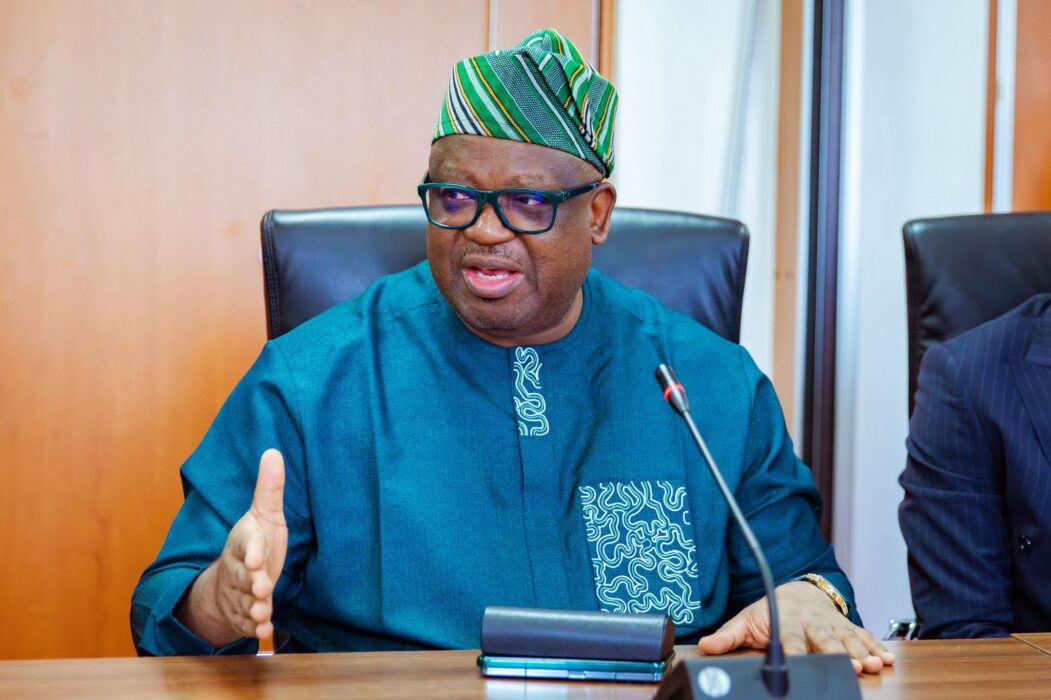
The Chairman of the Nigeria Revenue Service (NRS), Zacch Adedeji, has defended President Bola Tinubu’s economic reforms, saying the country’s monthly revenue allocation has risen from about ₦700 billion in 2023 to ₦4.5 trillion.
Adedeji stated this on Sunday during an interview on Channels Television’s Sunday Politics, where he argued that the impact of the administration’s reforms should be assessed using available economic data rather than immediate public sentiment.
“When we came on board in 2023, the total monthly allocation was around ₦700 billion. Today, we are sharing ₦4.5 trillion. That’s about 530 per cent,” he said.
He dismissed concerns that the increase in government revenue had not translated into improved living conditions for Nigerians, arguing that the additional revenue had strengthened the capacity of state governments to meet their obligations.
“People are talking about it not reaching the people. I was Commissioner of Finance 11 years ago. We used to come here looking for support to pay salaries, looking for bailouts. How many times have you heard that happen in the last three years?” he asked.
Adedeji also highlighted developments in Nigeria’s refining sector as evidence that the administration’s reforms were beginning to produce structural changes in the economy.
According to him, the country’s refining capacity, which he put at about 30,000 barrels per day before May, has risen significantly under the current administration.
“Through the conducive environment and the help and ingenuity of Mr President, we are now refining 700,000 barrels per day,” he said.
He said the significance of increased refining capacity went beyond generating additional revenue, stressing that it would create jobs, improve economic stability and reduce Nigeria’s vulnerability to disruptions in global oil markets.
“When you talk more money, money is consequence. It’s employment. It’s stability,” Adedeji said.
He cited the recent conflict involving Iran as an example, arguing that increased domestic refining capacity had helped Nigeria avoid some of the fuel supply disruptions experienced in the past.
“Now, imagine when we have the Iran war. We were protected for the better part of it. Do you remember when last you heard about queues in Nigeria? Do you remember the last time people went on strike on petrol pricing?” he asked.
The NRS chairman said NigeriansNRS should also consider the potential long-term impact of investments in refining, particularly employment and economic activity that would arise from increased domestic production.
“And this is just three years,” he said. “Now imagine the refinery that is now doing 700,000 barrels per day, the number of employment, the number of impact that this will have.”
Adedeji also defended the government’s decision to remove fuel subsidy, saying the policy was necessary to enable private refineries to operate on a commercially viable basis.
“If Mr President had not removed subsidy, there is no way refinery will work,” he said.
He explained that private refiners would struggle to operate if they were required to sell petroleum products at government-controlled prices rather than market-driven rates.
“Because if you produce and you are not government producing, it is private and you cannot sell it at market-driven price. How would that happen?” he asked.
Adedeji further argued that the growth in refining capacity represented an important shift in Nigeria’s economic structure, particularly as the country moves towards becoming a net exporter of refined petroleum products.
“This is added value. This is giving to that same decision I’m telling you,” he said.
While acknowledging concerns about the pace at which economic reforms were translating into improvements at the household level, Adedeji described the process as gradual.
“No, it is a process. That is what I’m explaining to you. Just look at the data,” he said.
He urged Nigerians to give the Tinubu administration credit for what he described as difficult but necessary decisions, saying the President had demonstrated the courage to prioritise long-term national interests over short-term political considerations.
“So I think what Mr President deserves now is support, is commendation for his courageous decision to be a statesman and not a politician,” Adedeji said.
He, however, challenged those criticising the administration’s economic policies to present alternative solutions rather than merely condemning the reforms.
“When it is time for politics, you will, of course, ask anybody that says it’s coming, just ask them: What will you do differently?” he said.
We’ve got the edge. Get real-time reports, breaking scoops, and exclusive angles delivered straight to your phone. Don’t settle for stale news. Join THISTIMES on WhatsApp for 24/7 updates →
Join Our WhatsApp Channel