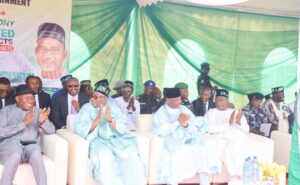
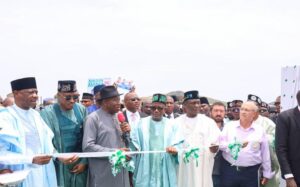
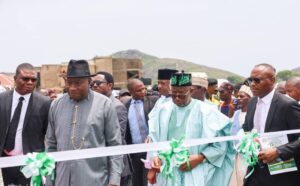
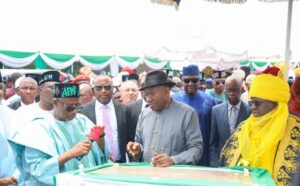
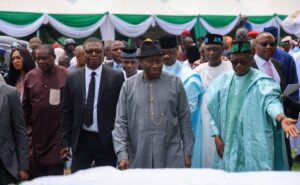
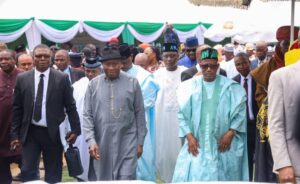
Former President of Nigeria, Dr. Goodluck Ebele Jonathan, on Monday commissioned 18 completed township road projects executed by the Bauchi state government across Bauchi metropolis.
Jonathan, who commissioned the projects at the BRC 2-Yelwa Road, Bauchi, he said no society can attain sustainable economic growth and development without modern and reliable infrastructure, noting that roads are critical to the development of any state as they connect communities, facilitate commerce, create opportunities and promote inclusive growth.
Jonathan said the confidence reposed in Governor Bala Mohammed by the people of Bauchi State was justified by the transformation taking place across the state.
He said, “Governor Bala Mohammed has consistently demonstrated leadership through tangible improvements in the lives of the people. His administration’s commitment to infrastructure, education, healthcare, agriculture and human capital development reflects a clear vision for a more prosperous and inclusive Bauchi State.”
Jonathan added that he was not surprised by the governor’s achievements, having known him over the years and being aware of his passion for service, determination to deliver democratic dividends and commitment to development.
He urged the people of Bauchi State to continue supporting the government and protect the newly commissioned roads and other public infrastructure.
“Roads are not merely physical infrastructure; they are investments in a connected future. Their maintenance and protection are a shared responsibility that requires the cooperation of every citizen of the state,” he said.
The former president expressed confidence that Bauchi State would continue on the path of peace, stability and sustainable development through prudent management of resources and a strong partnership between government and the people.
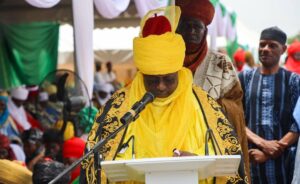
Speaking earlier, Governor Bala Mohammed said his administration, from inception, resolved to embark on projects that directly impact the lives of citizens.
“We believe that quality roads are essential because they connect communities, stimulate commerce, improve access to education and healthcare, and create opportunities for sustainable development,” he said.
The governor listed the completed projects to include Sabon Kaura-BRC Road, Gwallameji-Doka-Rafin Zurfi Road, Bayara Township Road, dualisation of Muda Lawal Road, Malam Goje-Muda Lawal Road, Yakubu Wanka Street, Shagari Road, Sam Njoja Road, Joja Road, Gwangwangon-Gwabba Road, Karofi-Dumi Road, Nufawa Road, Dorawa Close Road, International Conference Centre Road, Central Market-Wunti Street, Bayan Nital Road, dualisation of Sabon Gari Road and dualisation of Murtala Mohammed Road.
Mohammed said the completed township roads covered a total length of 49.7 kilometres and were strategically constructed to connect key economic areas, commercial centres, educational institutions, security formations and public facilities within the state capital.
The projects, he said, were executed at a cost of over N58 billion, with the aim of improving connectivity, transportation, security and access to essential services within Bauchi metropolis.
“Beyond improving mobility, these roads are stimulating economic activities, enhancing the beauty of our capital city, increasing property values and creating opportunities for sustainable growth and development.
“Most importantly, during construction, they provided both skilled and unskilled workers with opportunities for employment and self-development,” the governor said.
He added that the roads were constructed in accordance with modern engineering standards, incorporating durable pavements, efficient drainage systems, reinforced culverts, concrete curbs, traffic signs, thermoplastic road markings, speed-calming measures and solar-powered street lighting on selected routes.
Mohammed said the projects were designed to encourage investment, create employment, increase property values, support businesses and improve the delivery of social services.
He noted that although significant attention had been given to Bauchi metropolis, his administration was equally investing in rural and semi-urban roads because of the importance of agriculture to the state’s economy.
According to him, good rural roads enable farmers to transport their produce, reduce post-harvest losses, improve access to markets, schools and healthcare facilities, strengthen security and promote inclusive development.
“Our desire was to develop about 5,000 kilometres of roads, but so far, we have completed about 3,000 kilometres,” he said.
The governor stressed that the state’s infrastructure programme was not merely about construction but about opening economic opportunities, improving livelihoods and laying a solid foundation for the prosperity and growth of Bauchi State.
He reaffirmed his administration’s commitment to delivering more dividends of democracy through continued investment in roads, bridges, healthcare, education, agriculture, water supply, housing and other critical sectors.
Mohammed also expressed appreciation to Jonathan for his friendship, mentorship and contributions to Nigeria’s democratic development.
“Your presence has added great honour and national significance to this occasion,” he said.
He appealed to residents to protect the newly commissioned roads as public assets, urging them to keep drainage channels clear, avoid indiscriminate dumping of refuse and prevent vandalism of public infrastructure, particularly the solar-powered street-lighting facilities.
Also speaking, the Commissioner for Works and Transport, Prof Titus Uba Ketkukah, said the commissioning reflected the commitment of the state government to infrastructure development.
He assured that the ministry would continue to ensure that road projects were properly executed, delivered and certified in line with approved engineering standards and specifications.
We’ve got the edge. Get real-time reports, breaking scoops, and exclusive angles delivered straight to your phone. Don’t settle for stale news. Join THISTIMES on WhatsApp for 24/7 updates →
Join Our WhatsApp Channel