Abuja is often portrayed as a city of power, privilege and promise. Yet, behind its grand boulevards and imposing structures lies another reality, one of people battling hunger, displacement, disability, unemployment and loss simply to survive.
From women caring for children after losing their husbands to insecurity, to persons living with disabilities and others displaced by conflict, their stories reveal the human cost of poverty and weak social protection.
In this special report, CYNTHIA ONUADO speaks to beggars across Abuja to uncover the untold stories behind their daily struggle for survival, the dangers they face on the streets, the factors driving more people into begging, and the efforts by government and other stakeholders to address the crisis.
Abuja, Nigeria’s capital is a landscape of irony. A city of glass towers, government convoys, and dreams polished into marble. But beneath the bridges, at the road junctions, under the scorching sun and the midnight rain, another ‘Abuja’ exists. People are fighting for something far simpler. The right to exist without hunger.
Street begging is often not a voluntary lifestyle choice but a coping mechanism adopted by individuals and families who lack access to basic necessities such as food, shelter, education, healthcare, or employment. It is commonly linked to poverty, displacement, insecurity, disability, illness, breakdown of family structures, and weak social welfare systems.
Street begging in Abuja is visible at major intersections, malls, airports, parks, markets and places of worship. Beggars range from elderly individuals to children, and some are seen with placards detailing their plight, while some carry infants, capitalising on the sympathy that comes from showing vulnerability.
Although there is no recent published research that quantifies the percentage of Abuja’s total population who are beggars, multiple studies and surveys confirm that street begging remains a visible and growing phenomenon in Abuja’s public spaces, involving men, women, children, and people with disabilities.
The number of these beggars has continued to rise despite the intervention of the relevant agencies of the Federal Capital Territory (FCT) Administration.

What Causes The Influx Of Beggars Into Abuja?
Abuja is a city of promises. But for thousands, the promise ended the moment they arrived. Some fled conflict. Some fled bullets, some survived bullets, and some were wounded by both. Many did not come here to beg. They came fleeing bullets, burning villages, and stolen livelihoods. Some lost everything to sickness. Some were born into displacement. And some were sent here, deliberately.
We see them every day, but we rarely hear their stories. On the streets of Abuja, encountering these beggars, they told harrowing tales. To understand the lives and how they ended up begging in Abuja, LEADERSHIP spoke to a few beggars at various points across the city, and their responses showed that they are mostly from the troubled parts of northern Nigeria as a result of insurgency.
Specifically, some of the women who beg with their children told LEADERSHIP that they were widows displaced by the unrest in some northern states.
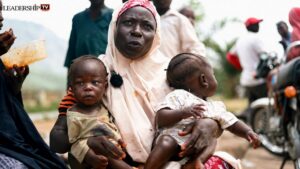
Aisha begs with her twin babies at the Kubwa axis of Abuja. She said, “Today, it makes it almost a week now that I make just 500 to 1,000 Naira. That’s how I have been surviving. I go home hungry, lie down and force myself to sleep. I have twins, and I’m still breastfeeding them. Sometimes I just want to cry.”
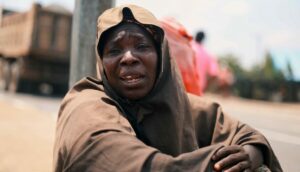
We came across Hadiza at the Dutse axis begging on the street. She said, “We want to send our children to school so they can have a better life, and they can help us too, if they grow up with good values. But people treat us like we don’t matter. Some insult us. Some just look at us with pity. That’s why we are praying to God to send us help. We are begging for help so we can send our children to school.”
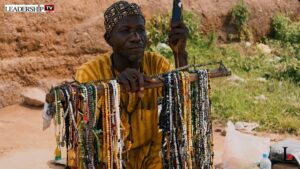
Mohammed, who sells religious beads, chewing sticks, perfumes and equally begs at the Efab Estate Junction has been suffering from Glaucoma for the past 20 years. He said, “I used to live in Hadeija local government, Jigawa State. I was a trader working alongside my children, then I developed Glaucoma, and everything changed. Even at that, I did not let that stop me. That was when I started this business.”

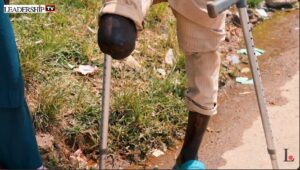
Ahmed, who is handicapped and also begs at the Efab Estate tells a harrowing tale of how he lost one of his leg while doing his business which resulted into him begging on the street says, “What happened my legs was that I used to sell cattle, one day, we had an altercation with theives at our ranch. That was when they shot me. Now I’m looking for what to do. When they shot me, they took everything and left me in the middle of the forest along this Abaji road. It still hurts when I remember. Back then, I wasn’t alone in the market, I had six apprentices that were helping me out. During that time, I had 7 million Naira stolen from me including two cattle worth three hundred and fifty thousand naira each. I used to sell big cattle. They picked the money from my pocket and left with the cattle.”
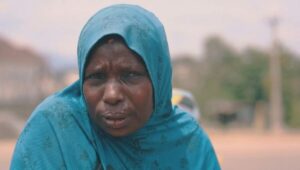
Hauwa, who is one out of many women sitting by the roadside at Dutse and begging tells pitiful tales of her family being attacked by bandits and killed, she said, “What happened that brought us here is that there were some terrorists, who killed our parents, children and husband. They destroyed our livelihoods, and left us with nothing. They took everything away from us. Now we’re left roaming around the streets with orphans. There’s no way we can return back to our area, because they’ve taken everything away from us.
Another beggar Rakiya said, “Our hometown in Katsina is no longer safe. That is why we are begging here. If God sends someone to give us the help we need, we can go back home and live in peace again.”

Amina, another beggar we met at the roadside in the Utako district said she was displaced from her home due to insecurity, “We stay on this road from morning until night. Some people insult us, and others look down on us. It’s just that God is protecting us because many drivers just speed past like they are going to hit us. Even when people want to help us by giving us food stuff, we have to cross the road and collect things from them. If you want to cross the road and a car hits you, what will you say? She further talks about a fellow beggar who got killed by a car while trying to collect food from a passerby.
Some of the beggars said they were forced to engage in begging because there are no job opportunities in the country.

Abubakar, who hangs around the National Mosque to beg because he has been unable to secure a job talks about how he is at the mercy of good Samaritans to be able to feed daily, he said, “People insult us, saying that we are lazy. But there’s no work. We are just idle and have no work to do. And nobody has given us any job. They keep insulting us, saying we are thieves and should get jobs. But it’s because there are no jobs that’s why we are staying here.”
Asmau who also begs by the roadside at Jabi, said, “It’s been a year since I lost my husband. He left me alone with our children. Now I’m just looking for something to feed them with. May Allah provide for us.”
Risk Factors Involved In Street Begging
Street begging in Nigeria is driven by deep-rooted structural failures; poverty, lack of access to education, cultural practices, and weak social protection systems. NGOs and organisations such as ActionAid Nigeria and the National Agency for the Prohibition of Trafficking in Persons (NAPTIP) argue that lasting solutions must go beyond handouts to address these root causes through education support, skills training, rehabilitation, advocacy, and social protection.

According to ActionAid Nigeria’s Country Director, Andrew Mamedu, “A good number of those that are involved in street begging are children, young people. They are deprived of education, so being deprived of education, they then find alternatives because they are not in a school.
“Basic education is supposed to be free but even the president, the governors, the local government chairman, they know that there is no free education in this country anymore… What they do is they resort to coming on the street because they are not going to school. They don’t have what’s keeping them busy.”
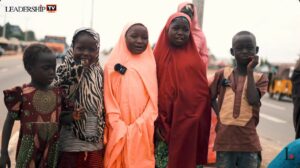
Children on the streets, experts warn, are especially vulnerable to exploitation and trafficking. Angela Aleakhue Agbayekhai, Acting Director of Counselling and Rehabilitation at NAPTIP, explains that “these are children that are in a vulnerable state, and so anything you offer them and dangle before their eyes, they accept it and it’s very easy for traffickers to make use of them.” She adds that “people are moved, children in particular, from one state to another for this purpose… even people that are handicapped are being used to beg, in fact that is going to send so much sympathy to the public… Disabled people are also sometimes coerced into street begging.”
Agbayekhai highlights red flags the public should watch for: “When you see a child shabbily dressed, practically all alone, or you see a child begging and always having a cause to look at a particular end, it means the trafficker is not far. It’s a control mechanism they use for these children.” She cautioned against indiscriminate giving, noting that “it’s not every child you see on the street that actually needs the money you give to them… By the time you keep giving this money, you’re encouraging them to keep begging.” Instead, she urged the public to support structured interventions. “Instead of giving money to these children, you can donate to an NGO or organization or even NAPTIP…Education is very important in this situation. If every child can be in school… they’ll be off the streets.”
Cultural practices also intersect with the problem. Mamedu points to the almajiri system, arguing that it must be formally integrated into Nigeria’s education framework to prevent exploitation. He explains that many children are sent to study under mallams without financial support, forcing them to beg daily, surrendering whatever they earn. “Some parents just think that once their male child is six years old, he is handed over to a mallam to take care of him,” he said. While acknowledging concerns that giving money to beggars may sustain the practice, Mamedu stressed that regulation, not criminalisation is key: “But that’s where the government support and regulation comes in.”
On exploitation and dependency, he added, “What they need is not a stipend, not the fish. What they need is to be taught how to fish… Ultimately, the government has the major responsibility to make sure that street begging is brought to the minimum, and it’s not about just driving them from the streets, but responding to the root causes of street begging.”
What is the government doing to address the issue?
LEADERSHIP reports that there are two agencies tasked with the responsibility of enforcing environmental legislation and sanitation; the Abuja Environmental Protection Board (AEPB) and the FCT Social Services Development Secretariat (SDS). While the Abuja Environmental Protection Board (AEPB) is saddled with the responsibility of cleaning the city, including the removal of beggars from the streets, the FCT Social Development Secretariat is responsible for the rehabilitation of those removed from the streets.
The Federal Capital Territory (FCT), has announced and repeatedly reiterated that street begging is prohibited throughout the FCT, but without reintegration, without skills, without dignity, the streets always call them back.
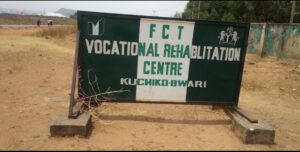
A director in the AEPB who spoke with LEADERSHIP on condition of anonymity said that many of the arrested beggars were taken to a rehabilitation centre at Kuchiko in Bwari Area Council, but wondered why their number keeps increasing. He said the organisation was reviewing its approach to ensure that those earlier arrested do not get back to the streets.
The Head of Enforcement at the SDS, Mrs Ukachi Adebayo, said 607 people had been evacuated from Abuja streets within six months. They comprised 583 beggars and 23 persons described as mentally challenged.
She said those apprehended were counselled and profiled before being taken to their respective state liaison offices for return and rehabilitation.
She, however, acknowledged that some return to Abuja because of insecurity and difficult conditions in their home states, making the enforcement exercise a continuous process.
The Secretary of the FCTA Command and Control Centre, Dr Peter Olumuji, also warned that street begging could create security concerns, with children and other vulnerable persons exposed to exploitation and criminal networks.
In mid-2025, the Federal Capital Territory Administration in a campaign called: “Operation Sweep Abuja” sought to round up those living on the margins, beggars, scavengers, and others deemed miscreants. Over 200 people were taken in July alone, sent to the Bwari Rehabilitation Centre for profiling and intended to return to their states of origin.
When LEADERSHIP visited the centre, we were refused entry. Although we found it empty and uninhabited. A chat with its workers revealed that it was specifically meant as a centre for drug addicts but serves a double purpose of harbouring beggars apprehended on the streets.
But the greatest responsibility remains with the state. Not just to remove beggars from the streets, but to remove the reasons they are there. Because poverty is not a crime. Displacement is not a choice. And survival should never come at the cost of dignity.
In May 2025 During the 2025 Federal Capital Territory (FCT) budget defence at the Nigerian National Assembly in Abuja, a public disagreement unfolded between FCT Minister Nyesom Wike and the senator representing Borno South Senatorial district, Senator Ali Ndume over government policy on street beggars.
Senator Ndume urged a more compassionate, social-welfare approach, arguing that simply arresting or driving away beggars was insufficient and suggesting that organised camps be created to feed, train and reintegrate them, citing an approach he said was once used in Kano.
In response, Minister Wike rejected the proposal, insisting that Abuja’s status as the nation’s capital required a different policy. He emphasised that the city should not tolerate large numbers of beggars on its streets and stressed the security and image concerns tied to the presence of international bodies and high-profile installations in the FCT. The exchange quickly became a focal point of debate, highlighting contrasting views on whether enforcement or social intervention should lead government efforts to address street begging in the capital.
Wike, had in October 2024, declared war on beggars defacing Abuja city and posing security risk. The minister explained that the move was necessary over concerns that Abuja was turning into a beggars’ city.
Wike has consistently declared a war on street begging, expressing concern about the image of the nation’s capital.
“It is embarrassing that people who come into Abuja, the first thing they see are just beggars on the road… We will not allow that,” he said.
Yet, for the beggars at Abuja’s traffic junctions and street corners , the issue is less about the city’s image and more about survival.
After all is said and done, It’s time we as Nigerians realize that Not everyone on the street chose the street, To some, there was no other option. Behind every outstretched hand, is a journey shaped by loss, displacement, or broken systems. But then, what if giving is not enough?
The documentary ‘’How Street Beggars survive in Nigeria’s Capital’’ can be watched on our Youtube page LeadershipTV
We’ve got the edge. Get real-time reports, breaking scoops, and exclusive angles delivered straight to your phone. Don’t settle for stale news. Join THISTIMES on WhatsApp for 24/7 updates →
Join Our WhatsApp Channel