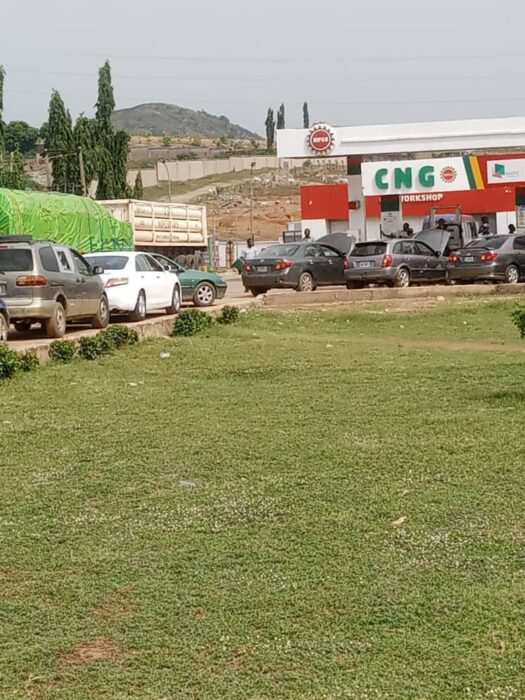
As the federal government intensifies its push to move Nigerians from petrol to Compressed Natural Gas (CNG), motorists in the Federal Capital Territory (FCT) are increasingly embracing the cheaper fuel alternative but are being forced to endure long queues, limited outlets and uncertain access to supplies.
Ahead of the October rollout of the next phase of the government’s CNG programme, checks at some CNG dispensing points across Abuja showed a growing gap between demand for the cheaper fuel and the infrastructure available to serve motorists.
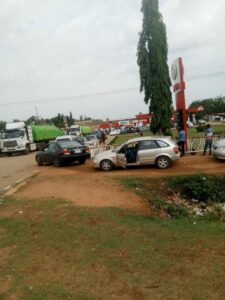
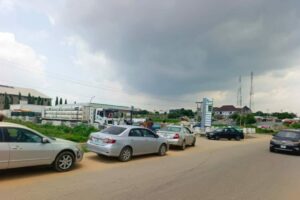
At some stations, motorists spend several hours waiting to refill their vehicles, with some arriving as early as dawn and others reportedly sleeping in their vehicles overnight to secure a place in the queue.
For many users, the attraction is obvious: CNG costs considerably less than petrol and, in several cases, has substantially reduced their weekly transportation expenses.
At the Dei-Dei Mega Filling Station, one motorist, Okechuku Austin, said he had been waiting for several hours to refill his vehicle.
Austin, who has used CNG for about three months, said there was little doubt that the fuel was more economical than petrol, but argued that accessibility remained the biggest obstacle to its wider adoption.
“For me, I’ve been here since morning. It’s around 7:30 to 8 and it’s now after one. So getting the CNG itself is a problem. That is the major problem with it,” he said.
According to him, the long queues are particularly difficult for motorists who use their vehicles for work and cannot afford to spend most of the day waiting at a filling station.
He observed that commercial drivers appeared more willing to tolerate the delays because the savings from CNG significantly affect their operating costs.
“Most of the people on the queue using CNG are in the transport sector. Many of them feel safer and cheaper, so they wouldn’t mind spending long hours. Some even park their cars. Some sleep overnight,” Austin said.
“But for somebody that is going to work, you can’t tell your boss that you want to go and queue for CNG the whole day.”
He called for the establishment of more CNG dispensing points across the FCT, saying motorists should be able to access the fuel with the same ease with which they buy petrol.
“Government should be thinking of how to make it readily available. It can be available in many filling stations so that people can access it easily, just the way you access fuel,” he said.
Austin, however, said he was uncertain about reports concerning the long-term effect of CNG on vehicle engines, describing the fuel as relatively new to many Nigerian motorists.
“As for the engine part, I don’t know, because we have not been getting any. It’s still a new product. We have to test and see how it affects,” he said.
Despite the concern, he maintained that CNG remained a good alternative to petrol if government and private investors could resolve the accessibility problem.
At the Ushafa-Bwari NNPC filling station, another user, Obera Victor, described the experience of obtaining CNG as “not easy,” blaming the situation on inadequate availability.
“Time will come to buy CNG. You have to queue for a very long time before you get the CNG. So the experience is not easy at all,” Victor said.
However, he said the lower cost and better mileage had made him remain committed to CNG.
“I prefer using CNG because the price for CNG is less compared to that of fuel. And it’s like it lasts longer than fuel,” he said.
According to Victor, the difference becomes more obvious when comparing the amount of CNG and petrol that the same amount of money can purchase.
“If I buy like N6,000 CNG now, it will take me a longer way than when I get fuel. Fuel of N6,000 cannot take me from inside town to this place. So CNG is more preferable,” he said.
Victor disclosed that he had been using CNG for about one year and six months, adding that the difficulty of obtaining the fuel remained his major complaint.
He appealed to the government to increase availability so that motorists would not have to spend hours at stations before refuelling.
Commercial vehicle operators, who constitute a significant proportion of CNG users, have increasingly turned to the fuel to reduce operating costs, although their higher daily mileage also means they require more frequent refuelling.
Ahmed Hassan, a civil servant at the Federal Secretariat, said his weekly expenditure on petrol had fallen from about N65,000 to approximately N9000 after switching to CNG, representing a dramatic reduction in his fuel bill.
Similarly, Moses Ibeh, who operates a Toyota Coaster bus, said his weekly fuel expenditure dropped from about N120,000 to N47,000 after converting to CNG.
But Ibeh said the savings had to be weighed against the frequency of refuelling and the time spent at CNG stations.
For drivers who spend most of their day on the road, repeated visits to filling stations can translate into lost income, particularly when each visit involves a long wait.
Uber driver, Philip Japhet, said the issue was more pronounced among high-mileage drivers.
According to him, a 75kg CNG cylinder could last only about two days depending on usage, forcing him to return to the station frequently.
For larger commercial vehicles, the frequency can be even higher, with some requiring refuelling daily.
In the FCT, the official retail price of Compressed Natural Gas (CNG) is ₦380 per Standard Cubic Meter (SCM) for passenger and commercial vehicles.
However, private retailers across Abuja sell the product within a general market range of ₦380 to ₦600 per SCM depending on the specific location and station operational costs.
The relatively low price has fuelled demand, but that demand is increasingly exposing weaknesses in the country’s CNG infrastructure.
At NIPCO’s CNG facility at Gosa along the Abuja Airport Road, a station attendant said hundreds of vehicles could be served daily, but the number of dispensing points was insufficient to cope with the volume.
He explained that while the actual refuelling process could take between five and 10 minutes per vehicle, the number of motorists arriving at the station created significant bottlenecks.
Even stations equipped for faster refuelling are struggling when large numbers of motorists arrive simultaneously.
Fast-fill stations are designed to dispense CNG relatively quickly, while time-fill systems are more suited to fleet operators and may require vehicles to remain connected for extended periods, including overnight.
The result is that the availability of CNG at the station does not necessarily translate into quick access for motorists.
At the Ushafa-Bwari NNPC station, Yusuf Patrick, the supervisor in charge, identified inadequate outlets, insufficient supply and limited compressor capacity as major factors responsible for the queues.
“To alleviate the challenges of CNG users, one, we need more outlets to ease the queue. Then two, there should be more supply. Then our compressor also, they should increase the number of compressors we have,” Patrick said.
He added that additional generators and reliable power supply were also necessary to ensure stations could operate continuously.
“We need more retail outlets, more compressors, more generators, so that they will continue to ensure that good security can run 24 hours. With that, all this should ease,” he said.
Patrick also acknowledged the impact of the government’s vehicle conversion programme, saying free or subsidised conversion had helped to encourage motorists to adopt CNG.
He urged the authorities to consider expanding similar conversion initiatives to other parts of the country to encourage more Nigerians to switch.
The infrastructure challenge is particularly significant because vehicle conversion appears to be progressing faster than the establishment of dispensing infrastructure.
Energy analyst, Joseph Osaremen, warned that the government risked losing motorists if the infrastructure problem was not urgently addressed.
He called for accelerated construction of CNG stations, particularly in major cities such as Abuja, Lagos and Kano, arguing that each would require significantly more outlets to meet demand.
Another CNG motorist, Hassan Addo, the issue is not whether CNG works as a cheaper alternative to petrol, the problem is whether they can obtain it without sacrificing an entire day.
“If you watch, those who are doing it are making money because they are always busy. There is no time you come here that there is no queue,” he said.
He, however, acknowledged that wider availability could eventually reduce the queues as more stations come on stream and supply improves.
For now, the government’s CNG transition presents a paradox: motorists are willing to switch because the economics are compelling, but the very success of the switch is placing enormous pressure on a distribution network that has yet to catch up with demand.
As the October rollout approaches, motorists say the next phase of the programme must therefore go beyond vehicle conversion.
They want more stations, more compressors, reliable power, steady gas supply and shorter waiting times.
For Abdul Ibrahim, another CNG user, the message to government is straightforward, “If the government wants us to keep using CNG, they must make it accessible not a daily struggle.”
We’ve got the edge. Get real-time reports, breaking scoops, and exclusive angles delivered straight to your phone. Don’t settle for stale news. Join THISTIMES on WhatsApp for 24/7 updates →
Join Our WhatsApp Channel