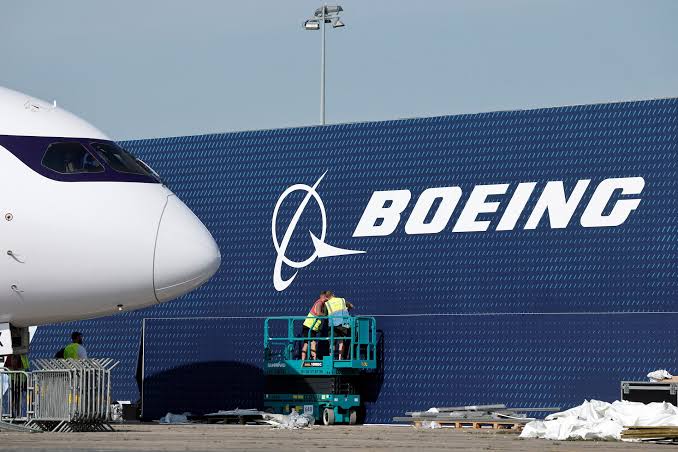
US aircraft manufacturer Boeing projects that African airlines will take delivery of 1,165 new commercial aircraft between 2026 and 2045 as carriers expand their fleets to meet rising air travel demand.
The projection is contained in Boeing’s 2026 Commercial Market Outlook (CMO) for Africa, which provides a 20-year outlook for the continent’s aviation market.
The deliveries are expected to grow Africa’s commercial aircraft fleet from 755 aircraft to 1,625 by 2045, while passenger traffic is projected to increase by nearly 6% annually.
Boeing said Africa’s young population, expanding middle class and improving infrastructure will drive air travel growth and encourage airlines to expand and modernise their fleets.
Boeing expects Africa’s fleet growth to be driven mainly by single-aisle and widebody aircraft, with 870 single-aisle and 240 widebody jets projected among future deliveries.
The continent’s cargo fleet is expected to more than double from 60 to 150 freighters, while MRO and digital solutions could create a $140 billion market.
Intra-African passenger traffic is expected to grow faster than the regional average, while Europe is projected to remain Africa’s largest international passenger market through 2045.
Boeing also forecasts a $140 billion market for maintenance, repair, overhaul and modifications (MRO) and digital solutions as aviation activity expands.
Africa will require an additional 75,000 aviation professionals, comprising 22,000 pilots, 25,000 technicians and 28,000 cabin crew, according to Boeing’s Pilot and Technician Outlook.
The projections point to growing demand for aircraft, airport infrastructure, maintenance facilities, digital solutions and skilled workers to support the continent’s expanding aviation industry.
Airlines serving African markets scheduled 25.8 million seats in September 2026, up 9.4% from 23.5 million a year earlier, according to OAG. International services accounted for 78% of total capacity, rising 8.9% year-on-year, while domestic capacity grew 11.6% and low-cost carriers recorded 5.3 million seats, up 11.5%.
Meanwhile, scheduled capacity to and from Nigeria rose 37.4% year-on-year in September 2026, adding 322,800 seats.
Despite the projected growth, Africa remains one of the world’s least connected aviation markets. The continent accounts for just 2% of global air traffic despite having about 18% of the world’s population, according to the Atlantic Council.
Its report, Opening Africa’s Skies to Trade, Growth, and Jobs, attributed the gap largely to high fares, limited connectivity and restrictive air service agreements.
The report recommended stronger implementation of the Single African Air Transport Market (SAATM), removal of capacity restrictions and greater competition among airlines.
Africa will need significant investment in aviation infrastructure and fleet capacity to support the projected growth in passenger traffic.
The developments underscore the need for aircraft financing, infrastructure and fleet expansion to support Africa’s projected aviation growth.