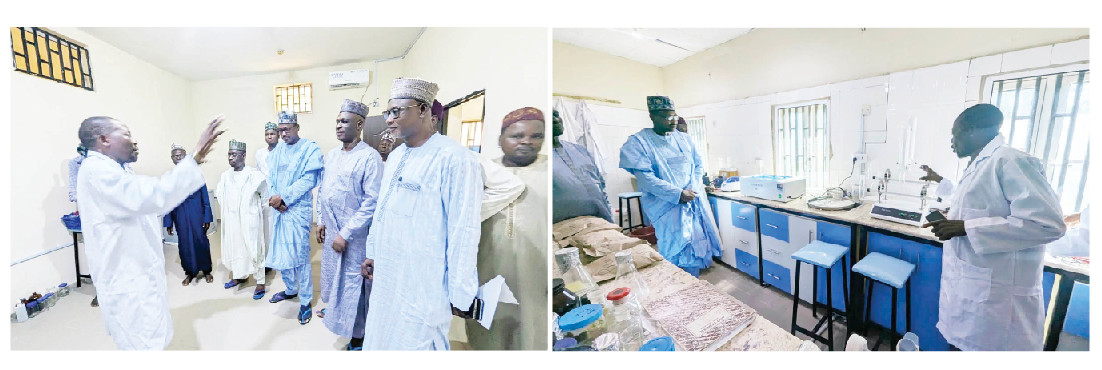
Recently, Jigawa State hosted a one-day stakeholder engagement and awareness session on the Nigeria Farmers’ Soil Health Scheme (NFSHS). During the session, the importance of soil health, as well as accessible and available laboratory and research facilities, was emphasised.
The meeting came at a time when the Jigawa State Research Institute in Kazaure had gone far in providing those services and supporting them, making it a role model for other states to emulate.
In the deliberations and presentations at the meeting, effective soil management, which involves policymakers, researchers, experts, farmers, and other critical stakeholders, was identified as essential to achieving smart and sustainable agricultural development in Nigeria.
To translate such a policy into practice, there is a need to strengthen soil-testing infrastructure, improve laboratory capacity and quality assurance, train technical personnel, and make soil-testing services accessible and affordable to smallholder farmers.
State governments must also integrate the scheme into their agricultural development programmes and strengthen collaboration among soil laboratories, research institutions, extension services, farmers’ organisations, development partners, and the private sector.
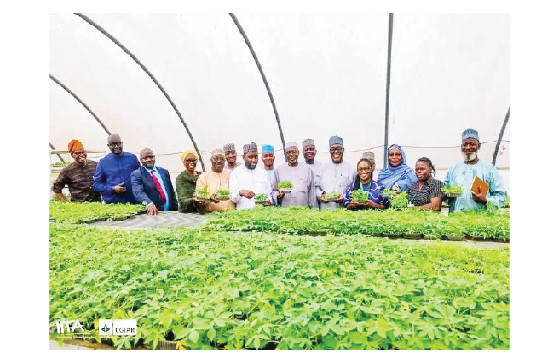
According to Madina Ayuba, Country Director of Soil Value, the NFSHS is a flagship national initiative of the Federal Ministry of Agriculture and Food Security, coordinated through the ALCCMS. It aims to provide a comprehensive framework for promoting sustainable soil fertility management and climate-smart agriculture.
The initiative is also expected to improve fertiliser use efficiency and data-driven soil governance across Nigeria’s agro-ecological zones, anchored in the National Agricultural Technology and Innovation Policy.
Every state in the federation is expected to domesticate the policy and establish a State Technical Working Committee for engagement with farmers, as well as a Coalition of the Willing platform to drive the scheme forward in the state.
As of the time of this meeting, a team from Katsina State was in Jigawa to study the blueprint of the Agricultural Research Institute, Kazaure, to replicate it in their state and achieve the successful and sustainable agricultural reform initiated by Governor Umar Dikko Radda.
When he assumed office, Jigawa State Governor, Malam Umar Namadi, found the institute almost paralysed, with very little activity despite the enormous need for its services in the agrarian state.
The centre suffered from years of inadequate financing, dilapidated infrastructure, obsolete equipment, and epileptic power supply.
“The Jigawa Research Institute was established by the Jigawa State Research Institute Law No. 2 of 2003,” he recalled. “Its mandate is to promote agribusiness development through applied research and to transfer the technologies and innovations developed by our scientists for the benefit of Jigawa farmers.”
Governor Namadi consulted all the critical stakeholders on how to revitalise and restore the institute to its glorious age, enabling it to provide the expected support in mechanising Jigawa’s agricultural sector and promoting smart agricultural practices by making laboratory services, data analysis, quality seeds, and new farming techniques affordable and accessible to the state’s farmers.
Governor Namadi reviewed the financial allocation for the sector, renovated and constructed new infrastructure, provided modern research equipment, and also installed a 60 KVA solar power system, which addressed the decades-long power supply problem.
Six laboratories and sixteen offices have been completely renovated. New departments dedicated to Molecular Biology and Plant Pathology have been established, expanding the frontiers of scientific inquiry within the institute.
The institute has also received the support and blessing of Governor Namadi, which has now facilitated the signing of numerous MOUs with other research institutes within and outside Nigeria.
According to the Director General of the Institute, Dr Sulaiman Rufai Babura, collaboration has been a key tool for modern research. He maintained that “Research cannot operate in isolation,” and that “Scientific advancement is best achieved through partnerships.”
Those partnerships now extend to institutions such as the Lake Chad Research Institute, the Institute for Agricultural Research at Ahmadu Bello University, the International Rice Research Institute, and Bayero University’s Centre for Dryland Agriculture.
Today, the Kazaure Agricultural Research Institute operates to modern, global standards, with its impact already stimulating crop and animal production across Jigawa State and beyond.
Driven by his passion and commitment to repositioning Katsina State’s agricultural sector, Governor Radda deemed it necessary to establish a state-owned agricultural research institute to provide timely, effective, and adaptable solutions to existing and emerging challenges.
Research, innovation, dedication, and financial commitment are the most critical interventions required of governments and farmers in any society determined to achieve food security and sustainable agricultural development.
Indeed, the initiative made by Governor Radda to start by studying the blueprint and success story of the neighbouring state’s research institute is a wise idea, as the two states share almost everything in common in agricultural practice, geographical location, climate, and farmers’ cultural values.
The success recorded by the Jigawa Research Institute (JRI) in agricultural research, seed development, and soil mapping has inspired Katsina State to consider establishing its own state-owned agricultural research centre, following a two-day study tour of the institute by a delegation from the Katsina State Ministry of Agriculture.
The five-member delegation, led by the Katsina State Commissioner of Agriculture, Hon. Aliyu Lawan Zakari Shargalle, was mandated by the State Governor, Malam Umar Dikko Radda, to study the institute’s operations, facilities, research activities, and development model.
Other members of the delegation included Alhaji Abdullahi Ibrahim Tsiga, Permanent Secretary, Ministry of Agriculture; Alhaji Abubakar Dabo, Managing Director, KTARDA; Mansir Sulaiman, Director of Agricultural Services; and Samaila Sulaiman, Director of Planning, alongside other senior officials.
The delegation spent September 9 and 10 at JRI in Kazaure, visiting its research farms, laboratories, and other facilities as it examined how the institute was established and how its research activities are connected to agricultural production.
Shargalle said the experience provided the delegation with a clearer understanding of the scale of investment in agricultural research in Jigawa, which he said could not easily be appreciated without visiting the institute.
“We have seen a lot of things and learned a lot of things,” the commissioner said.
He said the visit was undertaken to enable Katsina State to learn from JRI as it considers establishing what he described as the second state-owned agricultural research institute of its kind.
One of the institute’s flagship initiatives is the Jigawa Soil Mapping Project. “This project will help farmers understand the nature of their soils and determine the appropriate types and quantities of fertilisers required for optimum crop production.”
The institute is currently conducting research to develop a “Jigawa Poultry Breed” that combines the resilience of local birds with the superior characteristics of exotic breeds to deliver higher meat yield and increased egg production while retaining the ability to thrive under local environmental conditions.
Artificial insemination for livestock cross-breeding conducted at the institute and scaled up for the public has yielded fruitful results, and research continues to advance to enhance livestock production in the state.
wide varieties of new, improved seeds, including rice, sesame, wheat, millet, groundnut, and genetically modified corn, were also delivered to farmers, with results appearing very promising for farmers and national food security.
Research is not an event or something that you need only once; it is a continuous business of life and must be sustained as such. Therefore, it is important to encourage governments to support research into new ideas and innovation required for sustainable human development in all its ramifications.
We’ve got the edge. Get real-time reports, breaking scoops, and exclusive angles delivered straight to your phone. Don’t settle for stale news. Join THISTIMES on WhatsApp for 24/7 updates →
Join Our WhatsApp Channel