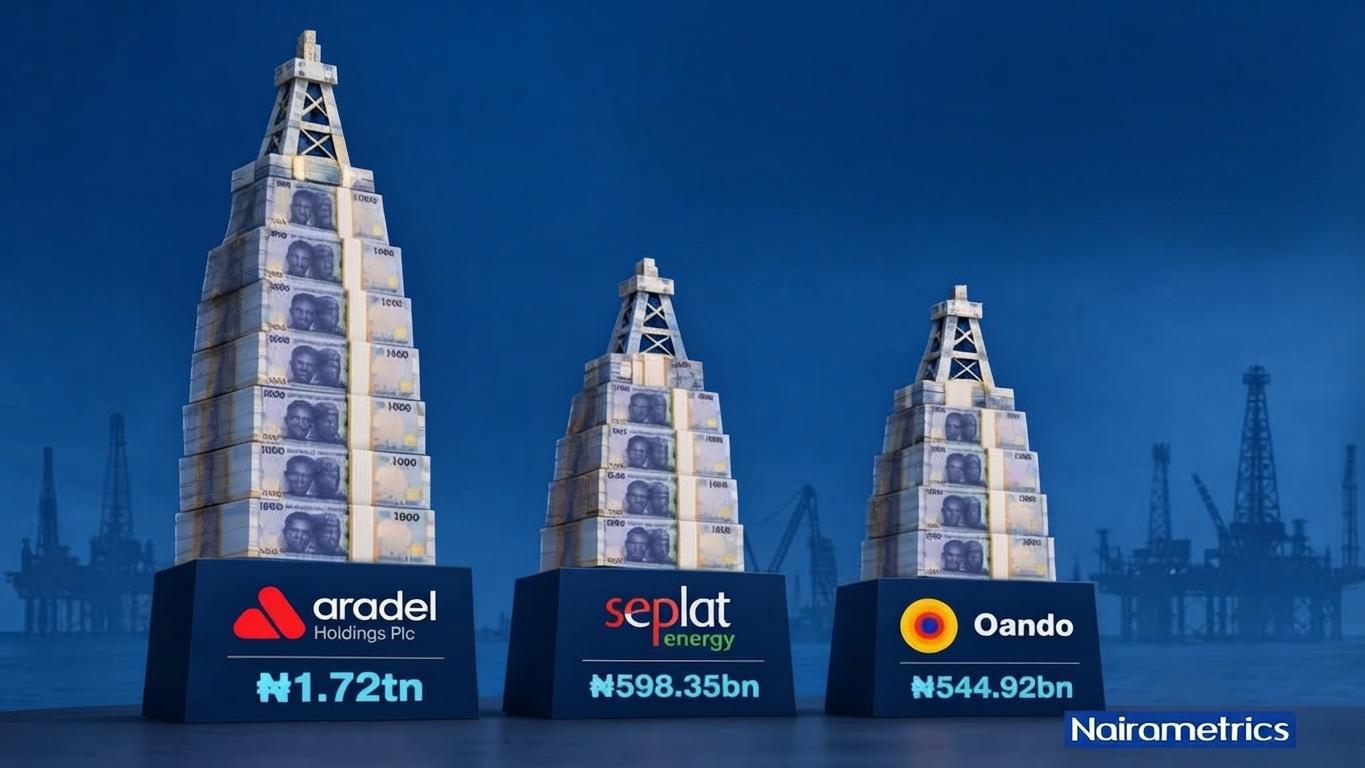
Aradel Holdings, Seplat Energy and Oando Plc built a combined N2.86 trillion cash war chest in the first half of 2026, providing substantial liquidity to support post-acquisition growth and higher production.
Financial statements reviewed by Nairametrics Research show that Aradel, Seplat and Oando ended H1 2026 with cash and cash equivalents of N1.72 trillion, N598.35 billion and N544.92 billion, respectively.
Their combined cash position increased by about N456.34 billion during the first six months of the year, reflecting stronger operating cash generation at Aradel and Seplat and increased financing activity at Oando as the companies move deeper into the investment phase of their expanded upstream portfolios.
Seplat and Oando have indicated that capital expenditure will remain a major priority in the second half of 2026 as they seek to increase production from their expanded asset portfolios. Both companies have outlined investment programmes focused on drilling, well interventions and other short-cycle activities.
Seplat expects eight rigs to be active during H2, compared with five in H1, while Oando’s planned expenditure will support new development wells and rig-less activities aimed at increasing and sustaining production.
The size of the companies’ cash balances tells only part of the story, as there are significant differences in how the cash was generated and the financial commitments competing for the liquidity. Their investment programmes suggest the N2.86 trillion held at the end of June should not necessarily be viewed as idle cash.
A significant portion of Aradel’s investment is going into assets still under development. The company recorded $217.43 million in additions to property, plant and equipment during H1, including about $189.59 million added to assets under development. Despite its investment and financing outflows, dollar-denominated cash and cash equivalents increased by about $197.15 million during the period.
Aradel’s investment coincides with a significant increase in the scale of its operations following the consolidation of ND Western Limited and its resulting majority interest in Renaissance Africa Energy Company, with group production averaging 139,500 boepd during H1 2026 compared with 22,400 boepd a year earlier.
The recent acquisitions have effectively moved the three indigenous producers into the next phase of their growth cycle.
This means roughly 69% to 75% of expected 2026 capital expenditure remained to be deployed at the end of June. The heavier H2 programme is expected to support production from new wells, the return of Yoho, the ramp-up of ANOH and completion of the first phase of Oso-BRT.
Oando, meanwhile, had about N2.70 trillion in borrowings at the end of June and plans to complete a N200 billion rights issue and advance a $1.5 billion issuance programme alongside its investment programme.
Production will ultimately be an important measure of the returns from the spending. Aradel maintained full-year production guidance of between 110,000 and 140,000 boepd.
Aradel and Seplat have seen their share prices rise by 163% and 177% respectively in the last one year. Oando, on the other hand, is down 29% in the same period as it positions for a new round of capital raise.