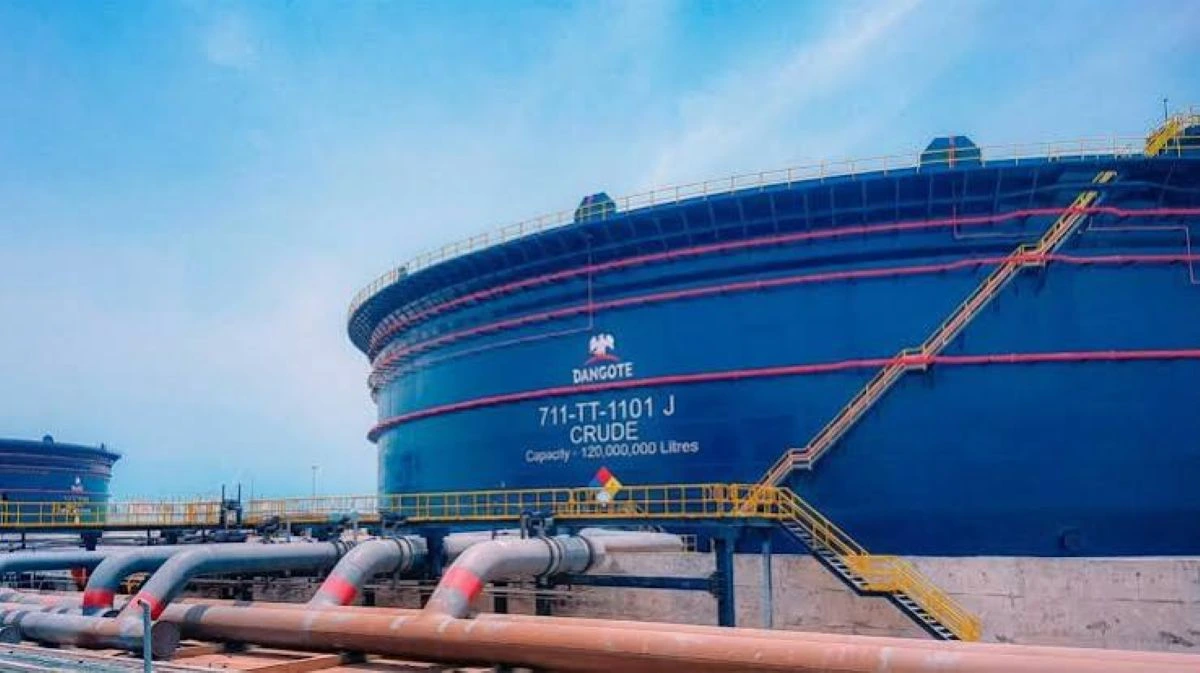
Dangote Refinery’s N525 public offer conversation has largely centered on valuation, its N2.5 trillion H1 2026 profit and whether those earnings can be sustained.
But another part of the business may prove just as important after listing: how efficiently Dangote manages the trillions of naira required to buy crude, hold products and collect money from customers.
H1 2026 provides an early indication.
Dangote generated about N2.08 trillion in operating cash flow from roughly N2.51 trillion in profit, meaning about 83% of reported profit translated into operating cash during the period.
Beneath this is a working-capital structure in which suppliers and customers are financing a significant part of the refinery’s everyday operations.
For investors, that matters because profits do not pay for expansion, debt or dividends until they become cash.
In June 2026, Dangote carried about N2.82 trillion in inventory, up from N1.92 trillion at the end of 2025.
But from this angle, an important question is: who is financing that N5.27 trillion while the money moves through the refinery?
More importantly, Dangote was not financing the entire N5.27 trillion from its own pocket.
Dangote is not funding the entire operating cycle with its own cash.
Trade payables, amounts owed for raw materials, spare parts and services, rose from N1.93 trillion to N3.35 trillion between December and June.
Customers were also providing cash ahead of delivery. Contract liabilities, which largely represent customer advances for petroleum products yet to be supplied, stood at about N655 billion, compared with N296 billion at the end of 2025.
Together, trade payables and customer advances amounted to about N4 trillion.
Against N5.27 trillion of inventory and trade receivables, that means suppliers and customers were effectively financing roughly three-quarters of this core operating requirement.
Using a simple measure; inventory plus trade receivables less trade payables and customer advances, Dangote had around N1.27 trillion of its own capital tied up in the cycle at June.
That is still a substantial amount, but the speed at which the money moves is important.
Using average opening and closing H1 balances, trade receivables represented roughly 14 days of sales, inventory around 27 days of cost of sales, while trade payables represented about 31 days of cost of sales. That produces an estimated cash-conversion cycle of about 11 days.
Inventory movements absorbed N976.6 billion, while trade and other receivables absorbed another N2.51 trillion. However, higher trade and other payables contributed about N1.54 trillion, while customer advances contributed another N371.7 billion. Operating cash flow eventually settled at N2.08 trillion.
That is the connection investors should make: working-capital efficiency sits between accounting profit and free cash flow.
If Dangote can keep customers paying relatively quickly, prevent inventory from sitting for longer and maintain favourable supplier terms as sales rise, less cash will be trapped inside the business. More can ultimately remain available for capital expenditure, debt repayment, and shareholder distributions.
Supplier financing should not be treated as free money.
The Reporting Accountant’s Report shows that Dangote had N1.19 trillion in outstanding bank guarantees issued in favour of crude-oil suppliers in June 2026, down from N1.42 trillion at December 2025.
That suggests part of the refinery’s crude-procurement system is supported by bank guarantees rather than simply unsecured supplier credit.
The test after listing will be whether Dangote can preserve that structure as the business grows. Receivable days, inventory days, payable days, and operating cash flow will show whether the advantage is holding or beginning to weaken.
If Dangote can keep the cash-conversion cycle short while production and sales rise, less cash should be trapped inside the business and more of its earnings should translate into free cash flow.
That is when the working-capital machine stops being an accounting curiosity and starts becoming a real advantage for shareholders.