Nigeria’s inflation continued to decelerate in August, with headline inflation falling for the third consecutive month to 15.39%, from 15.43% in July.
But that national figure masks wide differences across states, meaning two investors can earn the same nominal return and still end up with very different real outcomes.
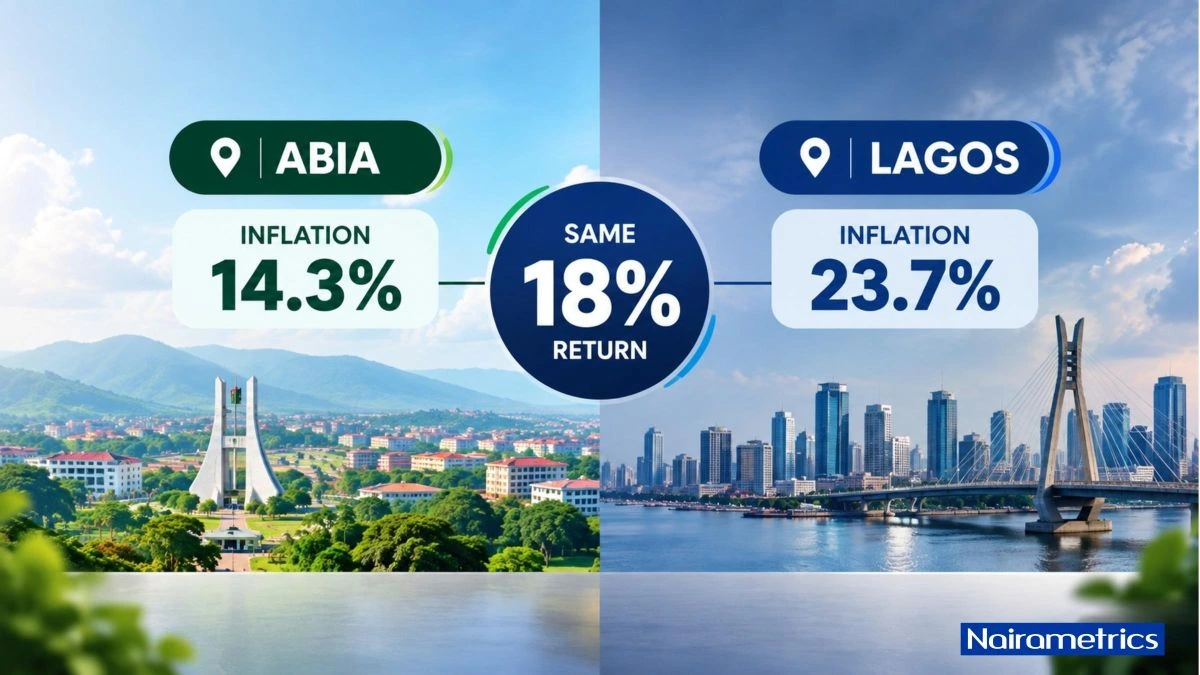
For instance, an 18% return would beat Abia’s 14.3% inflation rate but fall short of Lagos’ 23.7%.
The lesson is simple: beating national headline inflation does not always mean beating the inflation you face. To understand why, we first need to look at what the latest inflation numbers are telling us.
The latest figure represents a marginal 0.04 percentage-point decline from July and a much larger 7.75 percentage-point drop from the 23.14% recorded in August 2025.
On a month-on-month basis, headline inflation slowed to 0.71% in August from 1.57% in July, showing that prices were still rising, but at a much slower pace.
The moderation was also reflected across major parts of the inflation basket:
Importantly, the August inflation numbers do not capture the more recent surge in petrol prices recorded in September. This means the full impact of higher fuel costs on transportation, logistics, food distribution, and other household expenses is yet to show up in the inflation data.
That said, many Nigerians may still wonder why inflation is falling when food, transport, rent and other everyday expenses remain expensive.
The simple answer is that lower inflation does not mean lower prices, and this can be explained given the Consumer Price Index (CPI) numbers.
So, when headline inflation fell to 15.39%, it did not mean that the cost of living suddenly became cheaper. It meant that prices were increasing more slowly than before.
This helps explain why the official inflation number can be falling while households still feel pressure in their everyday spending.
For investors, however, the distinction creates another important question: is earning more than Nigeria’s headline inflation rate enough to protect your purchasing power?
An investment yielding 18% annually, for instance, appears to beat Nigeria’s headline inflation rate of 15.39% by about 2.61 percentage points.
But State-level inflation figures suggest that the same investment return may look very different depending on the inflation environment around the investor.
Inflationary pressures varied widely across states in August.
Lagos recorded the highest headline inflation rate at 23.7%, followed by Zamfara at 22.6% and Enugu at 22.1%. Imo recorded 20.5%, Delta 19.6%, Adamawa 19.4%, Rivers 19.1%, and Akwa Ibom 18.6%.
Abia, by comparison, recorded headline inflation of 14.3%, below the national figure.
Overall, 26 states and the FCT recorded headline inflation below the national rate of 15.39%, while 10 states recorded rates above it. The figures ranged from 23.7% in Lagos to just 2.1% in Sokoto.
This creates an interesting situation for retail investors.
Consider two investors: one lives in Lagos and the other in Abia. Each invests ₦1 million in an investment that delivers an annual return of 18%.
After one year, both investors would have ₦1.18 million, before taxes, fees and transaction costs.
On paper, both have made exactly the same return.
But whether that return has kept pace with rising prices is a different matter.
Using August’s state inflation rates as an illustration, the Abia investor is earning 18% against an inflation rate of 14.3%. The investment is therefore growing faster than the reported rate at which prices are increasing in the state.
In Lagos, however, the same 18% return is below the state’s 23.7% inflation rate.
The Lagos investor would still have more naira at the end of the investment period, but the return would not have kept pace with the reported increase in prices.
In other words, making money on an investment does not necessarily mean your purchasing power is growing.
Beating headline inflation may not be enough
For financial markets, national headline inflation remains an important benchmark. Investors use it when assessing the real attractiveness of Treasury bills, bonds and other fixed-income investments.
For an individual investor, however, the national average may not perfectly reflect the rate at which the prices they personally face are increasing.
An investor earning 18% can therefore be ahead of Nigeria’s 15.39% national headline inflation while falling behind a higher inflation rate being recorded in their state.
This does not mean investors in Lagos must be offered higher returns than investors in Abia. The same security will generally offer the same return to both.
Rather, it means the purchasing-power effect of that return can differ.
For retail investors, therefore, the question should not stop at: