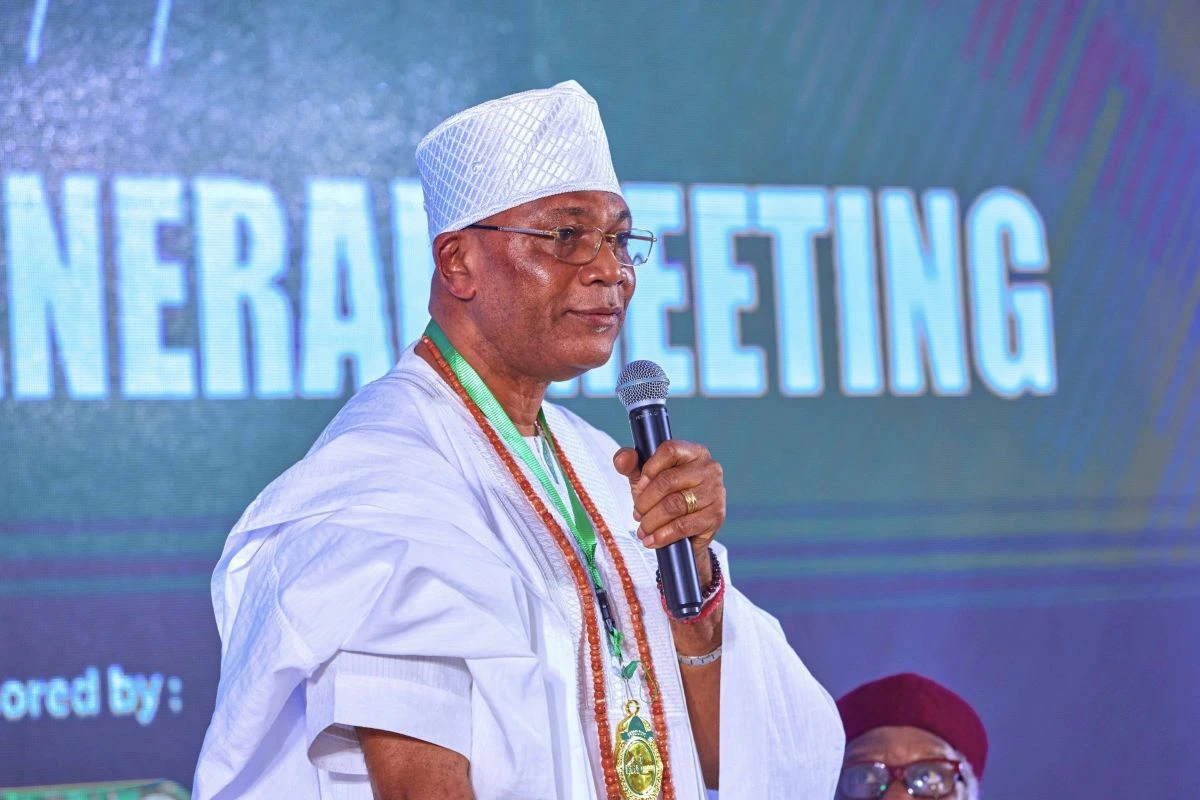
The Manufacturers Association of Nigeria (MAN) has called for stronger efforts to reduce Nigeria’s dependence on foreign supply chains, saying the country can leverage its new industrial policy to build domestic production capacity and emerge as Africa’s industrial hub.
MAN President, Francis Meshioye, made the call on Tuesday in Lagos at a news conference ahead of the association’s 54th Annual General Meeting scheduled for October 5 to October 7.
He said geopolitical tensions and disruptions in the global economy had exposed the vulnerabilities associated with excessive dependence on external supply chains, making stronger domestic industrial capacity increasingly important to Nigeria’s economic resilience.
Meshioye said Nigeria’s industrial strategy must take into account changes in the global economic environment and the risks associated with external supply dependencies.
He said MAN’s advocacy had continued to focus on the conditions required to enable manufacturers to expand domestic production and compete effectively.
He identified macroeconomic stability, infrastructure development, affordable long-term finance, a stable foreign exchange environment and a predictable regulatory framework as key priorities.
He said the opportunity was to harness these advantages through current industrial policy and disciplined implementation to build an economy that produces more of what it consumes, adds greater value to its resources and competes successfully across African and global markets.
Meshioye said the National Industrial Policy 2025, which was fully launched by the Federal Government in April 2026, provides an opportunity to address some of the structural weaknesses limiting Nigeria’s industrial development.
Meshioye said sustainable industrial growth also depended on the quality of institutions, consistency of public policy, critical infrastructure and effective collaboration between government and the private sector.
According to him, Nigeria has the resources and capabilities required to develop a stronger industrial economy, pointing to the country’s human capital, entrepreneurial capacity and power resources.
He said MAN had consequently chosen to focus its 54th AGM on leveraging the National Industrial Policy to position Nigeria as Africa’s industrial hub.
As part of measures to boost local manufacturing capacity, MAN had earlier called on the Federal Government to introduce annual local content benchmarks for government procurement in key sectors such as automobiles, textiles, pharmaceuticals and agro-processing.
The association said such a framework would help government agencies prioritise Made-in-Nigeria products and stimulate domestic production.
The Federal Government had announced the Nigeria First policy in May last year, declaring that Ministries, Departments and Agencies would be barred from procuring foreign goods and services where local alternatives exist.