Nigeria’s consumer goods companies make products that fill kitchen shelves, dining tables and refrigerators.
But for some, keeping money in the bank has also become an important source of earnings.
Nairametrics’ review of nine listed consumer goods companies shows that they held about N587 billion in cash and cash equivalents at the end of June 2026, up from N523 billion a year earlier, an increase of 12.2%
These holdings include bank balances and short-term investments readily convertible into cash. Together, the companies earned N31.08 billion in interest in H1 2026, compared with N22.76 billion in H1 2025, an increase of 36.5%.
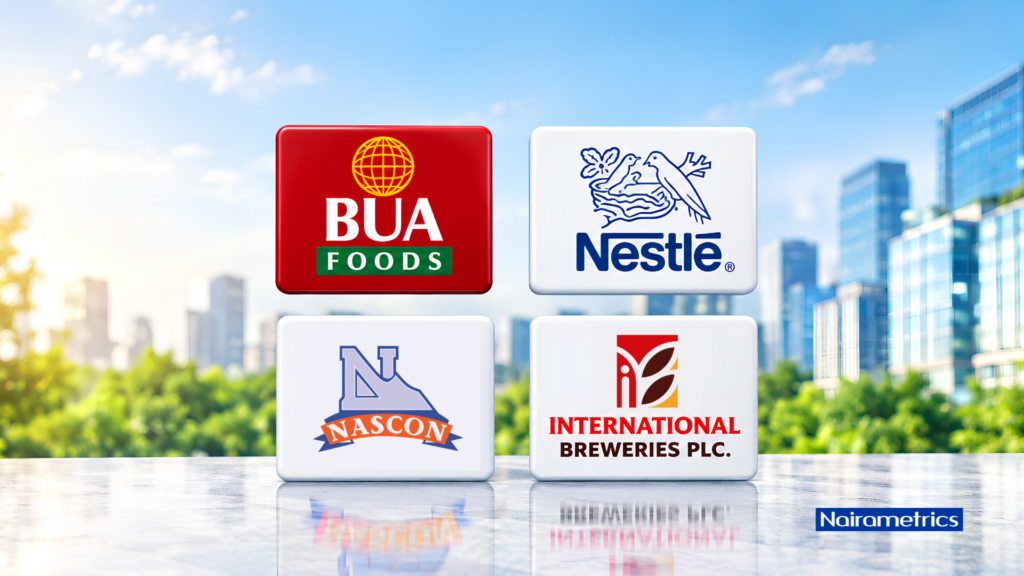
The review covers BUA Foods, Cadbury Nigeria, Dangote Sugar, Guinness Nigeria, International Breweries, Nascon, Nestlé Nigeria, Nigerian Breweries and Unilever Nigeria.
The growing cash pile gives these manufacturers financial breathing room. But following the CBN’s cut in its benchmark rate to 23 per cent, lower deposit returns could weaken that support to profits—putting greater attention on how companies use their cash to deliver value to shareholders.
International Breweries held N171.08 billion, followed by BUA Foods with N149.52 billion, Unilever with N97.15 billion and Nigerian Breweries with N74.63 billion. Together, they accounted for about 84% of the nine companies’ cash holdings.
International Breweries, Unilever and Nascon earned a combined N23.82 billion in interest, equivalent to about N18 for every N100 of combined profit before tax, compared with N15 a year earlier.
Interest income was equivalent to 22% of Unilever’s pre-tax profit, 18% of Nascon’s, and 16 per cent of International Breweries’.
Cheaper borrowing could provide relief, but businesses with substantial deposits and little borrowing may have more interest income to lose than borrowing costs to save.
International Breweries nearly doubled its cash holdings, from N86.64 billion to N171.08 billion, including N115.80 billion in short-term investments.
Interest income rose from N9.37 billion to N11.96 billion, supporting earnings as revenue barely increased, from N340.99 billion to N342.07 billion.
However, profit after tax fell from N41.29 billion to N38.31 billion. Higher interest earnings could not prevent the decline, while finance costs, largely interest on leases, rose from N3.90 billion to N7.05 billion.
Its shares have lost 27.86% this year, yet investors still pay about N40 for every N1 of past-year earnings.
If deposit income weakens, stronger profits from brewing will become more important to supporting those earnings and the price buyers are paying.
Unilever’s cash holdings increased from N83.70 billion to N97.15 billion, including N58.71 billion in fixed deposits. Interest income rose from N4.81 billion to N6.51 billion.
Its main business also grew. Revenue increased from N98.10 billion to N119.92 billion, while operating profit rose from N18.81 billion to N24.36 billion.
Interest earnings provided additional support, equivalent to about a quarter of operating profit and 22% of profit before tax.
Unilever’s cash provides a strong financial cushion, but deposits could earn less when renewed at lower rates.
With past year earnings of N5.80 per share, investors currently pay almost N19 for every N1 earned. Continued growth in manufacturing profits would help offset weaker deposit returns. Shareholders will also be watching how Unilever balances cash held for operations with expansion and dividends.
Nascon’s cash increased from N36.57 billion to N46.05 billion. Interest income from fixed deposits more than doubled, from N2.37 billion to N5.35 billion.
Revenue rose from N78.16 billion to N81.16 billion, while profit after tax increased from N15.60 billion to N19.60 billion. Interest income was equivalent to 18% of pre-tax profit, providing greater support as sales grew slowly.
With interest expenses of just N171.61 million, cheaper borrowing might offer limited relief if deposit income falls.
For illustration, a 10% decline in interest income would reduce pre-tax profit by about N535 million, if everything else remained unchanged. This is a scenario, rather than an estimate of the rate cut’s impact.
Nascon’s shares have gained 75.35% this year, with buyers paying about N14 for every N1 of past-year earnings. If earnings fall while the share price stays unchanged, buyers would be paying more for each naira of profit.
BUA Foods’ cash increased from N40.86 billion to N149.52 billion, including N103 billion in short-term investments. Yet interest income fell from N1.12 billion to N495.69 million.
The closing balance does not reveal when the investments were made or how much cash was held throughout the half-year, so it cannot establish whether returns were poor.
Nevertheless, BUA Foods incurred N6.05 billion in interest expenses, substantially more than it earned. If surplus cash earns less than its borrowings cost, using some to repay debt could improve profit, provided operating needs and planned spending remain covered.
Lower borrowing rates could also help. Revenue fell 16%, although lower costs helped profit after tax rise 12% to N292.27 billion.
Its shares have declined 4.79% this year, with investors paying about N25 for every N1 of past-year earnings. Sustaining profit growth will depend on managing costs alongside weaker sales.
Dangote Sugar’s cash fell from N147.75 billion to N29.17 billion, while Nestlé’s dropped from N37.40 billion to N5.62 billion.
Nestlé stands out: cash represented just 0.66% of its assets, the lowest among the nine, alongside N445.01 billion in borrowings.
With H1 finance costs of N47.86 billion, compared with interest income of N1.12 billion, lower borrowing rates could offer more relief than lower deposit returns would take away, depending on its loan terms.
A large cash balance offers security, but its value depends on the obligations it must cover, and the returns it generates.
For cash-rich companies with little borrowing, lower deposit returns could put pressure on earnings. More indebted manufacturers could benefit if borrowing costs fall.