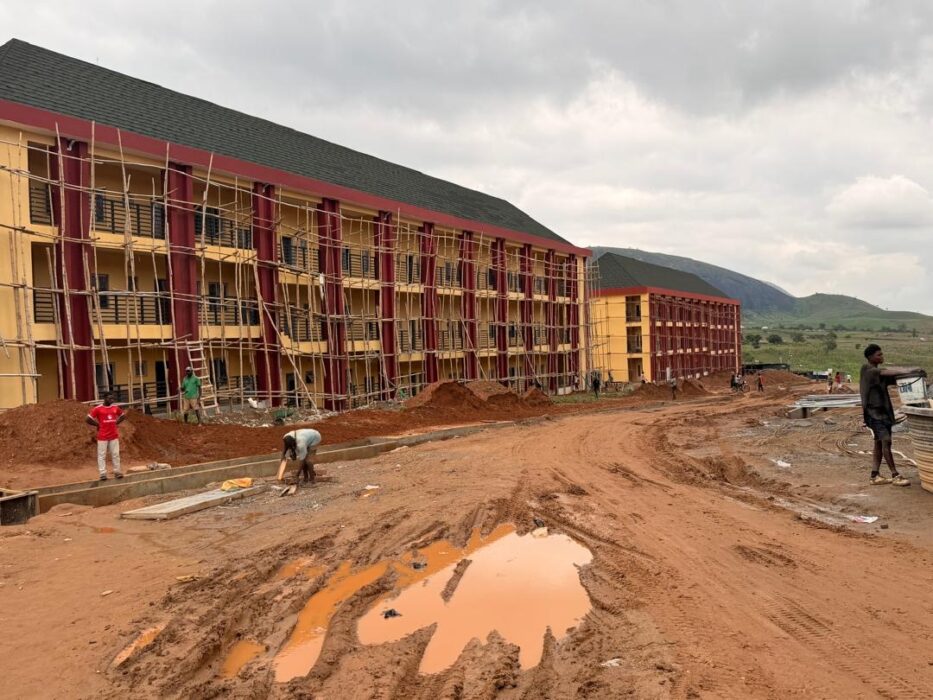
The Bola Ahmed Tinubu Barracks Phase II project in Abuja is one of the tangible projects through which resources previously committed to fuel subsidy are being redirected to infrastructure and national development, the Presidency has said.
The project, which is being constructed with the approval and funding of President Bola Ahmed Tinubu, is expected to provide accommodation for more than 1,000 soldiers and their families, with the wider residential community projected to serve more than 6,000 people.
The development comprises 30 family quarters, six blocks of senior officers’ accommodation, an Army club, a MAMI market, bridges, drainage systems and other essential infrastructure.
The project formed part of the wider investment in the Nigerian Army by the Tinubu administration in military infrastructure, personnel welfare, operational capacity and institutional development.
The Presidential Media Team, led by the Special Adviser to the President on Media and Public Communications, Sunday Dare, alongside the Senior Special Assistant to the President on Digital and New Media, Otega Ogra, inspected the project in Abuja on Tuesday.
The inspection provided an opportunity for the team to assess the scale of the development and its significance for military accommodation, personnel welfare, employment, economic activity and national security.
Speaking during the inspection, Dare described the project as one of the tangible benefits of the difficult economic decision taken by the Tinubu administration to remove fuel subsidy.
According to him, resources that would previously have been committed to fuel subsidy are now being redirected towards development projects capable of creating lasting public assets.
Dare said the project was made possible by the decision of President Tinubu to change the direction of public spending and redirect resources towards infrastructure and other areas of national development.
He said the significance of the project went beyond the buildings themselves, stressing that it demonstrated how public resources were being deployed under the administration.
Dare urged Nigerians to continue to believe in President Tinubu and the Renewed Hope Agenda, saying the administration’s policies were beginning to yield visible results across different sectors.
The Bola Ahmed Tinubu Barracks Phase II, he said, provided a physical representation of how a policy decision at the presidential level could translate into a major infrastructure project with implications for military welfare, employment and national security.
The project also highlights the relationship between military welfare and national security.
The welfare of soldiers, including the conditions in which they and their families live, forms part of the broader support structure required for an effective military institution.
The family quarters, senior officers’ accommodation and supporting facilities are designed to create a functional military community for personnel and their families.
The project is also part of a broader infrastructure development programme involving the Nigerian Army in different parts of the country.
A similar barracks project is approaching completion in Ekiti State, while expansion works are being undertaken at the Nigerian Army Depot in Amasiri-Edda, Ebonyi State, alongside the Osogbo project in Osun State.
These projects underscore the nationwide nature of the Army’s infrastructure requirements, with accommodation, training facilities, logistics installations, offices and other military infrastructure providing the physical foundation for its operations.
At the centre of the Nigerian Army’s responsibility for translating the Federal Government’s vision into practical outcomes is the Chief of Army Staff, Lieutenant General Waidi Shaibu.
President Tinubu provides the policy direction and governmental support, while the military leadership is responsible for ensuring that the investments are effectively implemented and that the Nigerian Army derives maximum institutional value from them.
Lieutenant General Shaibu is leading the Army at a time when it is confronting complex security challenges while also strengthening its personnel, logistics, infrastructure and welfare systems.
The progress of the Bola Ahmed Tinubu Barracks Phase II is one visible example of that responsibility, demonstrating the connection between presidential policy and implementation on the ground.
The Chief of Army Staff’s responsibilities extend beyond individual construction projects to ensuring that the Nigerian Army has the infrastructure, logistics, personnel and institutional capacity required to fulfil its constitutional responsibilities.
The project also has an economic dimension, with construction activities creating opportunities for Nigerians involved directly or indirectly in its development.
Ogra highlighted this aspect during the inspection, describing the project as part of the security measures being undertaken by the Tinubu administration while drawing attention to its economic impact.
According to him, the project is creating opportunities for thousands of Nigerians participating directly or indirectly in its construction.
Engineers, artisans, labourers, suppliers, technicians and other service providers form part of the economic chain generated by the project.
The investment therefore has an impact even before the buildings are completed, as workers earn incomes, businesses supply materials and services, and families benefit from the economic activity generated around the construction.
One of the workers at the site, identified as Usman, gave a personal account of the impact of the project on his life.
Usman said he could not thank President Tinubu enough because he had been unable to get married until he secured work on the Bola Ahmed Tinubu Barracks Phase II project.
He said he was now married and had a child.
His experience provided a human dimension to the broader economic argument surrounding infrastructure investment, illustrating how a major public construction project can create livelihoods beyond the physical structure being built.
While the completed barracks will serve soldiers and their families, the construction process has already created opportunities for workers such as Usman and others connected to the project.
The ultimate beneficiaries, however, are expected to be the soldiers and their families who will occupy the facilities.
The project is designed to provide more than individual housing units, with the family quarters, senior officers’ accommodation, Army club, MAMI market, bridges, drainage systems and other supporting infrastructure intended to create an integrated military community.
The investment in accommodation is also regarded as part of the broader welfare structure of the military, particularly for personnel who spend extended periods serving in demanding operational environments.
A soldier’s responsibility does not end with an operation, as the welfare of the family behind the uniform remains connected to the stability and morale of military personnel.
The project comes alongside wider measures being undertaken by the administration to strengthen Nigeria’s military and security architecture.
The government has cited investments in personnel, equipment, military formations, training and operational capabilities.
Four additional divisions have been created, while plans for additional recruitment have been announced. Military salaries have also been increased, alongside investments in combat-enabling equipment, including drones.
Other initiatives cited include the training of forest guards and enhanced military cooperation and intelligence-sharing arrangements with the United States.
The administration has also cited more than 10,000 terrorists neutralised, over 8,000 apprehended and approximately 7,700 hostages rescued, as well as educational support for more than 12,000 children of fallen heroes.
The figures relate to the periods and definitions used by the government and should be assessed against the relevant official records.
Taken together, the measures illustrate a broader approach to military strengthening in which personnel, equipment, infrastructure, intelligence, training and welfare are treated as interconnected components of national security.
The significance of strengthening the Nigerian Army also extends beyond the military itself, given the relationship between security and economic and social activity.
Businesses require safe environments to operate, farmers need secure access to their fields, children need safe communities in which to attend school, investors require confidence in the security environment, and families need assurance that those responsible for protecting them are adequately supported.
The Bola Ahmed Tinubu Barracks Phase II therefore represents more than a construction project in Abuja.
It began with a presidential decision and required approval and funding from the Federal Government, military leadership and supervision, as well as the work of contractors, engineers, artisans and labourers.
Upon completion, it will become a long-term asset of the Nigerian Army.
We’ve got the edge. Get real-time reports, breaking scoops, and exclusive angles delivered straight to your phone. Don’t settle for stale news. Join THISTIMES on WhatsApp for 24/7 updates →
Join Our WhatsApp Channel