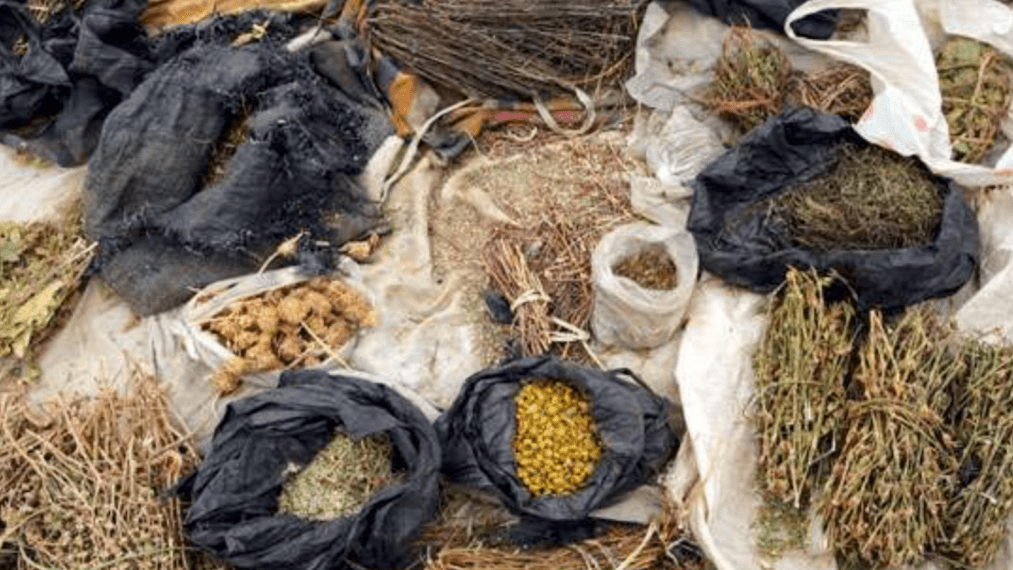
The rising cost of conventional medicines, cultural practices and limited access to healthcare are driving more Nigerians towards herbal and traditional medicines.
For some Nigerians, the use of herbal medicine is rooted in family traditions passed down through generations.
A civil servant at the Federal Secretariat, Abuja, Mr Jimoh Moses, said herbal medicine predated Western medicine in Nigeria.
“Herbal medicine is not new in Nigeria. Our forefathers used them even before the advent of Western medicine that we are taking today,” he said.
Jimoh, who said he uses herbal medicines obtained from his village in Ondo State, however, warned against equating roadside concoctions with genuine traditional medicine.
READ ALSO: How 24 Died After Taking Herbal Concoction In Ondo
“Those things you see women carrying on their heads and selling as herbal medicines are not necessarily herbal medicine. People need to know that,” he said.
Similarly, a retired civil servant in Jikwoyi, Abuja, Mr Babalola, said his family grows medicinal plants in its compound and uses them to prepare remedies for some ailments.
He said he also buys dried roots from a woman who brings them from her village and prepares the remedies himself.
A school teacher in Kurudu, Abuja, Mrs Binta Laah, said her experience with a traditional bone healer had strengthened her confidence in traditional treatment.
She said she took her son to a traditional bone healer, popularly known as Baba, after he suffered a fracture. According to her, the practitioner used herbs obtained from the bush to treat the injury.
“Since then, whenever I see anybody with a fracture, instead of referring the person to the hospital, I refer the person to Baba,” she said.
High cost of drugs
However, the increasing cost of conventional medicines is also pushing some Nigerians towards herbal alternatives.
A pharmacist in Abuja, Josiah Adanu, said the cost of drugs was a major factor influencing patients’ decisions.
“Some people come to the pharmacy to get drugs and when you tell them the cost, they will tell you they can’t afford it and leave,” he said.
According to Adanu, some of those patients subsequently patronise herbal medicine practitioners, while others prepare remedies themselves.
He said malaria treatment was one area where some people resorted to self-prepared herbal remedies or bought concoctions commonly known as agbo.
A petty trader in Jikwoyi, Mama Emeka, said affordability had influenced her decision to use herbal medicine.
“I am a widow and I have children to take care of. Sometimes, when you go to the hospital, the doctor will prescribe drugs, and when you get to the pharmacy, you discover that you cannot afford them. What will you do? You look for an alternative,” she said.
The director-general of the Nigeria Natural Medicine Development Agency (NNMDA), Prof Martins Emeje, confirmed the widespread use of traditional medicine by many Nigerians.
Emeje told LEADERSHIP Friday that a study conducted by the agency among civil servants at the Federal Secretariat, Abuja, found that 97 per cent of respondents used and preferred herbal medicine.
He disclosed that a qualitative study was conducted over three months, adding that the finding was consistent with World Health Organisation (WHO) data indicating that a large proportion of people in developing countries rely on traditional medicine.
According to him, previous WHO studies had estimated the use of traditional herbal medicines in developing countries, including African countries and Nigeria, about 80 per cent,
Emeje attributed the continued reliance on herbal medicine partly to limited access to healthcare services, particularly in rural communities.
“Look at the general hospitals in the local governments, how many doctors, pharmacists and drugs do you find there? The people will definitely resort to herbal medicine,” he said.
Documentation of herbal doctors
Emeje said the Nigeria Natural Medicine Development Agency (NNMDA) was working to document traditional medical practitioners, their locations and practices across the country.
He said the objective was to create a system through which traditional medical practitioners could be identified and registered, similar to the professional registration of doctors and pharmacists.
He also said the agency had developed at least 22 herbal products in the past three years, with government approval for what it described as “social production”.
Under the initiative, the products are made available to communities around NNMDA facilities at prices intended to cover production costs rather than generate profit.
The agency, he further said, had also established a herbal pharmacy, while discussions are ongoing with pharmaceutical and other industry players to move the products into mass production.
Emeje said Nigeria had a good opportunity to develop medicines from its abundant medicinal plants rather than depend heavily on imported pharmaceutical products.
“If you can make it, why are you importing?” he asked.
He, however, noted that the development of natural medicine would require scientific research, clinical trials, quality control, appropriate dosage standards, intellectual property protection and manufacturing capacity.
NAFDAC Seeks Clinical Evidence
Meanwhile, the National Agency for Food and Drug Administration and Control (NAFDAC) said it was collaborating with the NNMDA to facilitate clinical trials for selected herbal medicines.
NAFDAC director-general, Prof Mojisola Adeyeye, said the partnership was aimed at helping practitioners obtain full regulatory approval for products that demonstrate safety and efficacy through clinical trials.
She said the high cost of clinical trials remained a major obstacle for many herbal medicine practitioners.
According to her, NAFDAC grants two levels of approval for herbal medicines: a two-year “listing” approval following toxicology safety tests and a five-year full approval requiring clinical evidence of safety and efficacy.
Adeyeye said NAFDAC had listed thousands of herbal products, but only a few had undergone full clinical evaluation.
“Natural does not always mean safe. Some products can damage the liver or kidneys if not properly regulated,” she said.
She said the agency remained committed to supporting indigenous medicine while ensuring that products available to the public met safety and efficacy standards.
The coordinating minister of health and social welfare, Prof Ali Pate, had also called for evidence-based research and stronger support for local development of medicines and vaccines.
Pate noted that many pharmaceutical medicines had their origins in medicinal plants and said Nigeria would continue to work with international partners, including the WHO, West African Health Organisation and countries such as China and India, to develop traditional medicine for local use and commercialisation.
We’ve got the edge. Get real-time reports, breaking scoops, and exclusive angles delivered straight to your phone. Don’t settle for stale news. Join THISTIMES on WhatsApp for 24/7 updates →
Join Our WhatsApp Channel