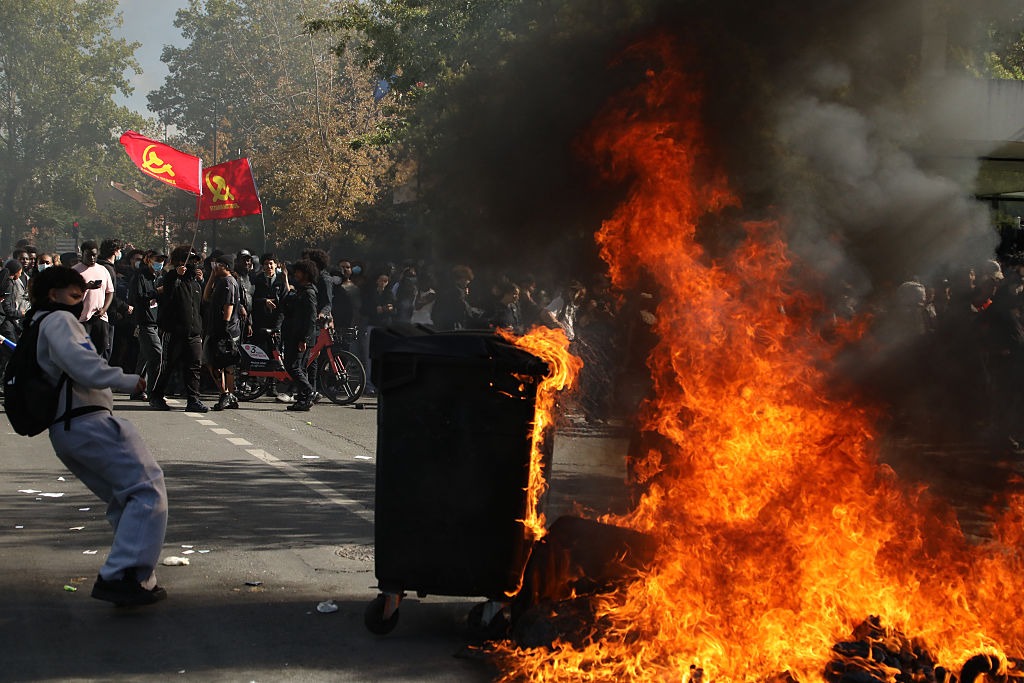
Tens of thousands of students and their supporters have taken to the streets across France to protest deteriorating school facilities, overcrowded classrooms and shortages of teachers and other essential staff.
The protests, which began in the Parisian suburbs last week, have spread to several cities, including Marseille, Strasbourg, Tours and Lille, with demonstrations and blockades reported at more than 1,200 high schools.
In Aubervilliers, north of Paris, 17-year-old Maisa joined other students outside Lycée Le Corbusier to demand improved learning conditions.
Maisa, who hopes to become an English teacher, said students in disadvantaged neighbourhoods were bearing the brunt of the education system’s problems.
“Last year I took the high school French exam without a French teacher, and teachers have a huge impact,” she said.
“These are not conditions to study in.”
Another student, 15-year-old Amelia, held a placard reading, “Our address should not decide our future.”
She said she joined the demonstration to demand equal treatment for students regardless of where they lived.
“The education authority is not investing enough in the suburbs. It’s classist and racist,” she said.
At Lycée Le Corbusier, several subjects, including mathematics, humanities, English and physical education, have reportedly been cancelled since the beginning of the academic year because of a shortage of teachers, according to Karima Kara Ali, an elected parents’ representative.
The situation is particularly acute in Seine-Saint-Denis, one of France’s poorer departments. The CGT education union said about two-thirds of high schools in the department participated in Thursday’s protests.
Students, parents and teachers in four towns also raised concerns over inadequate sanitation and shortages of nurses and social workers.
Louise Paternoster, a representative of the CGT education union in Seine-Saint-Denis, said the department was not receiving sufficient resources to meet the needs of its student population.
According to a union survey, two-thirds of schools in the department have vacant teaching positions.
“Our students are losing out on study time. Some schools don’t have drinking water. We are not equal to other departments,” Paternoster said.
She blamed the situation partly on government cuts that resulted in 3,256 teaching positions being eliminated nationwide in 2026.
In Pantin, northeast of Paris, teacher Dilan Roche joined her students during a protest outside their school, saying she wanted to support their demands and protect them amid police intervention.
“What they wrote on banners, we wrote in a letter to the local education authority: overcrowded classes, no nurses, no social workers – which is problematic for students with learning difficulties, many living in precarity,” she said.
The demonstrations have emerged as a political flashpoint for the French government, which announced unpopular spending reductions in its 2027 budget.
The education budget is scheduled to rise by 1.7 per cent to €65.53 billion, excluding teacher pensions. Education Minister Edouard Geffray said education remained a priority, arguing that the below-inflation increase was partly linked to a decline in the population.
The protests have also drawn a forceful response from police in some areas. Tear gas and rubber bullets were reportedly used during clashes, while more than 5,000 people were arrested. Some demonstrators suffered serious injuries, including eye injuries, broken teeth and blows to the head.
Interior Minister Laurent Nunez described the situation as an “unacceptable climate of violence” and called for a return to order.
Political scientist Ulysse Rabate of Paris 8 University said the protests reflected growing political influence among residents of marginalised urban communities.
“When there is a collapse of the public service, of public education, those who feel it the most, and the most violently, are those at bottom,” he said.
France ranks around the middle of OECD countries in education spending. Ministry data show that average spending per secondary school student was €11,660 in 2024, compared with €11,910 in 2010, indicating little change over the period.
The current mobilisation is being compared with a major nationwide high school protest movement in the 1990s, which also focused on inadequate funding.
According to Clemence Cardon-Quint, a professor at Paul Valery University who researches education funding, the earlier movement followed a rapid expansion in access to the baccalauréat, France’s school-leaving examination, without a corresponding increase in resources.
The protests eventually secured additional funding, but spending per student later stagnated even as schools took on new responsibilities.
Cardon-Quint said teachers and students now face additional demands, including navigating Parcoursup, the university admissions system introduced in 2018 and criticised by some for being opaque and discriminatory.
“In a period of budgetary restraint, it is more difficult to reduce inequalities,” she said.
We’ve got the edge. Get real-time reports, breaking scoops, and exclusive angles delivered straight to your phone. Don’t settle for stale news. Join THISTIMES on WhatsApp for 24/7 updates →
Join Our WhatsApp Channel