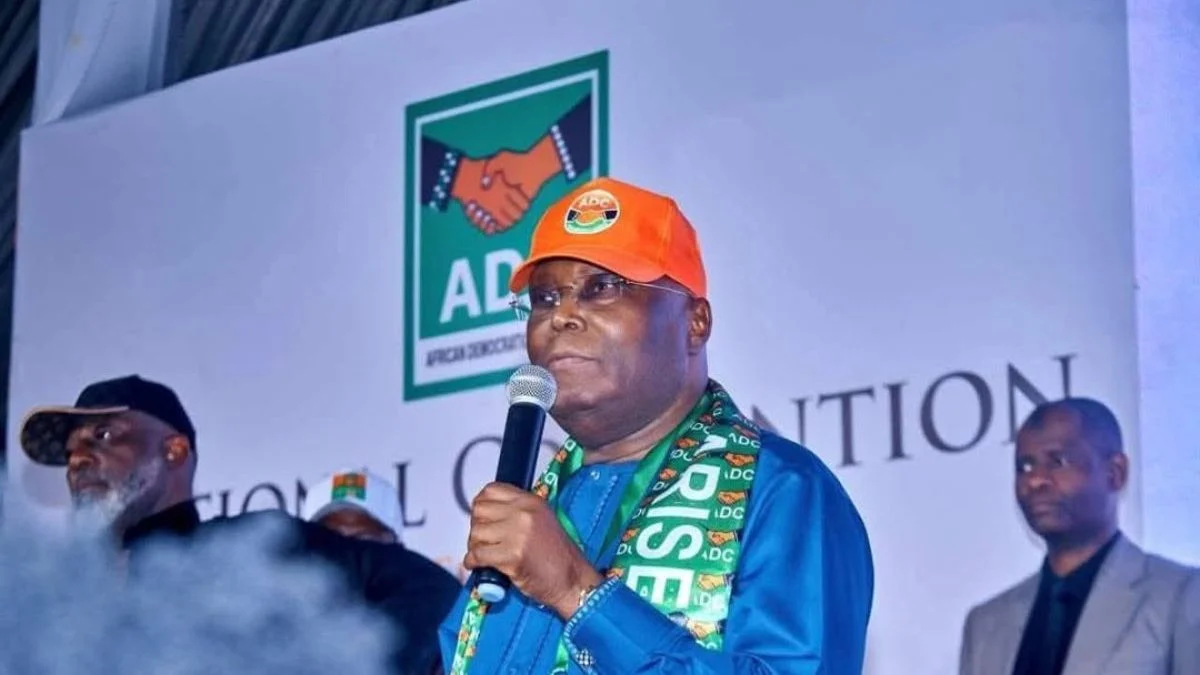
Paul Ibe, media aide to Atiku Abubakar, the presidential candidate of the African Democratic Congress (ADC), has questioned the reported N12.26 trillion allocation to private firms for pipeline security.
Ibe raised the concerns in a statement issued on Monday vis his social media handles.
This was just as he warned that the growing financial power of private security operators could pose risks to Nigeria’s national security without adequate oversight.
He questioned the expenditure amid the country’s persistent security challenges, including terrorism, banditry and kidnapping.
“At a time when Nigeria is battling terrorism, banditry, kidnapping and widespread insecurity, disturbing questions are emerging about the growing involvement of private security outfits and groups associated with former militants in protecting critical national assets,” he said.
Ibe noted that Nigeria allocated approximately N6.85 trillion to defence and security in 2025, while the 2026 budget proposed N5.41 trillion for the sector.
He demanded details of the pipeline surveillance contracts, including the amounts paid to operators, the identities of the beneficiaries and the mechanisms for supervising their activities.
“How much is actually being paid? Who are the beneficiaries? What are the contractual safeguards? Who supervises their operations, and to whom are they accountable?” he asked.
The former vice-president’s aide also drew attention to claims that expenditure on pipeline surveillance exceeds the combined budgets of the country’s military and security agencies.
He called on the Federal Government to publish the contracts and payment records to enable Nigerians to establish the actual cost of the arrangements.
Beyond the financial implications, Ibe warned that private security organisations could accumulate significant resources and influence without sufficient democratic oversight.
“Are we inadvertently creating powerful security organisations outside the conventional military command structure?” he asked.
He also questioned whether such organisations could be deployed for political purposes as the 2027 general elections approach.
“Could such organisations eventually be deployed for political purposes, particularly as the 2027 elections approach? And what institutional guarantees exist to prevent that possibility?” he said.
Ibe cited Somalia’s descent into state collapse in 1991, when the fragmentation of state authority and the rise of competing clan militias contributed to prolonged instability.
“Nigeria is not Somalia. But the lesson is unmistakable: when armed groups become powerful enough to challenge the authority of legitimate state institutions, national stability can be endangered,” he said.
He acknowledged the importance of protecting oil pipelines and combating crude oil theft but cautioned against allowing private security arrangements to undermine the country’s constitutional security architecture.
“Pipeline protection is necessary. So is the fight against crude oil theft. But these legitimate objectives must never become excuses for weakening the constitutional security architecture or empowering unaccountable armed organisations,” Ibe added.
Meanwhile, Peter Obi, the presidential candidate of the Nigeria Democratic Congress (NDC), has criticised the administration of President Bola Tinubu over what he described as a failure to translate economic gains into improved living conditions for Nigerians.
Obi made the remarks in a statement posted on his social media handles on Monday while reacting to a World Bank report on government revenue and spending priorities.
He argued that improvements in economic growth and revenue generation should not be presented as proof that Nigerians were experiencing better living standards.
“Nigerians and even the World Bank know that the criteria for economic development is whether poverty is declining, whether jobs are created for our youths, and whether we are reducing acute inequality. In the case of Nigeria under President Tinubu, the answer is no,” Obi said.
He maintained that economic stability should be measured by citizens’ ability to afford food, access healthcare and educate their children.
“An economy is not truly stabilized simply because government revenue increases, foreign reserves strengthen, or GDP grows. Stability exists when citizens can afford food, obtain healthcare, provide education for their children, and live with dignity,” he said.
Citing the World Bank report titled Beyond the Federal Purse: How Higher Revenues Reshaped State Priorities, Obi said the Federal Government spent N7.7 trillion on debt interest payments between January and June 2026, compared with total revenue of N6.2 trillion during the same period.
He said the interest payments exceeded the government’s revenue by approximately N1.5 trillion, raising concerns about the sustainability of the country’s debt.
“How do you explain the unsustainable debt crisis even with exponential increase in revenue that we have had since 2023?” he asked.
Obi further claimed that capital expenditure declined by about N700 billion in the first half of 2026, despite increases in revenue and borrowing.
He alleged that the Federal Government spent about 11 times more on debt interest payments than on capital projects, attributing the situation to what he described as reckless borrowing, corruption and incompetence.
Obi also criticised the administration’s presentation of economic statistics, arguing that the impact of government policies on citizens’ welfare should remain the primary measure of economic progress.
“A government cannot expect citizens to applaud statistics while they struggle to survive the effects of its policies,” he said.
He cited a figure of about 140 million Nigerians living in multidimensional poverty and referred to a United Nations Development Programme report that he said indicated a reversal of poverty-reduction gains.
Obi urged the Federal Government to focus on improving citizens’ welfare rather than relying on economic indicators that, in his view, did not reflect the hardship experienced by ordinary Nigerians.