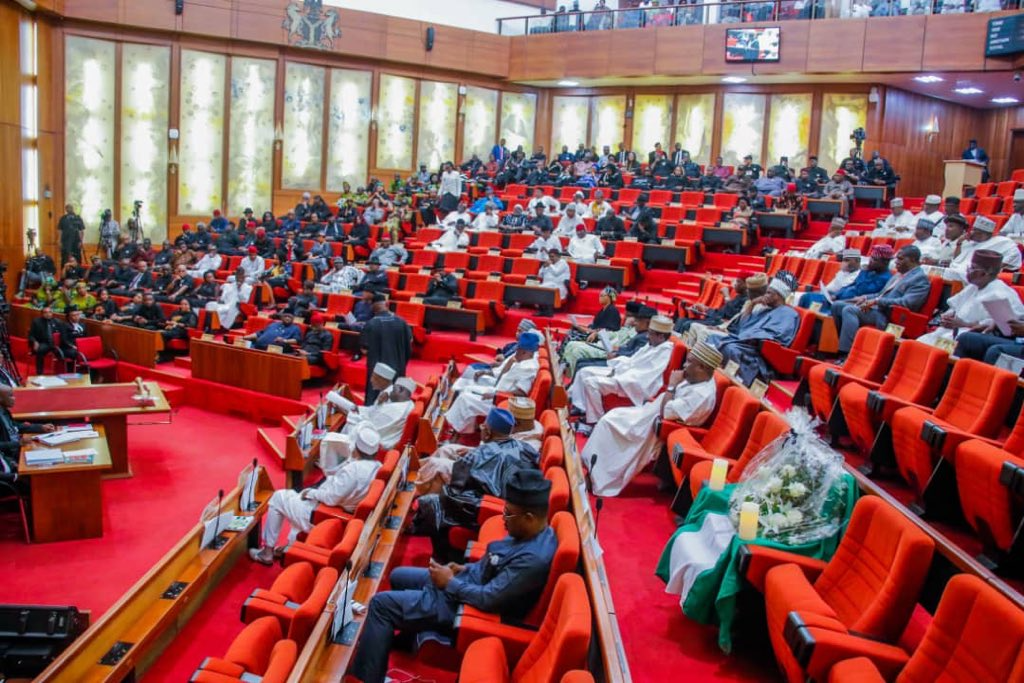
The Senate has appealed to the executive arm of government to provide urgent relief to communities devastated by flooding and erosion in Anambra, Imo and Ebonyi States.
The Upper House also demanded immediate intervention to protect lives, restore damaged infrastructure and prevent further environmental destruction.
The Senate further called for emergency repairs and comprehensive reconstruction of the Onitsha–Iyiowa–Odekpe–Atani–Ogwuikpele–Ndoni Federal Highway in Anambra State, warning that its deteriorating condition threatens road users and economic activities linking the South-East and South-South regions.
The resolutions followed motions and contributions by Senators Tony Nwoye (Anambra North), Victor Umeh (Anambra Central), Anthony Ani (Ebonyi South) and Osita Izunaso (Imo West), who highlighted the effects of flooding and erosion on communities, roads, farmland and livelihoods in their respective constituencies.
The Senate asked the National Emergency Management Agency (NEMA) to provide food, medical supplies and other relief materials to residents displaced or affected by the disasters.
It also directed relevant federal ministries and Senate committees to assess the damage and recommend immediate and long-term measures to address the ecological challenges.
In a related development, the Senate urged the Federal Government to undertake emergency repairs and comprehensive reconstruction of the Onitsha–Iyiowa–Odekpe–Atani–Ogwuikpele–Ndoni Federal Highway, describing it as a strategic transport corridor connecting the South-East and South-South geopolitical zones.
The motion, sponsored by Senator Tony Nwoye under Orders 41 and 51 of the Senate Standing Orders, drew attention to the road’s deteriorating condition and its importance to transportation, commerce and oil and gas operations in the Ogbaru area.
The Senate noted that sections of the highway were constructed in the late 1980s but had suffered decades of neglect without major rehabilitation.
According to the motion, prolonged abandonment, ageing infrastructure, increasing traffic volume and inadequate routine maintenance had left the road in a deplorable state, characterised by deep potholes, extensive pavement failures and severe erosion.
Nwoye warned that the condition of the highway posed serious risks to commuters and other road users and disrupted commercial activities along the route.
He said a journey of approximately 70 kilometres from Onitsha through Ogbaru to Ndoni, which ordinarily takes about one hour, now takes nearly two hours due to deteriorating road conditions.
The lawmaker said the increased travel time had raised transportation costs, wasted productive hours and hindered the movement of goods and services.
He added that vehicles frequently break down on damaged sections of the highway, leaving motorists and passengers stranded for extended periods and exposing them to road accidents and security risks.
The motion also described the highway as a vital economic corridor supporting oil and gas exploration and production activities in the Ogbaru oil belt.
Nwoye expressed concern that the continued neglect of the road had adversely affected interstate commerce, agricultural value chains, regional integration and investment.
He warned that further deterioration would endanger lives and property, disrupt economic activities, increase transportation costs and potentially affect oil exploration and production along the corridor.
To address the situation, the Senate urged the Federal Roads Maintenance Agency (FERMA), the South-East Development Commission or the Federal Ministry of Works to undertake immediate palliative repairs on failed and unmotorable sections of the highway pending comprehensive rehabilitation and reconstruction.
It also called on the Federal Ministry of Works to commence the road’s reconstruction through a special intervention programme or any other appropriate funding arrangement.
The Senate mandated its Committee on Works to conduct an on-the-spot assessment of the highway, engage relevant stakeholders and submit a report with recommendations within four weeks.
It further directed the Senate Committees on Works and Appropriations to ensure adequate budgetary provisions for the comprehensive rehabilitation and reconstruction of the road.
Contributing to discussions on the ecological challenges, Senator Victor Umeh warned that expanding erosion gullies were threatening communities and major transport routes in Anambra State.
He specifically highlighted the danger to sections of the Onitsha–Owerri Expressway, cautioning that continued erosion could disrupt interstate commerce and undermine the livelihoods of residents who depend on the road.
Umeh called for urgent intervention to prevent further damage to critical infrastructure and protect communities threatened by advancing erosion.
His contribution reinforced calls for coordinated government action to address ecological problems affecting several communities across the South-East.
Senator Anthony Ani, representing Ebonyi South, highlighted the devastating economic consequences of flooding in his constituency, where overflowing waters had reportedly submerged farmland, destroyed livestock and damaged household property.
He said the losses had compounded the economic difficulties facing residents, particularly farmers whose livelihoods depend on agricultural production.
Ani called on the Federal Ministry of Agriculture and Food Security to urgently assess the extent of crop damage and provide relief to affected farmers.
He stressed the importance of timely assistance to help farming communities recover their losses and resume agricultural activities.
The senator’s intervention drew attention to the wider implications of flooding for food production, household incomes and rural livelihoods.
Senator Osita Izunaso, representing Imo West, also raised concerns about persistent flooding and severe gully erosion threatening communities and road networks in his constituency.
Izunaso recalled that he had brought the ecological challenges before the Senate in 2023, stressing the need for sustained intervention to prevent further destruction.
He warned that without coordinated drainage works, road rehabilitation and effective erosion-control measures, motorists, pedestrians and residents would remain exposed to danger.
His contribution highlighted the need for lasting solutions to recurring environmental problems that threaten homes, roads and other critical infrastructure.
Following deliberations, the Senate called on NEMA to immediately provide food, medical supplies and other relief materials to residents displaced or affected by flooding and erosion.
It also directed the Federal Ministries of Works and Environment to conduct rapid assessments of affected areas, restore blocked access routes and implement long-term ecological control measures.
The Senate further mandated its Committees on Environment, Works, Ecology and Climate Change to conduct joint field inspections of the affected communities and submit a comprehensive report within 30 days.
The inspections are expected to establish the extent of the damage, identify urgent intervention needs, and inform recommendations to address the environmental challenges.
At the end of the proceedings, lawmakers observed a minute of silence in honour of those who lost their lives to the natural disasters.
The Senate’s resolutions underscore the need for immediate humanitarian assistance, urgent rehabilitation of damaged infrastructure and sustained investment in ecological control measures to protect vulnerable communities across the affected states.
We’ve got the edge. Get real-time reports, breaking scoops, and exclusive angles delivered straight to your phone. Don’t settle for stale news. Join THISTIMES on WhatsApp for 24/7 updates →
Join Our WhatsApp Channel