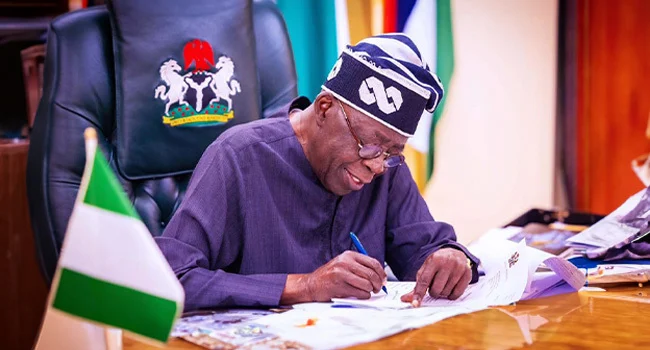
President Bola Tinubu has approved the acquisition of additional train coaches and security equipment as the Federal Government moves to improve railway transportation and address threats posed by banditry, kidnapping and vandalism across the country.
The approval covers the procurement of more railway coaches to increase passenger and freight capacity, alongside surveillance systems designed to protect railway infrastructure and improve safety along train routes.
Permanent Secretary of the Federal Ministry of Transportation, Funso Adebiyi, disclosed the development on Saturday during an inspection of the ongoing Kano–Maradi railway project.
He said the ministry was also working to strengthen the capacity of Nigerian railway workers to operate and maintain the new coaches when they are delivered.
Adebiyi spoke during an inspection tour accompanied by the Senior Special Assistant to the President on Transportation and Mobility, Prince Adetokunbo Ademola Ade-John, and other ministry officials.
The team also witnessed the casting of a bridge beam along the railway corridor.
The permanent secretary said insecurity remained a major concern for the ministry, particularly because attacks on railway infrastructure could disrupt services, endanger passengers and increase the cost of maintaining the rail network.
He cited the Abuja–Kaduna railway corridor as an example of the security challenges facing railway operations.
However, his reference to a head-on collision involving two trains and the circumstances surrounding the incident could not be independently established from the information provided.
Speaking on the planned security improvements, Adebiyi said, “Security challenge has remained a major source of concern to us in the ministry. You will recall that in Kaduna, the train activities between Kaduna and Abuja, two trains, had a head-on collision. It was due to vandalism and banditry.
“I’m glad to inform you that Mr President has given the go-ahead for us to embark on the acquisition of surveillance security equipment all across the country, and we are working around the clock to ensure this. I can assure you, by the time we are through, there will be no reason for vandalism. The Nigerian Railway Corporation has also recruited a surveillance team that patrols its routes regularly. So, I can assure you that security is seriously being considered”.
The proposed surveillance equipment is expected to support efforts to monitor railway corridors and identify threats to tracks and other critical facilities.
Railway infrastructure can be vulnerable to the theft of metal components, damage to signalling equipment and other forms of interference that may disrupt train movements.
The government has also indicated that it intends to introduce a tracking system as part of its wider response to banditry and kidnapping along railway routes.
The Senior Special Assistant to the President on Transportation and Mobility, Ade-John, also confirmed that the government was considering additional technology to improve security along the railway network.
He said a tracking system had received approval in principle, while the necessary documentation was being processed.
He stated, “We are putting up a tracking system to prevent any banditry or kidnapping. The tracking system is already approved in principle. Depending on the time, all the paperwork and documentation are being done.”
The proposed system is expected to complement existing security arrangements by helping authorities monitor railway movements and respond to suspicious activities.
However, the government has yet to disclose the installation timeline, the number of systems to be deployed or the specific railway corridors that will receive priority attention.
Adebiyi also addressed the need to prepare Nigerian workers for the arrival of the new coaches.
He said the government wanted local railway personnel to acquire the technical knowledge required to operate, service and repair the equipment without depending heavily on foreign specialists.
He explained that Nigerian workers would participate in the assembly of the coaches, giving them practical experience that could prove useful throughout the equipment’s service life.
“Mr. President has approved the contract for the acquisition of more coaches, and we are going the extra mile also to get Nigerian railway staff trained in the operation and maintenance of those new coaches. They will be deeply involved in assembling the coaches to ease maintenance thereafter. I can assure you people will be smiling very soon,” he said.
As part of the plan, the permanent secretary said he had directed the Nigerian Railway Corporation to identify young engineers who would undergo additional training in railway operations and maintenance.
The initiative is intended to develop a pool of skilled local personnel capable of handling routine servicing, technical inspections and repairs after the coaches enter service.
It could also help reduce delays associated with sourcing foreign expertise and spare parts, although the ministry has not provided details of the training programme or the number of engineers to be selected.
Ade-John, meanwhile, said efforts were being made to accelerate construction work on the Kano–Maradi railway project.
According to him, the number of workers on the project had increased, while working hours had been extended to meet the government’s completion target.
.