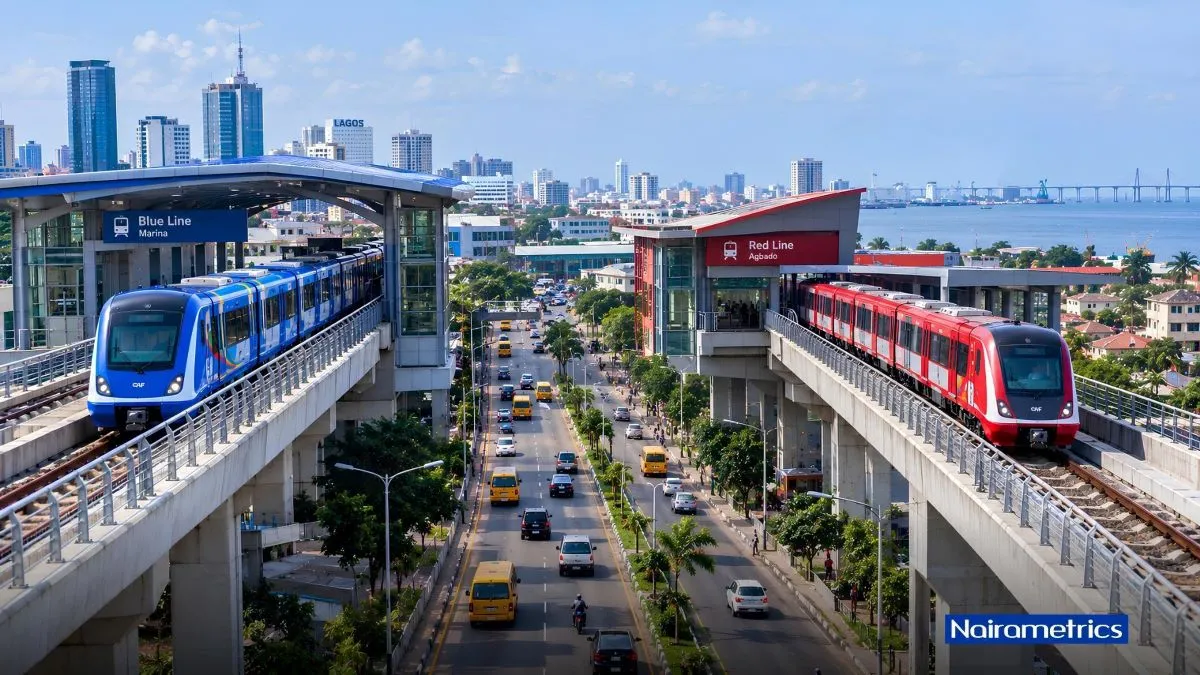
Lagos State’s public transport network is undergoing significant changes, with the ongoing expansion of the Blue Line, developments on the Red Line and plans for a proposed monorail linking Murtala Muhammed International Airport to the rail network.
As these projects progress, questions remain about the capacity of existing services, the effectiveness of planned expansions and how best to improve connectivity for commuters and air travellers.
In an exclusive interview with Nairametrics, independent transport researcher Tonami Playman examined the state’s transportation plans, assessing the performance of its rail services, the implications of planned expansions and the proposed airport connection.
He also discussed the operational changes needed to improve the impact of rail transport on mobility across Lagos.
The scale of passenger activity across the network provides useful context for the discussion. Afolabi Olamide, co-founder and chief executive officer of Touch and Pay Technologies (TAP), which operates the Cowry fare payment platform, said regulated buses record more than 5 million monthly passenger trips, compared with approximately 500,000 on the Blue Line and 100,000 on the Red Line.
Tonami Playman: The Lagos Blue Line is still too short to have a noticeable impact. Its current low-frequency operation of four trains per hour makes that worse. The Red Line is even more poorly implemented, with its service frequency measured in trains per day instead of trains per hour.
For rail transit to have an impact, service frequency needs to be radically improved to global levels. That means a minimum of 10–12 trains per hour, not four trains per hour or five trains daily.
The rail network also needs to be expanded to provide greater coverage and properly integrated with reorganised bus routes that complement rail services.
Tonami Playman: The extension of the Lagos Blue Line from its current western terminus at Mile 2 to Trade Fair is a welcome development. However, every line extension requires more trains to maintain service frequency.
Going by the current schedule, the Blue Line needs five trains to maintain its current frequency of four trains per hour on the existing section. An extension to Trade Fair would require two more trains. A fleet of five trains could maintain the four-trains-per-hour frequency by reducing turnaround time from 17 minutes to five minutes.
Even with the extension, the Blue Line needs to operate at a much higher frequency to maximise the utilisation of the expensive infrastructure. The minimum is 10 trains per hour, but 12 would be more useful. This would require a fleet of 11 trains for Phase 1 and 23 trains for the Phase 2 extension to Okokomaiko.
Tonami Playman: FAAN’s proposal for an airport monorail linking the international and domestic terminals of Murtala Muhammed Airport to the Red Line at Ikeja Station seems like a good idea at first glance, but it has fundamental flaws that plague dedicated airport rail links.
First, dedicated airport rail links often underperform in ridership because airports are not major destinations for most urban travellers, potentially resulting in underused infrastructure.
Second, airport connections are best implemented as an integral part of the urban rail network rather than as specialised, dedicated services. Any airport link should be designed as a regular stop on a region-wide metro line.
Third, the current implementation of the Red Line, with a frequency of five trains a day, is an abysmal service that does not warrant a dedicated monorail link.
MMIA’s annual passenger traffic of seven million is too small to justify spending funds on a dedicated rail link, especially when dedicated airport rail links serving airports with 50–70 million annual passengers underperform.
Prague ranks as one of the best medium-sized global transit cities on a per-capita basis, with a population of 2.2 million and a 52% transit mode share. Its 65-kilometre, three-line metro network sees 1.5 million daily riders. The 144-kilometre tram network sees one million daily riders, while its fleet of 1,200 buses and 37 trolleybuses carries 780,000 daily riders.
Yet Prague has no rail link to Václav Havel Airport. Instead, the airport, which handles 18 million passengers annually compared with seven million for Lagos, is served by five bus and trolleybus lines connecting it to different parts of the city’s metro network.
Tonami Playman: Service frequency on the Red Line is important, but even at an optimal frequency of 12 trains per hour, or 192 trains daily compared with the current five trains daily, it still would not justify a dedicated airport rail link.
Airport travellers make up a tiny fraction of any metropolitan area’s commuter traffic. Building a dedicated rail link that would inevitably attract low ridership is like using public funds to buy Rolls-Royces for the tiny elite that flies, at the expense of the wider Lagos population.
An airport rail connection should not be a priority. The projected ridership could be better served by reliable bus connections to multiple locations.
Tonami Playman: The most valuable metric for measuring transit improvements is ridership. Transit investments need to meet or exceed ridership expectations to be considered successful.
Accurate ridership measurements should be carried out at every stage, from planning to rollout and post-implementation.