I have listened closely to the endless debates regarding the North’s role in determining electoral outcomes at the presidential elections. The perspectives are divergent, but none can be dismissed. The North delivers decisive bloc votes, and that is the reality. But in the north, there are three classes of influencers: those who have political value, those who have street value, and those who have religious value.
Historically, several examples explain the trend. This was why the late former President Muhammadu Buhari always secured a steady number of bloc votes from the region throughout his election contests. I have made a strong assertion in this statement. There might be other contributing factors, but religion can’t be ruled out.
However, a lot seems to have changed following Buhari’s passing in July 2025. Who among the current contestants will be favoured by the influencers in the North? Who among them shares an affinity with Buhari, or who among them honoured Buhari the most during his lifetime? This could be a decisive factor in the contest. Why do I say so? There was a scramble by some politicians to position themselves as a Buhari successor, but to no avail. Buhari was in a class of his own.
He was the Mai Gaskiya of Northern Nigeria. When he joined politics, he took control of the votes unintentionally. There is no record of any northern politician that commanded the type of political success that Buhari achieved. He did not play traditional politics, nor did he cut deals; he simply stated his desire to be president.
Yet, he could not achieve it alone, even with a secured northern bloc vote. He wept openly in 2011, days before the presidential election, stating it would be his third and final attempt if he did not win. He meant it, but he lost again. However, he changed his mind when Tinubu made an irresistible merger offer in 2015, and the rest is history.
The Long History
President Bola Ahmed Tinubu shares a long history with Northern Nigeria. He made inroads into the region long before he contested the presidency. It is on record that his alliance with Buhari in 2015 was responsible for the party’s victory. In a 2016 tribute to Tinubu at the 8th Bola Tinubu Colloquium, Buhari noted: “If Bola Ahmed Tinubu did not participate, there wouldn’t have been a merger and there wouldn’t have been an APC government at the centre. That is absolutely clear.”
There was also something else Tinubu did for Buhari: he rebranded him from a rigid former military ruler into an elder statesman and democratic reformer. Buhari delivered an address at Chatham House in London on February 26, 2015, during his presidential campaign—his first ever. He said, “I cannot change the past. But I can change the present and the future. So, before you is a former military ruler and a converted democrat who is ready to operate under democratic norms and is subjecting himself to the rigours of democratic elections for the fourth time.” The key takeaway of that speech was the phrase “converted democrat.” I knew who wrote that speech, and I knew whose idea it was.
The 2015 presidential contest was the first time Buhari released campaign posters featuring himself in a Western suit. This was the height of strategic political branding to amplify the “converted democrat” strategy, and it worked. Aisha Buhari also appeared in trousers in public, and Zahra Buhari released a photo of herself in classy attire that sent the internet abuzz. The media was entirely at Buhari’s disposal. His campaign messaging did not sound like the traditional Buhari of 2003, 2007, and 2011. Someone was responsible for all of this, and I know exactly who that person was.
Beyond Buhari
Beyond his relationship with Buhari, Tinubu has made institutional interventions that the North must recognize. I will share one personal example. This example seems simple and can easily be disregarded, but it is worth a deeper thought.
During the years I undertook my PhD studies at the Nigerian Defence Academy in Kaduna, I registered at the library of Arewa House. Arewa House is the Centre for Historical Documentation and Research of Ahmadu Bello University, which preserves the political, cultural, and intellectual history of Northern Nigeria. The facility originally served as the office and official residence of Sir Ahmadu Bello during his tenure as Premier of the Northern Region between 1954 and 1966.
Arewa House has a remarkably rich library. I was a frequent visitor. However, something struck me during one of my visits in 2023. I needed to consult a book for a research project, and as usual, I strolled into Arewa House and made my way toward the library complex. I immediately noticed a physical facelift of the building. As I approached the entrance, I saw a plaque on the wall that read: “The Arewa House Library Complex is upgraded and commissioned by His Excellency, (SEN) Asiwaju Bola Ahmed Tinubu, former governor of Lagos State on the 13th July 2021.”
I was curious, and my curiosity was satisfied when I entered the complex and saw the level of transformation that had taken place. I wondered why Tinubu, a Southern politician, was interested in the library of Arewa House. The Arewa House library is not a place where politicians converge; it is a historical research centre. I found the gesture curious then, but no longer, given the benefit of hindsight. There may be several other interventions of this nature by Tinubu across the North, but that is left for his media handlers to identify.
A Debt to Repay?
Do I think the North has a debt to repay Tinubu? In taking a position, let me classify debt into two categories: political debt and moral debt. For political debt, I would say yes; for moral debt, I would say no. Politics and morality are rarely friends. Whatever Tinubu did in the North before he became president, and what he continues to do as president, creates political debts that should ordinarily be repaid.
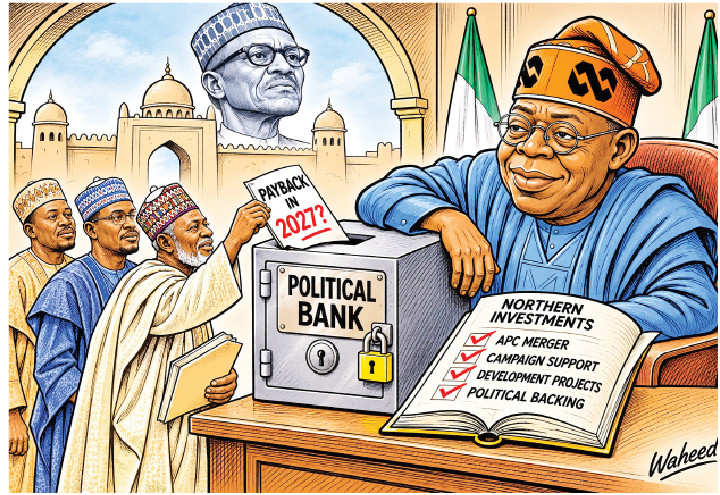
Sometime in April 2026, I wrote an article titled “If you owe him, please pay up” on TheCable. In that piece, I argued that politics is not a love story. In Tinubu’s political bank, when you take a political loan, you are bound to repay. He does not care about your name, religion, ethnicity, or political affiliations, and he is reputed to manage the largest political bank in the country. It can be argued that, upon close analysis, there are very few Northern politicians who have not banked with him. I stand to be corrected.
The 2027 presidential contest might be payback time for Tinubu in the North. I hear several Northern governors and political stakeholders in the region talking about it. Perhaps they too took loans from Tinubu’s political bank. The interesting part is that history has shown that Tinubu’s political loans are always repaid somehow.
This is why the outcome of the 2027 elections in the North will be incredibly fascinating to watch. I can predict the outcome, but I will wait for the official pronouncement by INEC. Even so, I doubt I will be surprised at the end of the day.
Ocheja holds dual PhDs: in Military History from the Nigerian Defence Academy, and in Leadership and Public Policy from the University of Abuja. He specialises in the security-development nexus in Nigeria and the Sahel
We’ve got the edge. Get real-time reports, breaking scoops, and exclusive angles delivered straight to your phone. Don’t settle for stale news. Join THISTIMES on WhatsApp for 24/7 updates →
Join Our WhatsApp Channel