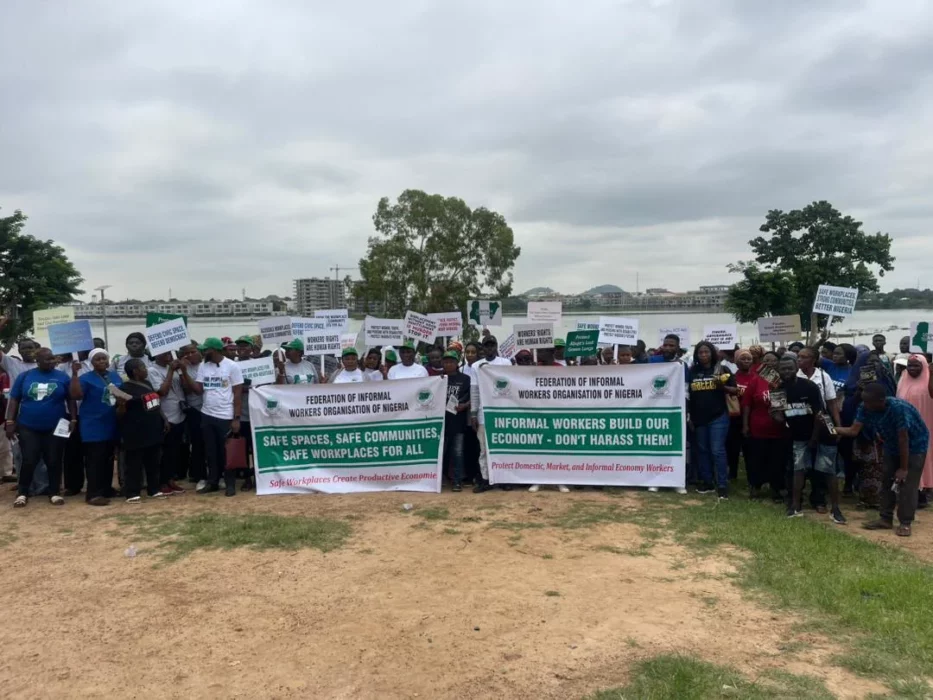
A coalition of civil society organisations, human rights groups, the Federation of Informal Workers’ Organisation of Nigeria and other advocacy groups, on Tuesday, staged a peaceful demonstration at Jabi Lake Recreational Park in Abuja, urging the Federal Capital Territory Administration (FCTA) to safeguard the livelihoods of informal workers affected by the facility’s ongoing redevelopment.
The protesters stressed that they were not opposed to the redevelopment project but called on the government to ensure transparency, engage relevant stakeholders and provide adequate compensation and social protection for traders and other informal workers whose sources of income have been threatened by the exercise.
The protest followed the signing of a Memorandum of Understanding (MoU) in February 2026 between the FCTA, under the leadership of the Minister of the Federal Capital Territory, Nyesom Wike, and Akida Hills Ltd. as well as Suburban Broadband Limited, for the redevelopment of Jabi Lake Park as part of the administration’s urban renewal agenda.
According to the FCTA, the project was designed to transform the park into a world-class leisure and tourism destination capable of attracting investment, stimulating tourism and generating employment opportunities.
However, the redevelopment has drawn criticism from civil society groups, environmental advocates and informal workers, who have questioned the transparency of the concession arrangement, the lack of public engagement and the implications for hundreds of traders and small-scale business owners who depend on the park for their livelihoods.
While the FCTA has maintained that the project was intended to upgrade the facility and maximise its economic value, the demonstrators insisted that their concerns centred on accountability and inclusion. They called for the publication of the Memorandum of Understanding, disclosure of the procurement process, protection of public access to the park and the provision of compensation and social safety measures for affected informal workers.
Addressing protesters, the Country Director of Accountability Lab Nigeria, Friday Odey, said the coalition’s action was driven by concerns over the welfare of those whose livelihoods were tied to the park.
“We are not against the development of this park. We are saying there should be a social protection plan for the informal workers. They have a right to be consulted because this park has been their source of livelihood for many years,” he said.
Odey said the coalition was also demanding the publication of the Memorandum of Understanding signed between the FCTA and the developers.
“Everybody has a right to know. Nigerians have the right to know. Publish the Memorandum of Understanding so citizens can understand what has been agreed and engage in an informed conversation,” he said.
He further raised concerns about the process through which the redevelopment contract was awarded.
“We did not see evidence of a transparent procurement process before the park was handed over. That is why we have asked the relevant anti-corruption agencies to investigate the process,” he added.
According to him, the coalition had submitted several Freedom of Information requests to the FCTA seeking details of the agreement but had yet to receive a response.
“As law-abiding citizens, we have followed the legal process by filing Freedom of Information requests. We expect the government to respond because citizens have a legal right to access public information,” he added.Seek
Also speaking, Blessing Yusuf of the Federation of Informal Workers’ Organisation of Nigeria called for an immediate halt to demolition, fencing and construction activities pending consultations with affected stakeholders.
“Our demand is the immediate suspension of all demolition, fencing and construction works until there is full public consultation, legal review and transparency around the project,” she said.
Yusuf also demanded the release of the MoU signed with the developers, the conduct of an independent Environmental Impact Assessment (EIA) before further work proceeds, guarantees that the park will remain affordable and accessible to the public, and compensation for traders and small business owners displaced by the ongoing activities.
“Any development must preserve affordable public access to the park. It should also provide compensation and support for traders and small business owners whose livelihoods have been disrupted,” she said.
She described Jabi Lake Recreational Park, which was inaugurated in 2007 as part of the Abuja Master Plan, as one of the few public leisure facilities in the Federal Capital Territory.
According to her, the park has, for almost two decades, served as a major recreational hub for residents and visitors while providing a source of income for hundreds of informal workers, traders, fitness enthusiasts and tourism-related businesses.
We’ve got the edge. Get real-time reports, breaking scoops, and exclusive angles delivered straight to your phone. Don’t settle for stale news. Join THISTIMES on WhatsApp for 24/7 updates →
Join Our WhatsApp Channel