By Ngozi Ibe, Abuja
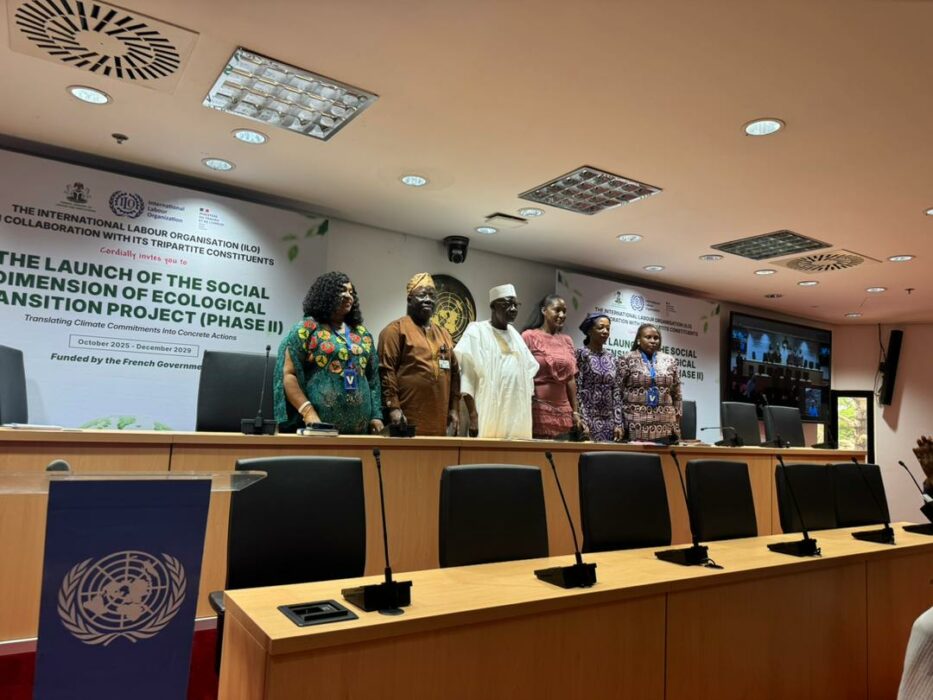
The International Labour Organisation (ILO), in partnership with the Federal Government of Nigeria and the Government of France, has launched the second phase of the Social Dimension of Ecological Transition Project aimed at translating Nigeria’s climate commitments into concrete actions that promote decent work, social justice and sustainable development.
The launch, held on Thursday at the United Nations (UN) House in Abuja, brought together government officials, labour unions, employers’ organisations, climate experts and development partners to chart a pathway for implementing a people-centred transition to a low-carbon economy.
Speaking at the event, Dr Vanessa Phala, ILO Country Director for Nigeria, Ghana, Liberia, and Sierra Leone, said the second phase would build on the gains recorded since the project’s inception in 2020.
She explained that the first phase focused on capacity building and engagement with government institutions and social partners on the principles of a just transition, leading to the integration of just transition into Nigeria’s updated Nationally Determined Contributions (NDC 3.0).
“For us at the ILO and for Nigeria, this was a major milestone because it was the first time a just transition had been integrated into the NDC. Nigeria also demonstrated strong leadership in this regard, being one of the few countries to do so,” she said.
Phala added that the first phase also produced Nigeria’s Just Transition Guideline and Action Plan, noting that Phase II would focus on implementing the framework and supporting the country’s shift from conventional energy sources to cleaner and more sustainable alternatives.
She said the interventions would align with national priorities, including the Energy Transition Plan, Energy Efficiency Plan, Economic Sustainability Plan and the country’s climate commitments under the NDC.
Dr Kamil Shoretire, Permanent Secretary of the Federal Ministry of Labour and Employment, stated that the report on Phase I highlighted major achievements and key lessons, underscoring the importance of data generation and evidence-based planning in ensuring an equitable transition.
“As we move into Phase II, we hope that the objectives we have set for ourselves, providing greener jobs and transitioning from conventional to sustainable energy, will be pursued with greater synergy, stronger cooperation, increased support and additional funding,” he said.
Delivering the keynote address and formally launching the project, Director-General of the National Council on Climate Change (NCCC), Mrs Tenioye Majekodunmi, commended the ILO for its commitment to advancing climate action and stressed that the real test of the second phase would be implementation.
She urged stakeholders to move beyond commitments by translating policies into programmes and investments that deliver tangible benefits for citizens.
Also speaking, she said climate action could no longer be separated from human dignity, social justice and economic survival.
She said Nigeria remained committed to implementing bold climate policies and integrating renewable energy targets into national development plans.
According to her, advancing clean energy solutions and clean cooking technologies remains central to the country’s climate strategy because of their potential to reduce emissions, improve health outcomes and expand energy access.
Minister of Labour and Employment, Dr Muhammad Maigari Dingyadi, described the initiative as timely, noting that Nigeria’s climate response must simultaneously advance decent work, social justice, sustainable enterprise development and inclusive growth.
He said climate change and environmental degradation were already affecting livelihoods, food systems, energy access and productivity, making environmental sustainability central to development planning.
The minister noted that Phase I had strengthened national capacity through evidence generation, social dialogue and inclusive policy engagement, culminating in the validation of Nigeria’s Just Transition Guidelines and Action Plan.
“Phase II can strengthen the labour and employment dimensions of NDC implementation by identifying green jobs, skills needs, enterprise opportunities, social protection measures and workplace adjustments required for successful transition,” he said.
Dingyadi called on stakeholders to align their resources and expertise behind the project, adding that the promise of a just transition should translate into new skills for workers, resilient enterprises, sustainable livelihoods and expanded opportunities for young people and women.
The Trade Union Congress (TUC) declared that there could be no ecological transition without a just transition, stressing that workers must not bear the burden of economic transformation.
The Labou Centre pledged support for the initiative through social dialogue, promotion of decent green jobs and the upskilling and reskilling of workers to meet the demands of a changing economy.
The second phase of the Social Dimension of Ecological Transition Project will run until 2029 and is expected to support the implementation of Nigeria’s Just Transition Guideline and Action Plan while accelerating the country’s transition towards an inclusive, low-carbon and resilient economy.
We’ve got the edge. Get real-time reports, breaking scoops, and exclusive angles delivered straight to your phone. Don’t settle for stale news. Join THISTIMES on WhatsApp for 24/7 updates →
Join Our WhatsApp Channel
