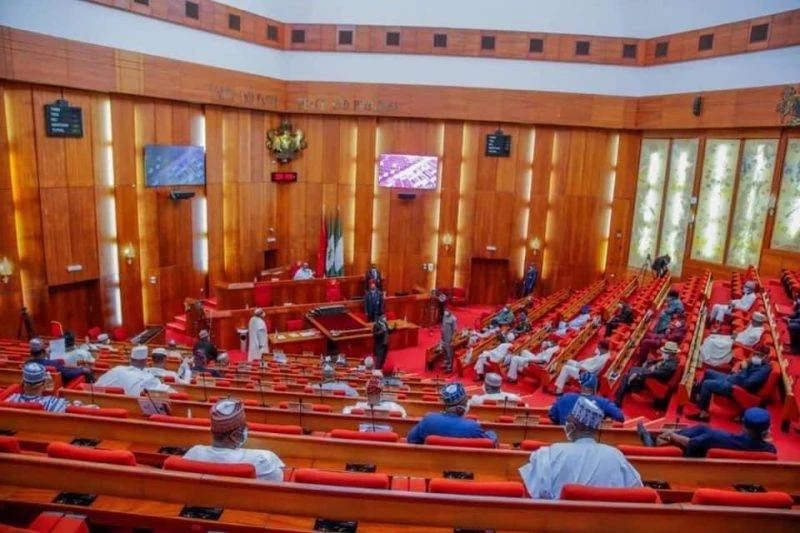
The Senate on Tuesday rejected proposals to nationalise South African-owned companies operating in Nigeria and use the proceeds to compensate Nigerians who have suffered losses from recurring xenophobic attacks in South Africa.
The proposal, which targeted companies such as MTN and MultiChoice-owned DStv, was defeated by a majority voice vote during plenary as lawmakers debated a motion on the continued attacks and killings of Nigerians in South Africa.
The motion was sponsored by Senator Asuquo Ekpenyong (APC, Cross River South), who called for stronger diplomatic efforts to protect Nigerians living in the country.
Leading the push for tougher measures, Senator Wasiu Eshinlokun (APC, Lagos Central) urged the upper chamber to consider nationalising South African businesses operating in Nigeria, lamenting the repeated killings of Nigerians and the destruction of their properties.
Former Edo State governor and senator, Adams Oshiomhole (APC, Edo North) backed the proposal, arguing that Nigeria should move beyond mere expressions of sympathy and adopt actions capable of exerting economic pressure on South Africa.
Oshiomhole recalled that the Senate had earlier resolved to send a delegation to South Africa to engage its government over the attacks, but said nothing had come of the decision.
Bauchi Central senator Abdul Ningi, also supported the proposal, insisting that Nigeria should adopt stronger diplomatic measures rather than continue with routine engagements.
However, the Deputy Senate President, Barau Jibrin, who presided over the session, opposed the recommendation, saying Nigeria must first establish the facts surrounding the attacks before taking any retaliatory action.
“Killing people in the name of protest is not something that should be accepted. It is unacceptable, we cannot allow that, but then we need to be careful, particularly because we live in Africa, we set the pace. Whatever we want to do, we need to be very careful,” Jibrin said.
Responding to claims that the South African government had refused to compensate victims of the attacks, Jibrin cautioned lawmakers against relying on unverified social media reports.
“What Senator Adams Oshiomhole said, sometimes, we don’t take things that are said on social media to analyse the situation. I saw what he is talking about. What the minister was saying was that those who live in illegal settlements will not be paid anything because they illegally occupied those areas. But those who have titles, nobody will take those titles away from them, nobody will take their properties from them, even if they have been displaced.
“The government (of South Africa) should be bold enough to say we have been threatened by certain people who are conspiring to destabilise our nation. The president (of South Africa) should come out to tell the world. Maybe after the committee has done its work, maybe we will find it necessary to advise the South African government,” he added.
Following his intervention, Jibrin urged the three senators to withdraw their proposals and instead allow the Senate Committee on Foreign Affairs to investigate the attacks and submit its report within two weeks.
Presenting the motion, Ekpenyong strongly condemned the wave of xenophobic attacks and urged the Federal Ministry of Foreign Affairs to obtain written assurances from the South African government guaranteeing the safety and protection of Nigerians residing in the country.
He also called for the arrest and prosecution of those responsible for acts of violence, intimidation, looting and unlawful immigration enforcement.
The senator further urged the Ministry of Foreign Affairs, the Nigerians in Diaspora Commission (NiDCOM), and the Nigerian High Commission in South Africa to strengthen emergency consular support and establish a verified register of Nigerians who have suffered death, injury, displacement, unlawful detention, or loss of businesses and property to facilitate legal redress, restitution and compensation.
He also called on the federal government to collaborate with other affected African countries and relevant organs of the African Union to establish an effective early warning and accountability mechanism aimed at preventing xenophobic violence and protecting African migrants.
The debate comes amid renewed attacks on African migrants in parts of South Africa, where several Nigerians have reportedly been killed and their businesses destroyed.
Recent videos circulating on social media showed mobs attacking foreign nationals, while allegations have also emerged that security officials failed to intervene in some of the incidents.
Two Nigerians were reportedly killed in April by personnel of the South African National Defence Force in Port Elizabeth. One of the victims, Ekpenyong Andrew, was arrested and later found dead in Pretoria, while another, Amaramiro Emmanuel, reportedly died from injuries allegedly sustained during an attack by security personnel.
The Nigerian government has since repatriated several citizens affected by the violence.
This is not the first time the National Assembly has considered punitive measures against South African companies operating in Nigeria.
On May 5, the Senate resolved to send a delegation, led by Senate President Godswill Akpabio and comprising members of both chambers of the National Assembly, to engage South African authorities and lawmakers on finding a lasting solution to the attacks.
However, there are no public records indicating that the planned diplomatic visit was eventually carried out.
We’ve got the edge. Get real-time reports, breaking scoops, and exclusive angles delivered straight to your phone. Don’t settle for stale news. Join THISTIMES on WhatsApp for 24/7 updates →
Join Our WhatsApp Channel