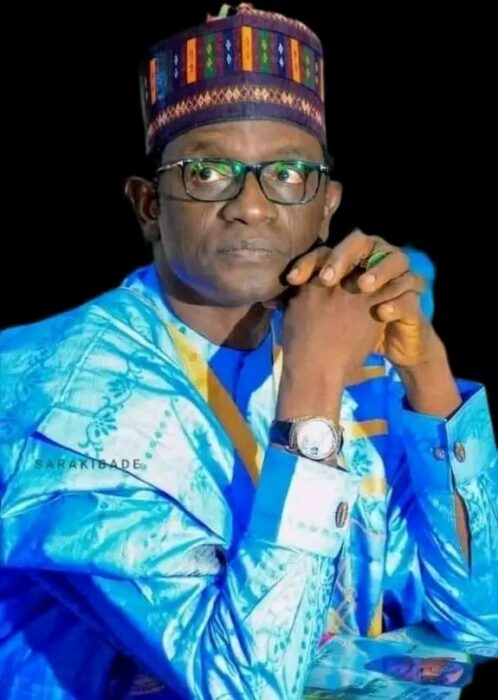
Yobe State Governor, Mai Mala Buni, has credited the state’s progress in tackling insurgency to sustained collaboration with security agencies and the adoption of a strategy that combines military operations with community engagement.
Speaking at the 16th African Business Leadership Awards (ABLA) in Westminster, London, Governor Buni said the state’s security successes were driven by a blend of kinetic and non-kinetic approaches that encouraged residents to actively support the fight against insurgency.
Delivering a lecture on the theme, “Leadership in an Era of Uncertainty: Building Resilience, Inclusion, and Shared Prosperity in Africa: The Yobe State Experience,” the governor said his administration first sought to win public confidence before intensifying security operations.
“We started with a vigorous sensitisation programme for the citizens to appreciate the government’s war against insurgency and other violence as a collective effort involving everyone,” Buni said.
According to him, while security agencies focused on military operations, the state government concentrated on non-kinetic measures aimed at building trust within communities.
“This approach worked very positively. As a result, locals started providing strategic and timely information on the movements and hideouts of non-state actors fighting the government and the populace.
“Parents, who were hitherto adamant about supporting the government, started volunteering critical and useful information on criminal activities in their communities, and it became an all-inclusive effort and everyone’s business,” he added.
Buni said the restoration of peace also enabled the government to rebuild infrastructure destroyed during the conflict and facilitate the return of displaced persons to their communities.
“As the process progressed, we reconstructed and replaced facilities destroyed by the conflict, while security agencies and other institutions were encouraged to resume their duties in the communities.
“This process also encouraged displaced persons to willingly return home, rebuild their destroyed homes and means of livelihood, and restart their lives,” he said.
Highlighting his administration’s investments in education as part of efforts to counter violent extremism, the governor said Yobe declared a state of emergency in primary and basic education, reconstructed 301 schools destroyed by insurgents, established more than 20 new schools, recruited 7,230 teachers, and retrained another 12,714.
He added that more than 50,000 students had received scholarships to pursue tertiary education within Nigeria and abroad.
“This is to build confidence among the people against the ideology of the insurgency, which seeks to discourage formal education,” Buni said, noting that the investments had significantly improved school enrolment.
He also disclosed that the Federal Ministry of Education had recognised Yobe’s implementation of the basic education policy as a model for other states.
On healthcare, the governor said his administration had embarked on far-reaching reforms by establishing functional primary healthcare centres in 142 of the state’s 178 political wards, with work ongoing in the remaining 36 wards.
Also speaking at the event, Imo State Governor, Hope Uzodimma, said Africa’s development would largely depend on the performance of subnational governments.
Represented by the Commissioner for Information, Declan Emelumba, Uzodimma described state governments as the tier of government closest to the people.
“The subnational government lives beside the pothole, the clinic, the classroom and the market. It cannot hide behind distance,” he said.
Reflecting on his six-and-a-half years in office, Uzodimma recalled that poor road infrastructure once defined public perception of Imo State.
“When I took over in 2020, content creators would use Imo’s bad roads, sometimes waist-deep, and film themselves swimming through them. The videos travelled far. They were funny, and they were devastating, because ridicule is the most honest audit a government ever receives,” he said.
The governor said his administration had since reconstructed more than 130 strategic roads across the Owerri-Orlu and Owerri-Okigwe corridors and expanded access to electricity through the Light Up Imo project, which now provides 24-hour power supply to major parts of the state capital.
The awards ceremony was chaired by former Tanzanian President Jakaya Mrisho Kikwete and attended by former heads of state, ministers, central bank governors, parliamentarians, diplomats, business leaders and development partners from across Africa and beyond.
We’ve got the edge. Get real-time reports, breaking scoops, and exclusive angles delivered straight to your phone. Don’t settle for stale news. Join THISTIMES on WhatsApp for 24/7 updates →
Join Our WhatsApp Channel