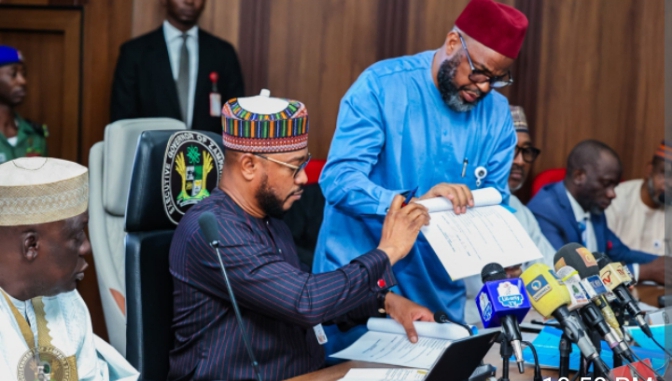
Governor Dauda Lawal of Zamfara State has signed a series of Executive Orders establishing a comprehensive governance framework aimed at reforming the state’s education sector.
The Executive Orders provide an integrated framework for education financing, school protection, classification, quality assurance, health and security. Governor Lawal also launched the distribution of the national curriculum to public schools during a meeting with education stakeholders at the Government House in Gusau.
According to a statement issued by the governor’s spokesperson, Sulaiman Bala Idris, the reforms are designed to strengthen school governance and operations, improve school feeding and student welfare, enhance transportation safety, implement safe school policies, and regulate graduation ceremonies.
The reforms also introduce measures covering unified examinations, school health services, merit-based appointments of school leaders, inclusive education, and the promotion of science, technology, engineering and mathematics (STEM), technical and vocational education and training (TVET), as well as digital education.
Speaking at the event, Governor Lawal described education as a critical driver of development, saying it remains the most effective tool for reducing poverty, promoting peace, strengthening security, stimulating economic growth and preparing future generations for a knowledge-based economy.
“Today, we are turning that commitment into concrete institutional reforms by signing and presenting these Executive Orders,” the governor said.
He explained that the directives form a unified governance framework rather than isolated policies, with the goal of strengthening school administration, improving accountability, protecting public educational assets, enhancing financing, promoting safety, raising academic standards and improving learning outcomes across the state.
Lawal noted that previous education reforms had largely focused on physical infrastructure such as classrooms and laboratories, stressing that quality education requires effective governance and institutional reforms in addition to improved facilities.
Earlier, the Commissioner for Education, Science and Technology, Abdulmalik Abubakar Gajam, said sustainable education reform requires collaboration among government, teachers, parents, communities, traditional institutions, development partners and the private sector.
He expressed confidence that the new reforms would translate into safer schools, stronger governance, healthier learners, improved teaching standards, better educational outcomes and increased public confidence in Zamfara’s education system.
We’ve got the edge. Get real-time reports, breaking scoops, and exclusive angles delivered straight to your phone. Don’t settle for stale news. Join THISTIMES on WhatsApp for 24/7 updates →
Join Our WhatsApp Channel