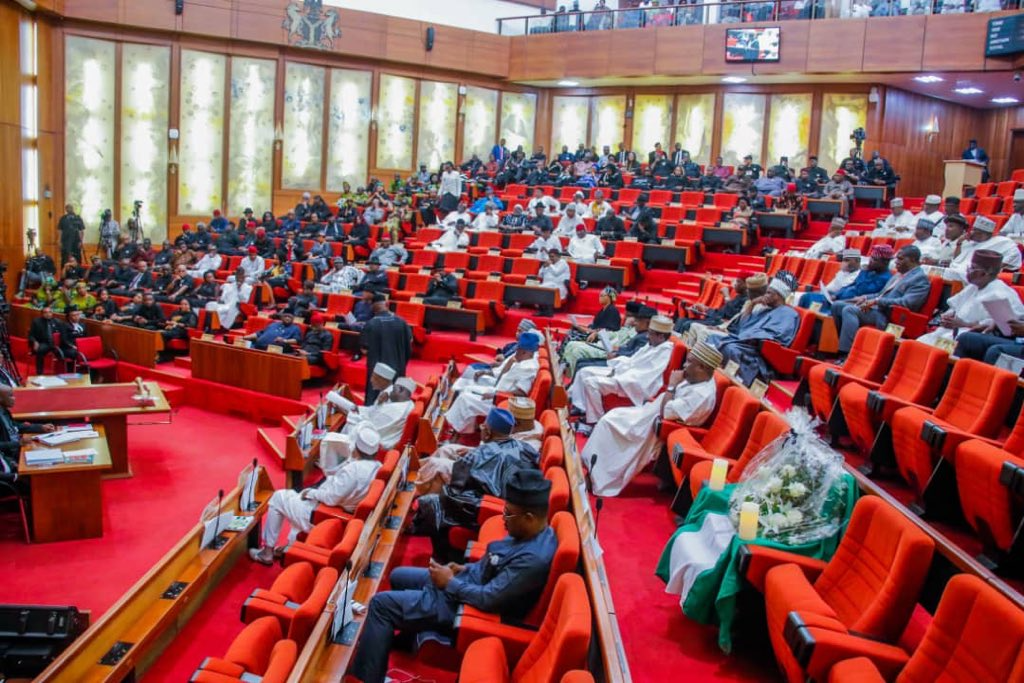
The Senate has advanced a bill to establish a regulatory framework for the coordination, disclosure, and management of foreign aid, grants, and donations received by Nigeria.
The bill, titled “A Bill for an Act to Provide for the Regulation, Coordination, Transparency and Disclosure of Foreign Aid, Grants and Donations in the Federal Republic of Nigeria, 2026 (SB. 1034),” sponsored by Senator Ibrahim Hassan Dankwambo (PDP-Gombe North), scaled second reading during Wednesday’s plenary.
Leading the debate, Dankwambo said the proposed legislation was aimed at promoting order, accountability and strategic coordination in the management of foreign assistance.
He noted that Nigeria receives substantial foreign support in the form of grants, technical assistance, humanitarian interventions and concessional financing from bilateral and multilateral partners, which have contributed to sectors such as health, education, agriculture and humanitarian services.
However, the senator said the country’s foreign aid management system remained fragmented, poorly coordinated and lacking adequate transparency.
He explained that donor-funded projects were often scattered across Ministries, Departments and Agencies (MDAs), with some implemented outside the national budget framework, duplicated or not fully aligned with national development priorities.
“This weak coordination undermines efficiency, reduces value for money and, in some cases, erodes public trust,” Dankwambo said.
The lawmaker said the bill was supported by constitutional provisions, particularly Sections 80 to 83 of the 1999 Constitution, as amended, which provide for legislative oversight of public funds and for the Auditor-General to audit public accounts.
According to him, foreign aid, once received and deployed within Nigeria, becomes a public resource and should be subject to transparency, accountability and constitutional oversight.
He also referenced the Fiscal Responsibility Act of 2007, which requires prudent management of public resources and proper integration of revenues and expenditures into a coherent fiscal framework.
Dankwambo said the legislation would address the existing gap in foreign aid management by ensuring that donor funds were not treated as “off-budget” resources outside accountability structures.
“The problem is not the absence of institutions, but the absence of a binding legal framework that coordinates them,” he said.
He explained that while the Federal Ministry of Finance engages development partners, the Budget Office integrates some projects, the Debt Management Office handles concessional loans and the Accountant-General’s Office tracks disbursements, there was no unified legal structure compelling coordination among all stakeholders.
He said the proposed law would establish a National Donor Coordination Framework, introduce mandatory registration and a national database for foreign aid, ensure alignment of donor-funded projects with national priorities, promote public disclosure and provide sanctions for violations, including misuse of funds and false reporting.
Contributing to the debate, Senator Adams Oshiomhole (Edo North) stressed the need for stronger oversight of foreign funding to safeguard Nigeria’s national interest.
Oshiomhole said foreign resources could sometimes be exploited for purposes that were inconsistent with national objectives.
“We have seen instances in advanced countries where foreign funds were allegedly provided to certain individuals and groups to pursue activities capable of undermining national unity and creating divisions within societies,” he said.
He added that Nigeria must develop mechanisms to enforce disclosure requirements and punish non-compliance.
“We have a responsibility to protect the peace, unity and stability of our nation, and I do not think any well-meaning Nigerian should object to that,” he said.
Senator Mohammed Tahir Monguno (Borno North) supported the bill, saying it would ensure that donor funds were deployed in line with Nigeria’s development priorities.
“What this bill essentially seeks to do is to align all these donor funds in accordance with our national priorities, rather than allowing them to be used at their whims and caprices,” Monguno said.
Deputy Senate President Barau Jibrin said concerns over the management of foreign donations had persisted for years, particularly regarding funds received by non-governmental organisations and subnational governments.
He noted that while federal government funds were generally captured through budgetary processes, some donations received by NGOs lacked sufficient regulatory oversight.
“There is no arrangement, no regulation at all. So the money comes in there, and you even find persons collecting money overseas and spending such money for their own benefits,” Barau said.
Senator Mohammed Adamu Aliero (Kebbi Central) said effective coordination of foreign assistance would strengthen donor confidence and encourage greater support.
“Donor agencies will have confidence if they are sure that the money is going to be prudently utilised. If they know that this money will be diverted, they will not donate,” he said.
Senator Mohammed Sani Musa (Niger East) said the bill would align Nigeria’s foreign funding framework with international best practices while improving transparency.
He also raised concerns about possible security implications of unregulated foreign funding, particularly through organisations operating in areas affected by insecurity.
Senate President Godswill Akpabio commended Dankwambo for sponsoring the bill, describing him as a lawmaker with extensive knowledge of foreign grants and assistance.
“He has extensive knowledge of foreign grants and assistance and understands where some of these funds go. He is also well-versed in the activities and backgrounds of some NGOs,” Akpabio said.
“I believe, therefore, that nobody was better suited to bring this kind of bill to the Senate at this time.”
Akpabio said there was a need to monitor foreign funds to prevent misuse and actions that could damage Nigeria’s image.
“In some instances, even the mode of demand tends to embarrass the nation because it is almost like going cap in hand to beg, and they will use all sorts of ideas,” he said.
He, however, stressed that the bill was not intended to discourage legitimate foreign assistance but to ensure proper tracking and regulation.
“What he is talking about is how to track and regulate these things so that people will not shame the country by their various actions,” Akpabio added.
Following the debate, the Senate passed the bill for second reading. It referred it to the Committees on National Planning and Economic Affairs, Finance, and Foreign Affairs for further legislative consideration. The committees are expected to submit their report within six weeks.
We’ve got the edge. Get real-time reports, breaking scoops, and exclusive angles delivered straight to your phone. Don’t settle for stale news. Join THISTIMES on WhatsApp for 24/7 updates →
Join Our WhatsApp Channel