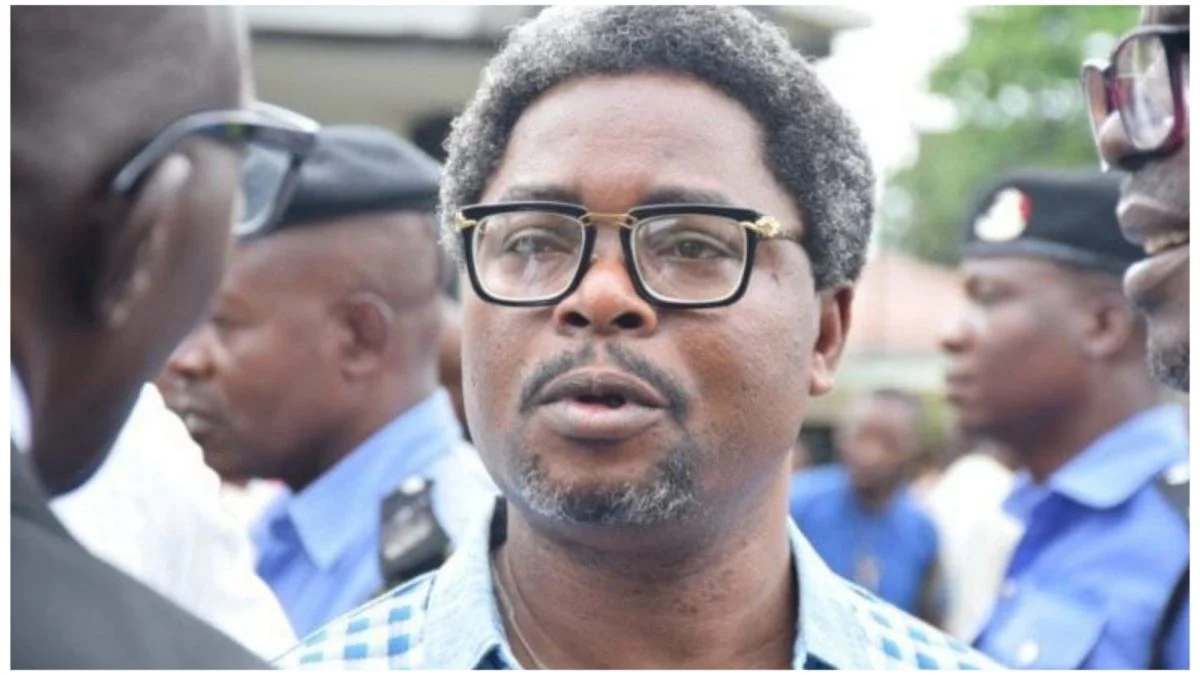
Reviewer: Professor Olu Obafemi
Professor Iyorwuese Hagher’s A Portrait of Paradise arrives like a furious wind from the postcolonial tropics — prophetic, theatrical, grotesque, and morally wounded. It is the kind of African political novel that rejects the polite discipline of realism. Instead, it opts for excess, allegory, satire, lamentation, and visionary rage.
In its architecture and rhetorical ambition, the novel stands somewhere between Ayi Kwei Armah’s The Beautyful Ones Are Not Yet Born, Wole Soyinka’s tragic-political dramaturgy, Ngũgĩ wa Thiong’o’s satirical nationalism, and the apocalyptic moral universe of Ben Okri. Yet Hagher’s voice remains unmistakably his own: steeped in the oral cadence of Tiv storytelling, sharpened by the sensibility of a dramatist, and burdened by the historical consciousness of a statesman who has seen power from the inside.
The fictional republic of Sofalia is, of course, not fictional at all. It is Africa’s wounded republic, the postcolonial state as a tragic masquerade. The novel opens not with a president or a military general, but with one of the most memorable figures in recent African fiction: Queen Aisha, the madwoman beneath the bridge, who becomes the novel’s moral oracle. Like Shakespeare’s fools or Soyinka’s metaphysical wanderers, Queen Aisha inhabits the liminal space between madness and revelation. She is dispossessed yet sovereign, naked yet clairvoyant, abject yet terrifyingly lucid.
The “Atsan” — the discarded poor, scavengers, drifters, and invisible citizens of Sofalia — become not merely victims of history but witnesses to its corruption. The novel repeatedly contrasts them with the “Ogas,” the decadent ruling class cocooned behind electrified fences and imported luxuries. This binary could easily have collapsed into ideological simplicity, but Hagher complicates it through irony and theatrical exaggeration. The rich are grotesque caricatures of postcolonial greed, yet the poor themselves are not romanticised. They are broken, bitter, voyeuristic, morally exhausted. The nation has not only failed materially; it has suffered a collapse of ethical imagination.
One of the most arresting aspects of A Portrait of Paradise is its language. Hagher writes prose that constantly strains toward performance. Sentences swell with rhythm, incantation, aphorism, and oral flourish. The narrative voice often sounds less like a novelist than a griot addressing a gathering at dusk. Consider this extraordinary passage describing Sofalia’s elite paradise:
“Paradise for the elite; hell for the poor.”
The simplicity is deceptive. Hagher’s prose oscillates between brutal compression and flamboyant excess. At times the novel reads like a political sermon; elsewhere, like a tragic folk opera. One senses throughout the hand of a playwright. Scenes unfold with dramatic staging, ritual gestures, processional entrances, symbolic props, and choreographed speeches. The chapter involving Senator Kanyi’s royal visit to Kepe reads almost exactly like political theatre staged for a collapsing republic.
Senator Kanyi himself is among the novel’s most fascinating inventions. He is neither merely villain nor antihero; he is the distilled product of neoliberal African modernity — internet fraudster, populist, billionaire, political operator, and tribal strongman rolled into one. Hagher wisely refuses psychological realism in the Western sense. Kanyi is larger than life because Sofalia itself has become hyperreal. He belongs to a society where corruption has become metaphysical, where theft is not a deviation but a governing principle.
The novel’s satire achieves extraordinary power in the scenes involving traditional authority. The confrontation between the senators and the monarch of Kepe Kingdom is one of the finest political set-pieces in contemporary African fiction. Here, Hagher stages a philosophical argument about legitimacy in postcolonial Africa: Who truly owns the nation-state? The elected politicians? The military? The traditional rulers? The foreign financial institutions? The answer, grimly, is none of them. Sofalia has become an orphaned republic.
Yet A Portrait of Paradise is not merely political satire. Beneath its public rage lies profound sorrow, especially in the story of Aishatu and her mother. These pages possess immense emotional gravity. The scenes of poverty, maternal guilt, hunger, trafficking, and violated girlhood recall the moral seriousness of Buchi Emecheta. Hagher understands that the catastrophe of the African state is finally borne in the bodies of women and children. The nation’s corruption becomes intimate: it enters kitchens, pregnancies, sickness, memory, and grief.
If the novel occasionally overreaches — and it does — its excesses are inseparable from its ambition. There are moments when speeches become prolix, metaphors crowd one another, and the satire threatens to overwhelm narrative subtlety. But restraint has never been the language of societies in crisis. Hagher writes as though moderation itself were morally inadequate to the catastrophe he is depicting. The novel insists on speaking loudly because Sofalia is collapsing loudly.
What ultimately distinguishes A Portrait of Paradise is its prophetic temperament. This is not a novel interested in fashionable minimalism or detached irony. Hagher belongs to the older African tradition in which literature carries a civilizational burden. The writer is not merely an entertainer but a witness, conscience, archivist, and warning bell. In that sense, the novel recalls Chinua Achebe’s conviction that African literature must help restore dignity to wounded history — though Hagher’s vision is far darker, closer to apocalypse than restoration.
And yet, amid the ruin, the novel retains a strange faith in human endurance. Queen Aisha, wandering beneath the bridge with her cracked phone and ecstatic delusions, becomes the symbolic conscience of the republic. She is madness born from truth. She is the nation’s rejected wisdom. Through her, Hagher suggests that when official institutions lose moral authority, truth migrates to the margins — to the homeless, the broken, the mocked, and the forgotten.
A Portrait of Paradise is therefore not simply a political novel. It is a lament for the betrayed African dream. It asks whether postcolonial independence produced freedom or merely transferred colonial instruments into indigenous hands. It interrogates the theatre of democracy, the pornography of wealth, the commodification of women, the absurdity of power, and the loneliness of the poor.
Most importantly, it restores grandeur to moral outrage.
In an era when much contemporary fiction fears seriousness, Hagher embraces it unapologetically. He writes with the urgency of one who believes literature still matters in the life of nations. Whether one agrees with all his methods is secondary. What matters is that A Portrait of Paradise possesses something increasingly rare in modern fiction: historical courage.
It is an unruly, excessive, wounded, visionary book — and precisely for that reason, impossible to ignore.
***Professor Olu Babafemi is a Nigerian poet, playwright, author and Professor of English and Dramatic Literature at the University of Ilorin.
We’ve got the edge. Get real-time reports, breaking scoops, and exclusive angles delivered straight to your phone. Don’t settle for stale news. Join THISTIMES on WhatsApp for 24/7 updates →
Join Our WhatsApp Channel