The National Agency for the Prohibition of Trafficking in Persons (NAPTIP) has raised alarm over the growing use of technology to facilitate Sexual and Gender-Based Violence (SGBV), warning that technology-facilitated abuse is creating new challenges in the fight against sexual violence.
The agency called for increased public awareness and stronger collaboration among government institutions, civil society organisations, development partners, communities and the media to prevent technology-facilitated abuse and improve access to support and justice for survivors.
Head of Press and Public Relations at NAPTIP, Mr. Vincent Adekoye, stated this during the Sexual and Gender-Based Violence Media Corps Workshop organised by NAPTIP with support from the European Union through the End Sexual and Gender-Based Violence (ESGBV) Programme, implemented by International IDEA.
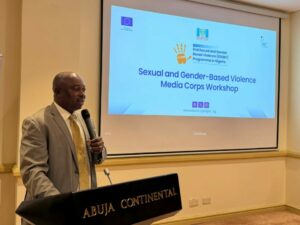
Adekoye said the emergence of technology-facilitated gender-based violence requires greater attention from stakeholders, particularly as digital platforms are increasingly being exploited to perpetrate different forms of abuse.
He stressed the need for greater public understanding of emerging forms of SGBV and stronger coordination among institutions responsible for preventing and responding to the menace.
The NAPTIP spokesman disclosed that 34 states have domesticated the Violence Against Persons Prohibition (VAPP) Act, while Kogi and Delta states are yet to do so.
He also revealed that NAPTIP has secured three life imprisonment convictions in SGBV-related cases, stressing the importance of ensuring that perpetrators are held accountable.
The workshop brought together journalists from the Federal Capital Territory and Kaduna State as part of efforts to strengthen public engagement on SGBV in the FCT, Benue, Kaduna and Oyo states.
The initiative seeks to improve the quality, ethics and coordination of media and community-based communication on SGBV by promoting professional, survivor-centred, evidence-based and action-oriented reporting.
Speaking earlier, International IDEA’s Civil Society and Community Mobilization Specialist, Wynyfred Achu-Egbuson, said the Media Corps initiative was designed to equip journalists with the skills to report SGBV responsibly while supporting the implementation of laws and policies protecting survivors.
She said the programme also seeks to strengthen institutions, improve coordination among stakeholders and support the enforcement of the Violence Against Persons Prohibition Act across the country.
Facilitator, Toyin Adewale-Gabriel, said the media has a critical role to play in breaking the silence surrounding sexual violence and ensuring that members of the public have access to reliable information.
She cited findings indicating that 21 per cent of women aged 15 to 49 have experienced physical or sexual violence, while 58 per cent of survivors neither seek help nor report their experiences.
Gabriel urged journalists to use ethical, accurate and survivor-centred reporting to promote awareness, encourage survivors to access support services and contribute to positive social change.
The workshop also examined gender roles, stereotypes, victim-blaming and the influence of the media in shaping public attitudes towards SGBV.
Also speaking, facilitator Tim Aniebonam urged journalists to avoid language that reinforces harmful stereotypes, stressing the need for sustained reporting that follows SGBV cases beyond the initial incident and promotes accountability.
Similarly, Dr. Lauratu Abdulsalam cautioned journalists about the impact of headlines, language, visuals and reporting angles on survivors, noting that insensitive coverage could deepen stigma and trauma.
She urged journalists, influencers and community correspondents to ensure that their reporting remains ethical, evidence-based and focused on accountability rather than blaming survivors.
On the legal framework for addressing SGBV, Armsfree Ajanaku highlighted international and regional instruments, including the Convention on the Elimination of All Forms of Discrimination Against Women, the Maputo Protocol and the Sustainable Development Goals.
He said the frameworks complement Nigeria’s domestic laws and stressed that ending SGBV requires sustained commitment from government, civil society, development partners, the media and citizens.
The workshop strengthened journalists’ capacity to provide accurate information, challenge harmful social norms, promote access to support services and contribute to more effective prevention and response to Sexual and Gender-Based Violence.
We’ve got the edge. Get real-time reports, breaking scoops, and exclusive angles delivered straight to your phone. Don’t settle for stale news. Join THISTIMES on WhatsApp for 24/7 updates →
Join Our WhatsApp Channel