The Independent Corrupt Practices and Other Related Offences Commission (ICPC) has faulted the Budget Office of the Federation (BOF) for allowing the purported Presidential Foreign Intervention Promotion Council (PFIPC) to be included in the 2026 federal budget without properly verifying its legal status.
The commission made the finding in its investigation into the activities of the organisation, which the Federal Government has said was never legally established.
According to the ICPC report, the Budget Office processed and onboarded the purported agency into the 2026 budget despite missing key documents and without independently confirming the legal instrument said to have created it.
The investigation found that the Budget Office relied on an administrative code issued by the Office of the Accountant-General of the Federation (OAGF), as well as establishment documents attributed to the Office of the Head of the Civil Service of the Federation (OHCSF).
However, the commission said the Budget Office did not independently verify the authenticity of those documents or establish that the purported council had a valid legal foundation.
POLITICS NIGERIA reports that the purported PFIPC was headed by Adeniyi Adeyemi, who presented himself as its Director-General. He had reportedly secured an office at the Federal Secretariat in Abuja and obtained official correspondence connected to the organisation.
The Presidency has maintained that the PFIPC was not created by President Bola Tinubu’s administration and that Adeyemi was never appointed to head such an organisation.
Adeyemi is currently facing an eight-count criminal charge involving alleged forgery and impersonation. He has denied the allegations and maintained that he will establish his innocence in court.
The ICPC investigation showed that the process through which the purported agency entered the federal budget began with an administrative code issued by the Accountant-General’s office.
On November 29, 2024, the Budget Office received a letter from the OAGF conveying Administrative Code 0111062001 for the purported PFIPC.
However, investigators found that the Budget Office did not receive direct official communication from the Office of the Head of the Civil Service transmitting an authorised establishment and recruitment waiver for the organisation.
Instead, the copy available in the Budget Office’s records was a scanned document.
The purported council later submitted a budget proposal on August 20, 2025, seeking N3.85 billion for personnel expenditure. The proposal was accompanied by a flash drive containing details of the proposed personnel costs.
The Budget Office did not approve the amount requested. The ICPC said that because there was no approved salary structure from the National Salaries, Incomes and Wages Commission, officials recalculated the personnel cost using the Consolidated Public Service Salary Structure.
The exercise resulted in a total allocation of N1.3 billion, made up of N802 million for personnel, N200 million for overhead and N300 million for capital expenditure.
The commission noted that the purported PFIPC had not submitted estimates for overhead and capital expenditure. The Budget Office nevertheless determined the figures by considering the proposed personnel structure, the functions of the organisation, comparable government agencies, as well as its size and age.

According to the ICPC, the Budget Office continued processing the proposal even though important documents and information were missing.
The commission said officials relied on informal engagements and unverified scanned approvals, with no evidence that the deficiencies were formally communicated to the relevant authorities or resolved before the proposal was processed.
The investigation established that a provision was eventually made for the purported agency in the 2026 budget. However, the ICPC said it found no evidence that the money was actually released, cash-backed, paid out or spent.
Recall that the 2026 Appropriation Act reportedly contains a N1.3 billion allocation linked to the Presidential Economic Advisory Council/Presidential Foreign Intervention Promotion Council.
Adeyemi had earlier denied involvement in preparing or defending the budget proposal, saying he was in police detention when the process was taking place.
The ICPC said the Budget Office also failed to conduct adequate due diligence before accepting the purported PFIPC into the budget system.
Investigators found no evidence that officials independently confirmed the establishment instrument, enabling authority, supervisory authority or presidential approval for the council.
Instead, the office largely relied on documents and approvals attributed to the OAGF and OHCSF.
The commission said this failure was one of the major weaknesses that allowed the purported agency to move through government processes despite questions surrounding its legitimacy.
The investigation also examined the Standard Operating Procedure of the Budget Office’s Expenditure Department, which outlines how budget proposals from government institutions should be received, examined and uploaded into the annual federal budget.
Under the procedure, officials are expected to examine submissions for completeness and integrity, identify deficiencies and bring them to the attention of the Director of Expenditure. Where necessary, proposals are expected to be returned to the originating agency for clarification or correction before processing continues.
The ICPC, however, found that these safeguards were not properly applied in the PFIPC case.
The proposal lacked overhead and capital estimates, an approved salary structure, an authorised establishment and a recruitment waiver. Despite the missing documents, the Budget Office proceeded with the proposal and calculated the personnel allocation using the Consolidated Public Service Salary Structure.
Investigators also found no evidence that the proposal was formally returned to the purported council for the missing documents to be supplied.
Instead, officials continued engaging representatives of the organisation informally while the budget process went ahead.
The commission further identified weaknesses within the Budget Office’s internal control system.
A budget manager who handled the PFIPC proposal reportedly told investigators that he had neither seen nor used the Expenditure Department’s Standard Operating Procedure. For the ICPC, this suggested that the procedure had not been sufficiently institutionalised among officials responsible for processing budget submissions.
Investigators also found that the procedure was due for review in November 2024 but had not been updated.
Another major weakness was the absence of a clear requirement for independent verification of critical documents before a newly established agency could be admitted into the federal budget.
The ICPC said the existing process did not specifically require officials to independently confirm an agency’s establishment instrument, organisational structure, supervising ministry or agency, or its approved salary structure.
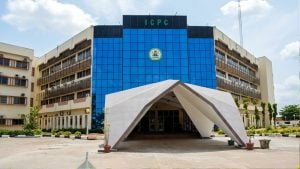
The commission therefore concluded that the budget onboarding system lacked sufficient verification and due diligence measures for newly established government institutions.
It said mandatory documents and escalation procedures were not consistently enforced, operational procedures were not properly institutionalised or regularly reviewed, and the system did not require independent confirmation of the legal instruments establishing new agencies.
“These weaknesses created a control gap that enabled the PFIPC to be included in 2026 budget,” the report said.
The scandal also expanded after investigators uncovered another suspected fake agency, the National Brands Development and Made in Nigeria Special Project Office, which allegedly operated from the Office of the Secretary to the Government of the Federation.
President Bola Tinubu subsequently ordered the suspension of three permanent secretaries and the arrest of the alleged promoter of the second organisation, George Nwabueze.
ICPC Chairman Musa Aliyu said investigators discovered that Nwabueze operated under different variations of his name and that some officials within the OSGF were suspected to have collaborated with him.
According to the commission, forged legislative instruments were allegedly used to make the entities appear legitimate and facilitate the opening of bank accounts in their names.