For years, the story of recovered loot in Nigeria ended with the same question: where does the money go? Billions were announced as recovered, but the trail often went cold, buried in bureaucracy and suspicion. The narrative is slowly changing. The question is no longer whether crime does not pay, but whether Niger can make it pay for the people who were robbed. EJIKE EJIKE reports.
A property that once stood as a monument to alleged illicit wealth now has students walking through its gates.
Instead of luxury and private accumulation, there are classrooms. Instead of an asset linked to alleged criminal proceeds, there is a university. And instead of asking only how much the government has recovered, another question is emerging: what has Nigeria done with the money it has recovered?
The answer may lie in a growing yet under-discussed dimension of the country’s anti-corruption campaign — the conversion of recovered proceeds and assets into public value. For years, the public conversation about corruption in Nigeria has largely centred on arrests, investigations, court cases, convictions and forfeiture.
The familiar imagery has been of suspects being paraded, properties being seized, and huge sums of money being announced as recovered.
But recovery is only one part of the story. The bigger question is what happens after recovery.
What happens when an asset that was allegedly acquired with criminal proceeds is transferred from private hands to public use?
What happens when recovered funds are used to finance education, consumer credit, government programmes and public institutions? And what happens when assets that once allegedly served private enrichment are converted into classrooms, factories, offices and other productive facilities?
That is where the anti-corruption story begins to intersect with development.
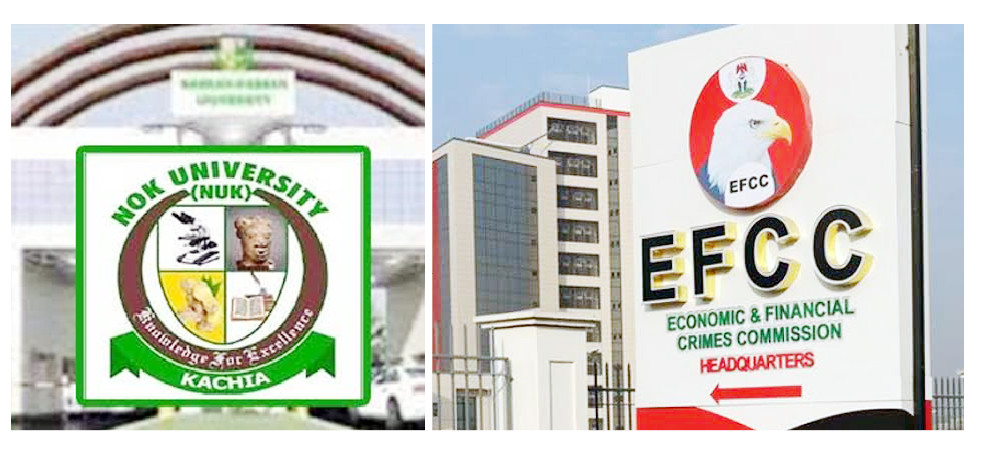
Presenting his three-year stewardship report at the Economic and Financial Crimes Commission (EFCC) headquarters in Abuja, the executive chairman, Ola Olukoyede, provided figures that offer a window into the scale of the recovery effort.
Between October 2023 and July 2026, the commission said it received 49,673 petitions, investigated 39,615 cases, filed 14,476 cases in court, and secured 10,872 convictions.
Those figures tell the story of enforcement.
But behind them lies another story — the movement of recovered criminal proceeds into legitimate economic and social use.
From Alleged Crime Proceeds To A University
Perhaps no example captures this transformation more vividly than NOK University.
The institution was among the properties recovered through the anti-corruption process. Rather than allowing the asset to remain a symbol of wealth allegedly acquired through criminal proceeds, the federal government converted it into the Federal University of Applied Sciences, Kachia, in Kaduna State.
By December 2025, 1,909 students had matriculated into the institution. The number may appear modest when viewed simply as a statistic. But behind each student is a potential career, a family and, ultimately, a contribution to the country’s human capital.
Security expert and retired police officer Iyke Odife said, “Each student represents a potential engineer, scientist, technologist, researcher, entrepreneur or professional, and their educational opportunity is now linked to an asset that entered the public domain through the recovery process.”
The transformation, in one example, captures what anti-corruption enforcement can mean when measured beyond the courtroom.
A property once associated with alleged illicit wealth has been repurposed as an institution for human capital development. The impact does not necessarily stop at the university gates.
Odife further explained that “the economic effect does not stop with the students. A university creates demand for accommodation, transport, food, retail, construction, security and other services. It employs academic and non-academic staff and generates economic activity in its host community.”
“In this sense, asset recovery becomes a development policy. The real value of the recovered property is no longer simply its monetary worth. Its value is multiplied by the number of people educated within it and by the economic activity it generates. There may also be an even larger social dividend. For young people from communities where access to tertiary education remains limited, the university represents an opportunity that might otherwise have been unavailable.”
“The journey from alleged criminal proceeds to a university therefore tells a powerful story: money that may once have been used to accumulate private wealth can, after due legal process and forfeiture, be converted into public opportunity.”
That is the point at which asset recovery takes on a meaning beyond punishment. The objective is no longer simply to deprive an alleged offender of an asset. It is to ensure that an asset that allegedly originated from wrongdoing can, after due legal process, serve a legitimate public purpose.
The Trillions Behind The Recoveries
The EFCC’s stewardship figures suggest that NOK University is not an isolated example of the broader principle.
Between 1 October 2023 and 30 June 2026, the commission reported recoveries of approximately N1.234 trillion, $684.48 million, £373.91 million, €9.34 million, and other currency amounts.
But the headline figure requires closer examination. According to the commission, about N397.26 billion, representing 33 per cent, constituted direct recoveries for the federal government.
The remaining N836.34 billion, or about 67 per cent, comprised indirect recoveries made on behalf of ministries, departments and agencies, state revenue services, companies, individuals and foreign victims. This distinction is significant.
It means the economic value of anti-corruption enforcement cannot be measured solely by how much money ultimately enters the federal government’s coffers.
Some recoveries restore funds to legitimate owners. Others return resources to public institutions. Some strengthen government revenue, while others remove productive assets from criminal enterprises and place them within legitimate economic structures.
In other words, where the recovered resources are used can be just as important as how much is recovered.
But Where Does The Money Go?
For ordinary Nigerians, this may be the most important question. A recovery announcement may generate headlines, but the real test of the exercise begins after the announcement.
The EFCC reported that N661.32 billion and $492.37 million were disbursed to beneficiaries during the period under review.
Of the naira releases, approximately N325.35 billion went directly to individuals and corporate bodies, while about N335.97 billion was released to ministries, departments and agencies, the Nigerian Revenue Service, states’ internal revenue services, and other public institutions, companies and individuals.
The commission also reported approximately N288.1 billion in federal and state tax recoveries during the period.
Of this amount, about N173.2 billion was attributed to federal tax recoveries, while N114.9 billion was attributed to state internal revenue services.
Another approximately N257.2 billion in naira recoveries was recorded for federal ministries, departments and agencies.
Taken together, the figures introduce another dimension to the anti-corruption conversation: fiscal mobilisation.
Recovering unpaid, diverted or withheld public revenue can expand the government’s fiscal space without relying exclusively on new taxes or additional borrowing.
At a time when governments at all levels are under pressure to finance education, healthcare, infrastructure and social programmes, recovering existing public resources can be economically significant.
The anti-corruption agency, therefore, becomes, indirectly, part of the country’s fiscal mobilisation architecture.
When Recoveries Fund Education And Credit
The development argument becomes even stronger when recovered funds are deliberately channelled into programmes that deliver direct social and economic benefits.
In August 2024, the federal government directed that N50 billion from EFCC recoveries be allocated to the Nigerian Education Loan Fund (NELFUND) and the Nigerian Consumer Credit Corporation.
Further allocations of N50 billion each to NELFUND and Credit Corp were subsequently approved in 2026.
The logic is straightforward. A recovered asset can be converted into public infrastructure. Recovered funds can be channelled into a programme that provides Nigerians with access to education or credit.
Reacting to this, an economic analyst, Oliver Edafe, said, “The significance goes beyond the headline figures. Education financing is an investment in human capital. Student loans can help people who might otherwise be unable to afford a tertiary education access it.
Consumer credit, when properly regulated and responsibly administered, allows individuals to acquire goods and services while supporting economic activity.”
This is where the anti-corruption campaign begins to acquire a distinctly developmental character.
The process starts with an alleged economic crime. It proceeds through investigation, prosecution and, where the courts so determine, forfeiture. But the final destination can be dramatically different from the point of origin.
What allegedly began as private enrichment can end as public education. What allegedly began as illicit accumulation can become government revenue. What was once an idle or improperly acquired asset can become productive infrastructure.
The Other Side Of Asset Forfeiture
The scale of asset forfeiture further illustrates the potential.
The EFCC also reported the forfeiture of 10,053 tangible assets under interim and final court orders between October 2023 and July 2026.
They included 8,198 electronic items, 1,177 real estate assets, 370 automobiles, and 251 plots of land, as well as schools, factories, hotels, shops, oil rigs, barges, machinery, and aircraft.
The commission also recorded the forfeiture of 102 tonnes of solid minerals.
The list raises a fundamental question: what happens to productive assets after they are forfeited?
The answer matters because an asset can lose much of its value if it is poorly managed, allowed to deteriorate or left idle.
The development dividend of asset recovery, therefore, depends not merely on the state’s ability to seize assets but also on its capacity to preserve and deploy them.
Edafe further said, “Every productive asset taken out of a criminal enterprise and lawfully converted for legitimate use represents an opportunity to change the economic purpose of that asset. A factory can produce. A school can educate. A piece of land can support infrastructure. A building can house a public institution. Machinery can contribute to production.
“The challenge, therefore, is not simply to recover assets but to ensure that the state has the institutional capacity to preserve, manage and deploy them efficiently. This is where the development dividend of anti-corruption becomes most visible.”
The Real Measure Of Recovery
For a country battling corruption, the significance of these developments goes beyond the impressive figures in an agency’s stewardship report.
The ultimate value of recovery is not necessarily realised at the moment an asset is seized, or a cheque is presented. It is realised when the recovered resource begins to serve society. A university filled with students is more consequential than a forfeited building standing empty.
A factory producing goods is more valuable than machinery gathering dust in a warehouse.
A recovered public fund used to finance education or support legitimate economic activity is not the same as money locked away in an account. That is why the story of NOK University is particularly instructive. It illustrates the possibility of a complete cycle: from alleged criminal proceeds to investigation to recovery to lawful forfeiture and, finally, to public benefit.
In that sense, the anti-corruption war need not end in the courtroom. Its most enduring victory may begin after the courtroom — when what was allegedly acquired for private benefit is transformed into something that serves the public.
For Nigeria, that may ultimately be the most compelling measure of recovery: not merely how much is taken from the corrupt, but how much of it is made to work for the people.
We’ve got the edge. Get real-time reports, breaking scoops, and exclusive angles delivered straight to your phone. Don’t settle for stale news. Join THISTIMES on WhatsApp for 24/7 updates →
Join Our WhatsApp Channel