- Gaya, Hanga, Doguwa join APC with 136,038 supporters
- Atiku, Kwankwaso dismiss defectors, target Tinubu’s Northern stronghold
By Ademu Idakwo, Abuja; Aza Msue, Kaduna; Muh’d Zangina Kura, Dutse; Longtong Yakubu, Kano
The battle for the Kano State 5.9 million registered voters heated up yesterday when some political leaders in the state joined the ruling All Progressives Congress (APC).
Among those received into the APC are former senators Rufa’i Sani Hanga, Kabiru Ibrahim Gaya, and Mas’ud El-Jibrin Doguwa.
Others include the chairman of the New Nigeria Peoples Party (NNPP, Fruit Faction), Ali Datti Yako; the Nigeria Democratic Congress (NDC) deputy state chairman, Badaru Umar; the former chairman of the Ungogo Local Government Area, Isyaku Ali Danja; and the former Speaker of the Kano State House of Assembly, Yusuf Bello Danbatta.
Also received were former PDP deputy governorship candidate, Senator Baraka Sani; former Special Adviser to the President, Abdullahi Zubairu Abiya; Chairman of the NNPP (Book Faction), and former NNPP senatorial candidate, Abdulmajid Dauda Dandawaki.
The defectors were accompanied by their supporters, who joined thousands of APC loyalists at the venue as they were all received into the ruling party.
Yesterday’s defections may have further deepened the ongoing political realignment in the state ahead of the 2027 elections, as several prominent politicians and groups have moved into the APC in recent months.
The political realignment and defections are expected to strengthen the APC’s structure further as the three main political parties battle for control of the state’s votes in 2027.
The parties are the APC, African Democratic Congress and the National Democratic Congress.
While President Bola Tinubu is the APC’s presidential candidate, Atiku Abubakar, a former Vice President, is the ADC’s flagbearer, and Peter Obi, a former Governor of Anambra State, leads the NDC.
Speaking at the event, Governor Yusuf welcomed the defectors, describing their decision as an indication of growing acceptance of the APC in Kano.
He urged the new members to work with existing APC stakeholders to strengthen the party and mobilise support for Tinubu and other APC candidates in the 2027 elections.
Yusuf said Kano would play a leading role in the President’s re-election bid, calling on youths, women, support groups and other stakeholders to remain united and committed to the party.
Earlier, the Director-General of the Tinubu Support Group, Dr Umar Tanko-Yakasai, said the group had commenced its grassroots mobilisation to secure Tinubu’s re-election in 2027.
Yakasai, who praised Tinubu’s economic policies and projects in Kano, also commended Governor Yusuf for what he described as his developmental strides across the state.
He assured the gathering that members of the support group across the 36 states and the Federal Capital Territory would work to deliver victory for Tinubu at the polls.
He also urged the newly inaugurated national and state executives of the support group to begin immediate grassroots mobilisation.
Senator Hanga, who spoke on behalf of the defectors, pledged to work with Governor Yusuf and other APC leaders to secure victory for the party in 2027.
However, a former governor of Kano State, Senator Rabiu Kwankwaso, who also has a large following, is Obi’s running mate.
Yesterday’s defection is expected to strengthen the ruling party’s political structure in the state as it intensifies preparations for the presidential, governorship and National Assembly elections.
The Independent National Electoral Commission has fixed the election for 16 January 2027.
Before now, several political figures from opposition parties, particularly the NNPP, have moved to the APC following the state governor, Abba Kabir Yusuf’s defection to the ruling party.
Several lawmakers and political appointees also joined the APC as soon as the governor defected.
Some of yesterday’s defectors were politicians who had been elected to the Senate, the House of Representatives, state legislatures, and other offices.
The defectors, who said they were joining the party with 136,038 of their supporters, are expected to give the APC additional grassroots structures across various local government areas of the state.
Defectors won’t stop APC defeat – Atiku, Kwankwaso.
Meanwhile, both Atiku and Kwankwaso have dismissed the defection, saying the act won’t stop the defeat of President Tinubu and the APC in 2027.
Speaking on behalf of Atiku, his running mate, Rotimi Amaechi, said the people of Kano cannot be deceived with those he described as emergency democrats.
He said, ‘‘The people of Kano, in particular, and Nigeria as a whole cannot be stopped by these defectors. They know that the misrule of President Bola Tinubu and the APC has come to an end. So don’t worry. They will be defeated. The defectors are also aware that they are going to labour in vain.’’
Also speaking on behalf of Kwankwaso, Asiwaju Mashood Shittu, National Coordinator of the Kwankwaso National Network (KNN), said the defections were not new to Kano politics, insisting that Kwankwaso remained a formidable political leader in Kano.
Shittu said the NDC would win the state in the 2027 elections, arguing that the party enjoyed the support of the masses despite the latest political realignment.
He said, “In 2023, we had no senator, representative member, commissioner, nor even a councillor, but we defeated an incumbent government.
“All these rented crowds who were given N2,000 each to troop into the arena cannot change the political reality in Kano.”
Kano had 5,921,370 registered voters for the 2023 general elections, making it one of Nigeria’s largest electoral blocs and a critical battleground ahead of the 2027 presidential and other elections.
However, only about 1.7 million votes were recorded in the presidential election, underscoring the difference between the state’s huge voter register and actual electoral participation.
Atiku, Kwankwaso Target Tinubu’s Northern Stronghold
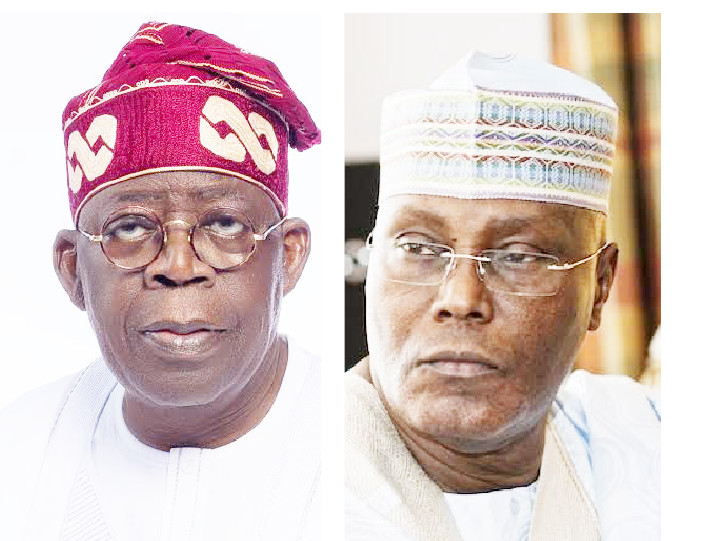
Meanwhile, both Atiku Abubakar and Rabiu Musa Kwankwaso said they are set to challenge President Tinubu’s political dominance in the northern region.
Atiku and Kwankwaso are expected to draw on their established political structures in the North-East and North-West, respectively, as the opposition seeks to consolidate its support base and make significant inroads into states where Tinubu and the All Progressives Congress (APC) currently hold a political advantage.
The North remains critical to the presidential contest, given its large electorate and the political importance of states across the North-West, North-East and North-Central geopolitical zones.
The 2023 presidential election showed that Tinubu’s support in the region was significant but not absolute, with Atiku winning several northern states and Kwankwaso securing a decisive victory in Kano.
Atiku, who contested the 2023 election on the platform of the Peoples Democratic Party (PDP), won Adamawa, Bauchi, Gombe, Taraba and Yobe in the North-East, as well as Kaduna, Katsina, Kebbi and Sokoto in the North-West.
In Adamawa, Atiku polled 417,611 votes, representing 57.12 per cent, against Tinubu’s 182,881 votes, while in Bauchi, he secured 426,607 votes against Tinubu’s 316,694.
Kwankwaso, who contested the election on the platform of the New Nigeria Peoples Party (NNPP), won Kano with 997,279 votes, giving him a commanding lead over Tinubu, Atiku and Labour Party candidate Peter Obi.
The result reinforced Kwankwaso’s position as one of the most influential political figures in Kano and a major factor in the electoral calculations of the North-West.
Former Secretary General of the Arewa Consultative Forum (ACF), Anthony Sani, however, said the opposition coalition would not be able to defeat Tinubu in the North or nationally in the 2027 election.
Sani, who spoke with LEADERSHIP Sunday, said zoning and the expectation that the presidency would remain in the South until 2031 could favour Tinubu.
He said the North and South appeared to have accepted the zoning arrangement in 2023 after former President Muhammadu Buhari completed eight years in office, arguing that the same consideration could influence northern voting patterns in 2027.
“I do not think the coalition of opposition political parties can prevail in the presidential elections coming up next January. And many factors will influence voters in the North next January,” he said.
“One of them is the politics of zoning, which influenced the elections in 2023. Both the North and the South seemed to have agreed on the politics of identity called zoning. As a result, both regions pushed the presidency to the South after President Buhari’s eight years in office.
“That was why southerners did not vote for the former VP in 2023, and accounts for why Bola Tinubu could defeat Atiku in the North. Only the politics of zoning could cause that to happen,” he added.
Sani added that the sentiment around zoning had not changed, with the South expecting to retain the presidency for eight years after Buhari’s administration and the North hoping to produce the president in 2031.
“As long as such expectations still exist, it is hard to avoid the conclusion that both Atiku and Kwankwaso may not prevail over President Bola Tinubu in the North come 2027,” he said.
He also cited the presence of APC governors across the region and the influence of incumbency as factors that could shape northern voters’ choices.
“In addition, mere political coalition and alliances short of merger of political parties hardly work in Nigeria,” Sani said.
The Speaker of the Jigawa State House of Assembly, Hon. Haruna Aliyu Dangyatin, also dismissed the possibility of Atiku and Kwankwaso defeating Tinubu in the North, saying the President’s popularity had increased since 2023.
Dangyatin, who is also Chairman of the Progressive Speakers Forum and Chairman of the City Boys Movement, Jigawa State chapter, attributed the President’s growing support to what he described as the impact of the Tinubu administration’s economic policies.
“The economic transformation policy introduced by President Bola Tinubu has rescued the country from decades of economic instability,” Dangyatin said.
“It has also provided governments at all levels with more funds to execute laudable projects that are now positively impacting the lives of Nigerians.”
He said Tinubu’s political experience and the administration’s Renewed Hope Agenda would help the President secure northern support in 2027.
Dangyatin further argued that Atiku’s popularity had declined since the 2023 election and that Kwankwaso had lost some of his political allies.
“As for Kwankwaso, he has become a political liability, neither here nor there. Almost all of his reasonable political allies have abandoned him because they understand he has lost his direction,” he said.
He maintained that neither Atiku nor Kwankwaso had anything substantial to offer northern voters compared with the Tinubu administration.
“I am assuring the President and Nigerians that the North stands firmly with President Tinubu, just as he stands with the North and Nigeria with a deep sense of commitment and patriotism,” Dangyatin said.
Atiku, Kwankwaso remain major political force in the North – Supporters
But supporters of Kwankwaso argued that the former Kano governor remains a major force in the North and that the political equation of 2027 could be different from that of 2023.
Asiwaju Mashood Shittu, National Coordinator of Kwankwaso National Network (KNN), said the APC’s victory in the 2023 presidential election in the North was aided by the political goodwill and following associated with the late former President Muhammadu Buhari.
Shittu, who spoke with LEADERSHIP Weekend on Friday, argued that Tinubu could not automatically inherit Buhari’s political following.
He said Kwankwaso remained stronger at the grassroots in the North than both Tinubu and Atiku.
“Tinubu and Atiku do not have the kind of followership Kwankwaso commands in the North,” he said.
“I tell you for free that Atiku and Tinubu will be defeated in the North by Peter Obi because of Kwankwaso.”
In Kano, the political structure associated with Kwankwaso is also being presented as a major factor ahead of the 2027 election.
The Kano State Chairman of the National Democratic Congress (NDC), Hussaini Isah Mairiga, said Kwankwaso’s Kwankwasiyya movement remained strong enough to influence the outcome of future elections in the state.
Mairiga, speaking in a telephone interview with LEADERSHIP Weekend, said that Kwankwaso remained at the head of the Kwankwasiyya movement despite his continued political realignment.
He attributed the electoral victories of former Governor Abdullahi Ganduje and incumbent Governor Abba Kabir Yusuf to Kwankwaso’s political structure.
“Everybody knows that Kwankwaso is the one at the head of Kwankwasiyya. Ganduje and Abba, who drove them into power? It was Kwankwaso. By the power of Kwankwaso and the structure of Kwankwasiyya, they were able to become governors,” he said.
Mairiga argued that the APC could not rely solely on its control of the Federal Government and the Kano State Government to defeat Kwankwaso’s political structure in 2027.
He cited the 2019 election as evidence that Kwankwaso’s political structure could withstand the influence of both federal and state governments.
“Before, with Tinubu in the Federal Government and Ganduje in the state, did they beat Kwankwaso to win the election in 2019? That is why Abba was brought into government. Nothing can change,” he said.
The NDC chairman expressed confidence that the opposition would retain its dominance in Kano in 2027, predicting the party’s victory in the state’s major elective positions.
He said he was “100 per cent” confident that the NDC would win the governorship, senatorial, House of Representatives and state Assembly elections in Kano.
We’ve got the edge. Get real-time reports, breaking scoops, and exclusive angles delivered straight to your phone. Don’t settle for stale news. Join THISTIMES on WhatsApp for 24/7 updates →
Join Our WhatsApp Channel