| Plan to unfold in phases, state-to-state, not blanket directive — Agency
BY NSE ANTHONY-UKO, Abuja, YUSUF BABALOLA and ABIODUN SIVOWAKU, Lagos
With three weeks to October 1, the deadline set by President Bola Ahmed Tinubu for measures to cut intra-state transport fares through Compressed Natural Gas (CNG) and electric vehicles, transport unions have said they have not been consulted by either the federal or state governments and are yet to receive clear implementation guidelines.
Transport unions, stakeholders and analysts who spoke separately to LEADERSHIP also expressed doubts about the practicality of the president’s promise.
The Presidential Initiative on Compressed Natural Gas and Electric Vehicles (Pi-CNG & EV), however, insisted that the rollout would proceed through phased, state-by-state engagement rather than a blanket directive.
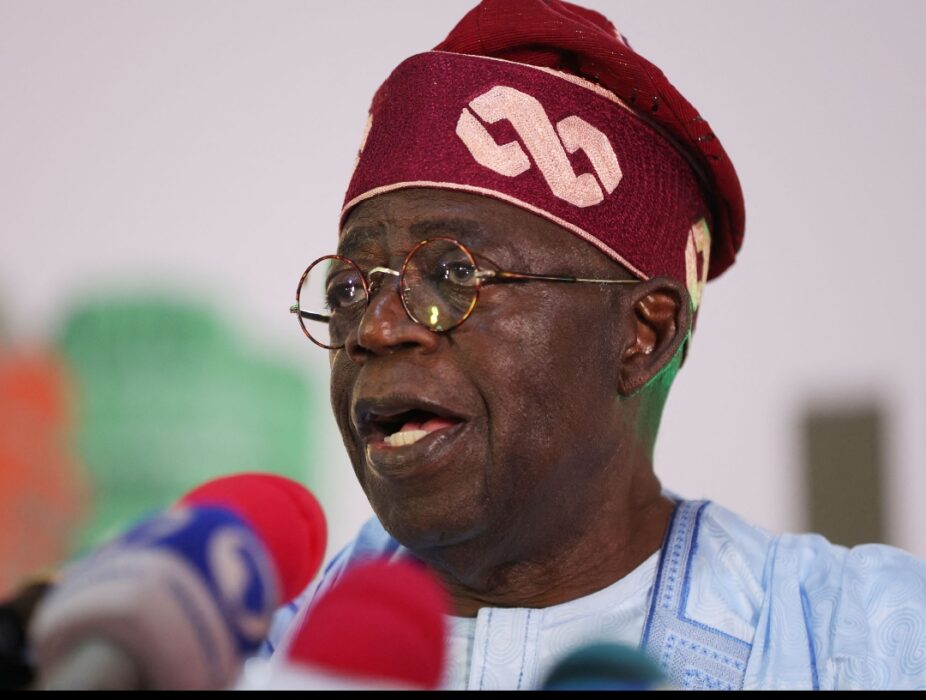
The development followed President Tinubu’s directive that the lower operating costs associated with CNG and electric vehicles should translate into cheaper transportation for Nigerians.
The president, during a meeting with All Progressives Congress (APC) governors at the State House, Abuja, had revealed that the governors had resolved to take immediate measures to bring down intra-state transportation costs by leveraging the cost advantages of CNG and electric vehicles.
He said a joint federal and state committee would be established to commence immediate implementation of the measures agreed with the governors.
However, nearly three weeks to the deadline, transport unions said they were yet to receive clear implementation guidelines.
Speaking exclusively to LEADERSHIP, the Ikeja branch chairman of the National Union of Road Transport Workers (NURTW), Comrade Isiaka Apena, said transporters had not been briefed by either the state or federal government on how the fare reduction would be implemented.
“The issue is that when the President gives a directive to reduce transport fares, the government should convene a stakeholders’ meeting and engage transport unions on how to implement the directive.
“For now, we have only heard about the directive in the news, but we do not know the strategy for implementing it. We do not know whether the government plans to subsidise transport costs or provide CNG-powered vehicles to the unions while directing them on how much to charge passengers.
“It would be difficult to tell a commercial vehicle owner who used his money to buy fuel or fill his vehicle with CNG to charge passengers a fixed fare. I do not think that would be wise. What we can do is appeal to transporters to reduce their fares slightly. For instance, if a transporter charges N1,500 on a route, we can ask the person to reduce it to N1,300.”
Apena said the government could only determine the appropriate fare if it subsidised the vehicle or its operating costs.
“If the fare is N1,500, for example, and the government provides a N500 subsidy, it can direct the operator to charge passengers N1,000 because the government is covering the remaining N500.
“Therefore, I believe the government should set up a committee and meet with the NURTW to determine how best to implement the directive and achieve its objectives.
“The government should clarify whether it plans to provide buses or subsidise a percentage of the operating costs. If that is done, the policy can work. But transport fares will not simply fall without the government providing some form of support.”
Apena also identified inadequate CNG refuelling infrastructure as another major challenge.
“We have a limited number of refuelling stations. There are often long queues at the few available stations, but the problem will reduce when more stations are established. For instance, Agidingbi is currently the only CNG station in Ikeja, while the next available stations are in Agege or Mushin.
“You can see the difference in the waiting time. At a petrol station, you may spend no more than five minutes buying fuel. But at a CNG station, some people sleep in queues while waiting to refuel.”
Findings by LEADERSHIP at CNG stations in Lagos and Abuja corroborated his account, with drivers describing hours-long waits that eat into their earning time and, in some cases, force them to pass the extra cost on to passengers.
A tricycle operator at the Agidingbi station, who simply identified himself as Chidi, said he now arrives as early as 4 a.m. to secure a place in the queue because the crowd builds up quickly once the station opens.
“By the time petrol drivers have filled up and gone three or four rounds, we are still waiting for our turn. Some of us close very late because of the time we lose here,” he said, adding that some of his colleagues had reverted to petrol on days when the queue was too long.
A commercial bus driver operating on the Berger-Ikeja route said the wait sometimes stretches beyond five hours during peak periods, with drivers occasionally sleeping in their vehicles overnight to be among the first served.
“If you don’t come very early or you don’t queue overnight, you can spend almost half of your working day here,” he said, noting that the lost hours often meant fewer trips and less income.
Also speaking, the executive secretary of the Nigerian Association of Road Transport Owners (NARTO), Aloga Ogbogo, said the association was monitoring the president’s directive and would provide an update.
“We refrain from speaking now but we will give comprehensive update on the presidential directive,” Ogbogo said.
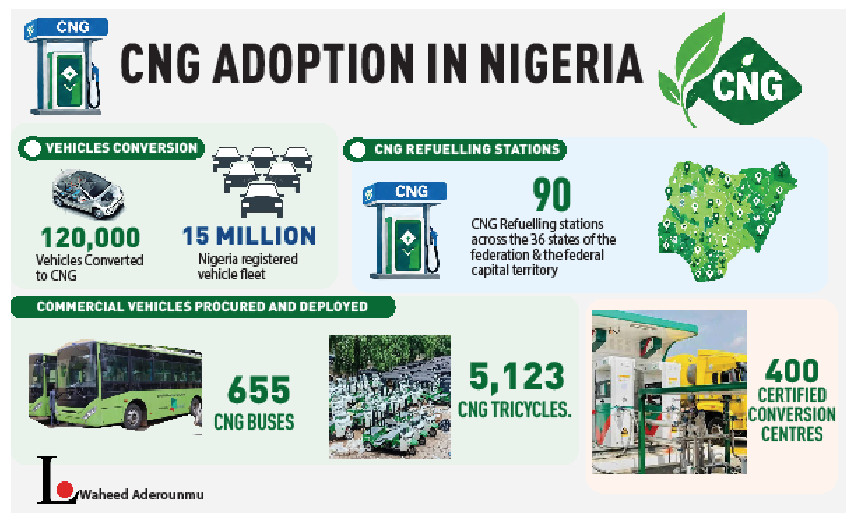
Data from Pi-CNG & EV indicates that about 120,000 vehicles have been converted to CNG since 2023 through a network of about 400 certified conversion centres and barely 90 refuelling stations across the 36 states and the Federal Capital Territory.
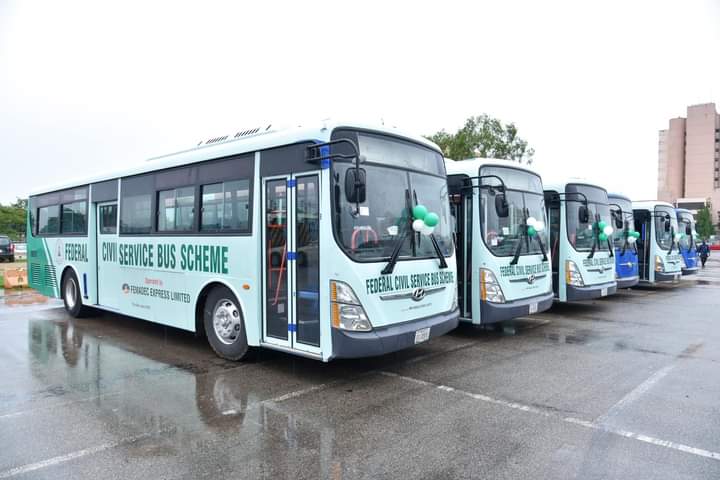
The government has also procured and deployed 655 CNG buses and 5,123 CNG tricycles.
Despite the growing number of CNG-powered buses, tricycles and mini-buses on some major routes, checks by LEADERSHIP showed that transport fares have remained largely unchanged.
For instance, the Sango-Ota, Ogun State, to Oshodi, Lagos State, route still attracts between N1,500 and N1,700, while fares from Atan-Ota to Abule-Egba or Agege range between N1,200 and N1,500.
Similarly, commuters travelling from Sango to Abeokuta still pay about N2,000, while the fare from Ojodu Berger to Ibadan stands at about N2,500. The fare from Ojodu Berger to Oyo State is as high as N5,000.
The Bus Rapid Transit (BRT) service has also maintained its existing fares within Lagos metropolis as of the time of filing this report.
The situation has raised questions over whether the cost advantage of CNG is being passed on to commuters as the October 1 target draws closer.
A commuter, Adebayo Ojo, said there had been no reduction in transport fares.
“Interestingly, the bus I boarded from Iyana-Ipaja to Oshodi charged me N500, the same fare charged by petrol-powered buses. This shows that without proper monitoring and public sensitisation, the directive will not bring about any change,” he said.
Another commuter, Bolu Adegbite, said that despite the growing number of CNG-powered vehicles around Toll-Gate, Ota, fares remained high.
“I commute from Toll-Gate to Abule-Egba daily and the vehicles that I use are mostly CNG vehicles, but transport fares are still high,” he said.
Stakeholders and analysts who spoke with LEADERSHIP also questioned whether the president’s promise could be realised in the short term.
Automobile engineer and chairman of the Board of Directors of Driving Schools in Nigeria, Saliyu Aliu, cited the limited spread of CNG infrastructure across the country.
“There will be no significant impact for now.
“I do not think the president’s directive will be fully realised because CNG infrastructure has not covered most states. If CNG were widely available across the country, we would already be experiencing a drastic reduction in transport fares.
“Currently, only a few vehicles and tricycles operate on CNG in places such as Lagos and Abuja. In many other states, people cannot see or experience the benefits of CNG.
“If the government wants the directive to have an impact, it should establish more CNG refuelling stations across the states. This would help reduce the pressure created by high petrol prices.”
Aliu said the North was particularly affected because of its heavy dependence on commercial transportation.
“For now, however, the impact of CNG is insignificant, particularly in the northern part of the country. The North is bearing the brunt of rising transport costs because about 75 per cent of motorists there are commercial drivers.
“Regardless of what the government does, its efforts will have little effect if motorists in the North cannot convert their vehicles to CNG or access CNG refuelling stations.”
Automotive development expert, Luqman Mamudu, however, commended the government’s commitment to alternative energy and efforts to tackle spiralling transport costs.
He noted that the scale of CNG conversion remained small relative to Nigeria’s total vehicle fleet, making additional measures necessary for commuters to experience significant fare reductions in the short term.
“However, converting 120,000 vehicles against Nigeria’s registered fleet of 15 million is only a starting point. To achieve rapid, widespread fare reductions, these efforts must be augmented in the short term by targeted transport subsidies while we build out EV and gas infrastructure,” Mamudu said.
Responding to the concerns, the chief operating officer of Pi-CNG & EV, Tosin Coker, said the lower operating cost of CNG must translate into tangible savings for commuters, but stressed that implementation “will not be one-size-fits-all”.
According to Coker, the rollout will be driven at the state level through committees involving state governments, Pi-CNG & EV and other stakeholders, since transport structures, routes, operators, infrastructure and CNG penetration vary from state to state.
Specific metrics will track fare trends, he said, with the focus on measurable reductions in transport costs rather than simply counting conversions or refuelling stations.
Coker clarified that the October 1 target should not be interpreted as a single national conversion quota, given the varying levels of transport activity and CNG development across states.
“The emphasis is on increasing the number of commercial vehicles operating on CNG while simultaneously expanding the infrastructure required to support them. Conversion alone cannot deliver sustainable fare reductions if operators cannot conveniently access CNG.”
On the involvement of transport unions, Coker said fare reduction had always been part of Pi-CNG & EV’s discussions with operators and that state-level structures were being developed to bring the relevant actors together.
“Engagement with NURTW, RTEAN, NARTO and other state transport unions, cooperatives, operators and state governments are part of the implementation process. State-level structures are being developed to bring the relevant actors together and determine the model best suited to each state.
“Fare reduction has always formed part of our engagements with transport unions and operators. As infrastructure expands across the country, we are now in a stronger position to reinstate those commitments and develop more fit-for-purpose terms that reflect the realities in each state.”
He said it would be premature to publish a definitive list of participating unions, cooperatives or fleets because the engagements and arrangements were at different stages.
“The important point is that the programme depends on collaboration between the federal government, state governments, transport operators and other stakeholders to ensure that the savings from CNG reach commuters.”
Coker added that the strategy was not to compel motorists to abandon petrol outright, but to make CNG sufficiently affordable, accessible and commercially attractive to give operators a strong economic incentive to switch.
Pi-CNG & EV, he said, is facilitating partnerships, including with fintech firm Moniepoint, to provide credit options that allow eligible vehicle owners and operators to finance conversions and repay over time rather than bear the full cost upfront.
He added that infrastructure remained equally critical, noting that conversion alone could not deliver sustainable fare reductions unless operators could conveniently access CNG.
Many converted vehicles, he said, were bi-fuel and could still run on petrol. The long-term objective was not to remove that choice but to ensure CNG remained the more attractive option through its cost advantage and an increasingly accessible refuelling network.
For that reason, Coker said monitoring should not focus simply on whether individual drivers switch between CNG and petrol, but on CNG availability, utilisation and the extent to which lower operating costs translate into reduced transport costs for commuters.
We’ve got the edge. Get real-time reports, breaking scoops, and exclusive angles delivered straight to your phone. Don’t settle for stale news. Join THISTIMES on WhatsApp for 24/7 updates →
Join Our WhatsApp Channel