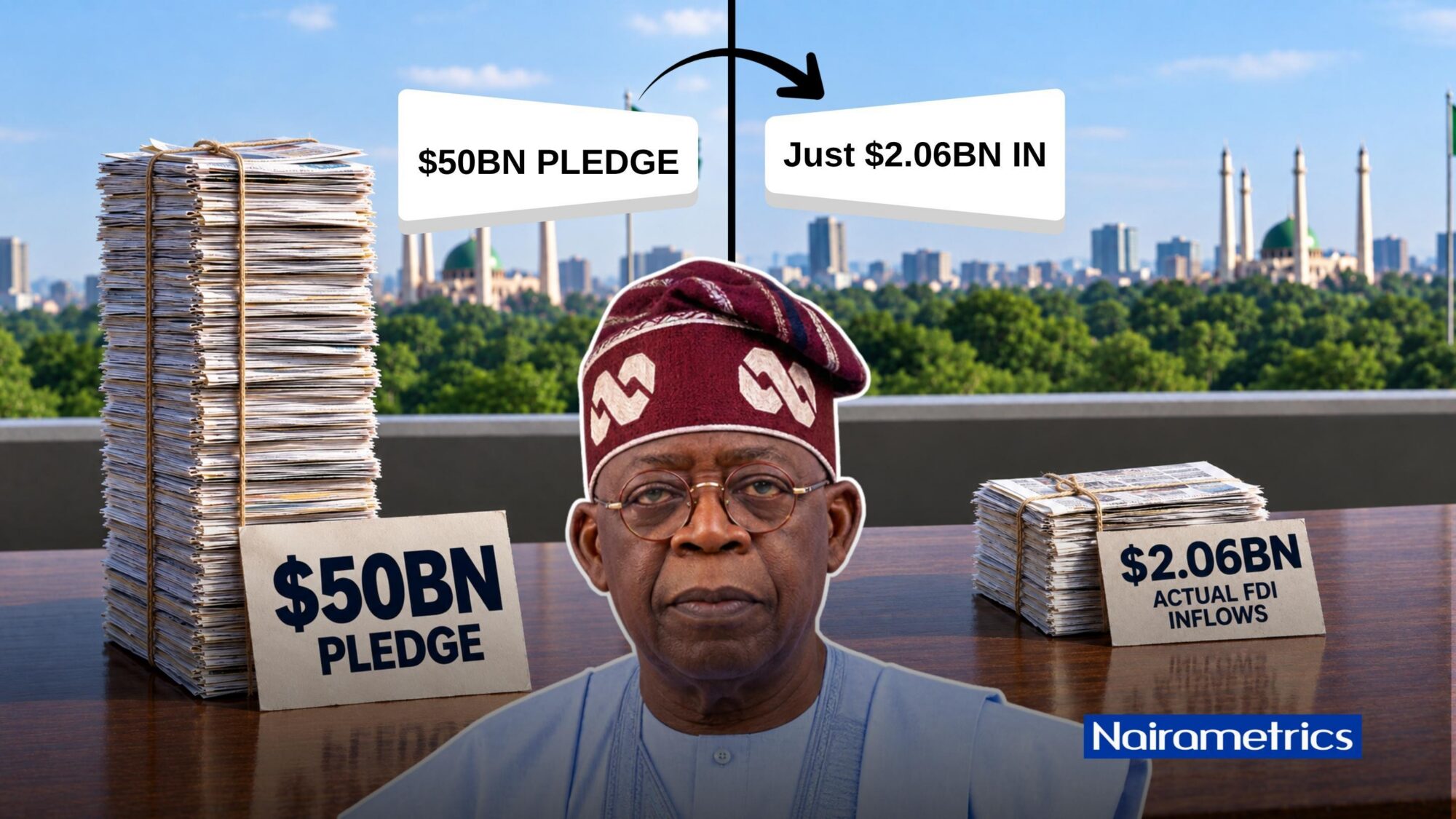
President Bola Ahmed Tinubu has secured over $50 billion in Foreign Direct Investment (FDI) commitments through 87 Memoranda of Understanding (MOUs) since assuming office on May 29, 2023, but only about $2.06 billion has been recorded as actual FDI inflows into Nigeria in that period.
The commitments, secured through the President’s foreign trips and diplomatic engagements, span sectors including energy, manufacturing, logistics, agriculture, technology and infrastructure.
While the Federal Government has highlighted the commitments as evidence of growing investor confidence, the wide gap between pledged investments and actual inflows has generated mixed reactions, with some Nigerians and public commentators questioning the figures.
President Tinubu has embarked on more than 36 foreign trips in over three years of his administration, visiting countries across Africa, Europe, Asia, the Middle East, the Caribbean and the Americas, with about N37.6 billion reportedly spent on travel-related expenses.
The trips have focused on strengthening Nigeria’s bilateral relations with other countries and attracting investments.
Some of the major investment pledges include ExxonMobil’s $10 billion for expanding deepwater oil production, APPL’s €9.2 billion for the Hydrogen Polis project in Akwa Ibom State, and Indorama’s $8 billion to expand petrochemical and fertilizer facilities in Rivers State.
Other commitments include Jindal Steel’s $3 billion for iron ore processing and steel production, Shell’s $3 billion for oil and gas investments, and Arise Integrated Industrial Platforms’ $3.5 billion for infrastructure and industrial development.
The Federal Government has maintained that investment commitments should not be interpreted as immediate cash inflows, as investors may require time to reach final investment decisions and implement projects.
Nigeria attracted about $47.6 billion in foreign capital between May 2023 and the first quarter of 2026, marking one of the strongest three-year periods for capital inflows since 2019, according to data from the National Bureau of Statistics (NBS).
The figures show a significant gap between investment commitments announced by the Tinubu administration and FDI that has actually entered the economy.
However, commitments do not translate immediately into capital inflows. Large investments can take years to materialise as businesses consider financing, regulatory approvals, exchange-rate risks and other operating conditions.
This makes announced commitments an imperfect benchmark for measuring actual investment flows. While they indicate investor interest and a potential pipeline of projects, realised FDI provides a clearer measure of capital that has actually been deployed.
Economist and Founder/Chief Executive Officer of the Centre for the Promotion of Private Enterprise (CPPE), Dr Muda Yusuf, said FDI investors typically take time before committing funds because they assess country risks, alternative investment opportunities and other factors.
Yusuf said previous company divestments and the broader macroeconomic environment could also influence investors’ decisions, with some investors preferring to wait and assess developments.
Economist and University of Abuja lecturer, Dr Olu Olajemgbesi, said the $50 billion in pledges shows that the Tinubu administration has attracted considerable interest from international investors, but stressed that investor interest is different from realised investment.
He said the key issue is how much of the announced commitments have progressed beyond announcements into actual projects and capital deployment.
He also questioned how many jobs have been created and how much additional productive capacity has been established from the pledged investments.
Olajemgbesi said the foreign trips should not be considered a failure simply because $50 billion has not translated into $50 billion of FDI.
He, however, said the gap raises legitimate questions about the government’s ability to convert investment diplomacy into deployable capital.
He emphasised that investor confidence should be judged not by the size of the cheque mentioned at a meeting, but by the amount of capital investors are willing to commit, transfer and put to work in Nigeria.
Nairametrics had earlier reported that FDI accounted for less than 4% of total capital imported into Nigeria in 2025, according to NBS data.
The data showed that while total inflows strengthened significantly in 2025, the bulk of the increase came from foreign portfolio investors rather than long-term direct investors associated with factory investment, business expansion and durable job creation.
The figures underline the continued dominance of more mobile portfolio funds in Nigeria’s capital importation, despite the increase in the absolute value of FDI.