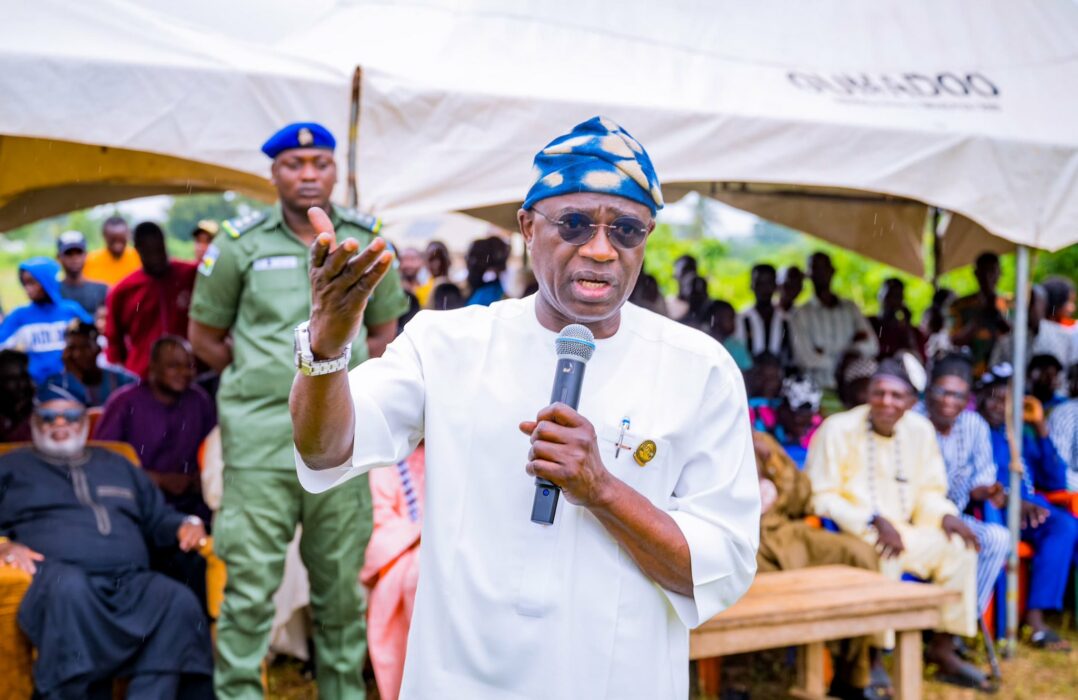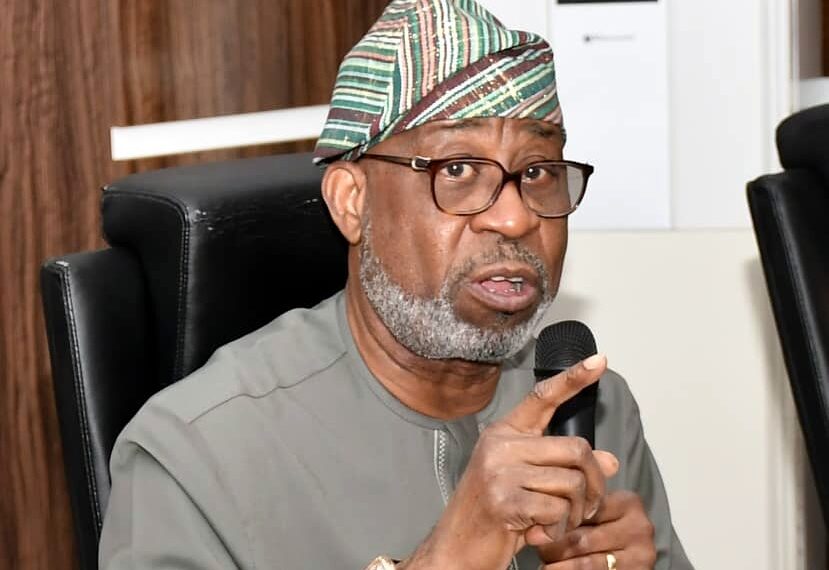
The Minister of Solid Minerals Development, Dele Alake, has said Nigeria needs President Bola Tinubu beyond 2027 for the consistency and continuity of positive reforms introduced by the administration.
Alake, the Lead Spokesperson of the 2027 All Progressives Congress (APC) Presidential Campaign Council, stated this during an interactive session with journalists in Abuja on Wednesday.
He stressed that Tinubu’s economic reforms, especially the removal of the fuel subsidy, which has a far-reaching effect of freeing up resources for infrastructure development and meeting other government responsibilities at all levels, deserve protection by re-electing the president in the 2027 polls.
According to Alake, Tinubu took the bullets for removing the subsidy, which was hitherto the big elephant in the country’s economic room, despite being fully aware that the action would have repercussions on his re-election bid.
He said Nigerians knew what the economy was before the coming on board of the present administration in 2023, and all the reforms and the policies that were necessary to correct “these distortions and contradictions in the Nigerian society were there and identifiable by those previous governments,” but they lacked the courage to take those decisions.
“If a man who is a politician himself, who should be very sensitive to elections coming back to office, decided to take the bullet, regardless of the consequences on his own political career, on behalf of the nation, because the nation had to be reset, I think it’s just very, very important for us to appreciate that. And that is the kind of person that Nigeria needs for consistency.
“Yes, those hard decisions have been taken. The hard decisions, as I said, must have their own attendant challenges. There’s no government policy anywhere in the world that is 100% foolproof, especially when it has to do with human beings.
“Like I always say, human beings are the most difficult factor of economic production or economic progress. What are the factors of production? Land, capital, and all that machinery. But the most difficult to manage is labour, because labour means human beings,” Alake stated.
He also said there are some individuals in society who were benefiting from the negative system that had brought the country to its knees, such as the fuel subsidy.
Alake insisted that: “the beneficiaries of the fuel subsidy were the oil cartels. They would buy the fuel at a lower price, cross the border, immediately make humongous profits and come back to Nigeria to oppress the rest of us.
“Those people were benefiting from it, and so when the fuel subsidy was removed, did you think that they would fold their arms and be looking? No, they will fight back, they will push back, and they are fighting back, and they are pushing back.”
He recalled that before the Tinubu administration and the removal of the fuel subsidy, more than half of the states could not pay salaries, while the federal government was borrowing to meet those obligations.
“I recall more than 18 states, if not more, I’m sure more, could not meet up with the wages. Some who were trying were paying maybe half salary or a quarter, or spreading the salaries and stuff like that.
“Money that should have been freed and put into use, into infrastructure and other constructive regenerative sections of the economy, could not get the funds.
“So, somebody came who did not care about the political fallout to his own political experience and decided, like I said, to take the bullet. And oh, all hell broke loose. There are pains. There’s nothing good that comes without some modicum of pain,” Alake said.
He identified, among other benefits of the subsidy removal, the student loan scheme, which, in addition to covering school fees, provided monthly allowances to students to address the challenge of funding tertiary education.
“That is the trickle-down effect. Now, students have access to loans. So the issue of my dropping out of school because my parents cannot afford it is no longer there.
“Now, on top of that, they are getting allowances monthly, N20,000 or so, which was never there. Now, that is a direct, the student himself or herself is a partial beneficiary. They are scattered in various sectors of the economy like that,” Alake said.
He urged Nigerians to demand from the various presidential candidates and others contesting the election, the stewardship of the previous offices they held to earn their support.
“When people who have no tangible landmarks, they’ve been in public office, they’ve been governors or vice presidents or whatever – ask them what landmarks did they leave in their various spheres of authority when they were in public office that would justify their coming or aspiring to come and lead Nigeria. Ask them. None of them can point to several landmarks…, Alake said.
He also dismissed concerns about the Presidential Campaign Council list, saying it is an internal party mechanism and not a cabinet list that would influence government policies.
“It is just an internal mechanism of the party. So whether the list is being adjusted, tinkered with, or not is an internal matter of the party. What the public requires is what the campaign messaging, the manifesto, the policies, the projections, and all that entail, not the internal constitution of the campaign council, because it bears no relevance to the aspirations of the public.
“Or may I ask, dutifully, that it is the faces of the campaign council that will determine the policies that will affect Nigerians? No. Honestly, the policies the campaign council develops can be developed without announcing a single name. The campaign council is an internal thing,” he added.
We’ve got the edge. Get real-time reports, breaking scoops, and exclusive angles delivered straight to your phone. Don’t settle for stale news. Join THISTIMES on WhatsApp for 24/7 updates →
Join Our WhatsApp Channel