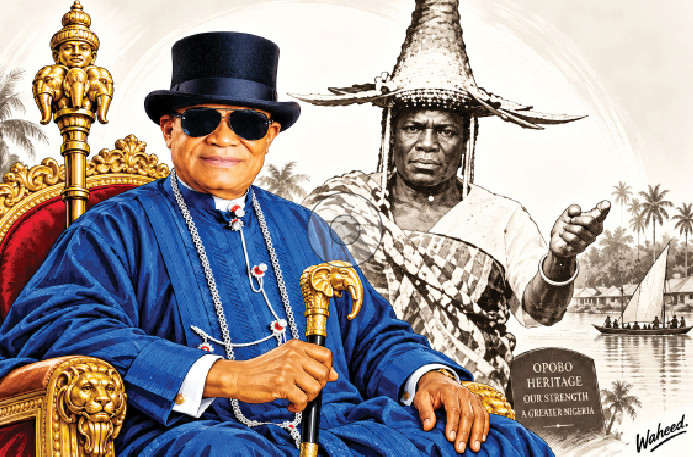
If King Jaja of Opobo were alive today, where would he stand amid Nigeria’s diplomatic pressure, economic uncertainty and deepening social tension—and what would he do? Would he negotiate, confront, build, or turn adversity into leverage?
History is most useful when it refuses to remain in the past. More than a century after Jaja’s rise, his story speaks urgently to Nigeria’s struggles over resources, economic independence, leadership and institution-building. His life poses a contemporary question: what might Nigeria become if its leaders pursued sovereignty and economic agency with Jaja’s strategic audacity?
The question gains resonance as Opobo Kingdom prepares for the coronation of His Majesty, King Charles Douglas MacPepple Jaja, Jeki VI, as Amanyanabo and Treaty King on September 26, 2026. Coronations honour ancestry and tradition. Yet the finest tribute to Opobo’s legacy is to ask what Jaja’s example demands of a nation still struggling to convert abundance into prosperity.
Jaja’s achievement was extraordinary not simply because he rose from adversity to become a powerful king and merchant, but because he understood the architecture of power. Palm oil was more than a commodity; it underwrote a political economy. Whoever controlled access to the hinterland, trading channels, terms of exchange and relationships with foreign merchants possessed not only wealth, but leverage.
From Opobo, Jaja built a formidable commercial and political order. He organised people, secured routes, cultivated alliances and resisted European attempts to bypass African middlemen and dictate commercial terms. His struggle was not against trade with the outside world. It insisted that engagement must not become surrender and that partnership must not deprive a people of the right to defend their interests.
From Resources to Economic Power
Here Jaja becomes a mirror for modern Nigeria. The commodities have changed; the questions have not. Who sets the terms on which Nigerian resources enter the world economy? Who owns the technology, finances production, processes raw materials and controls distribution? Who captures the value, and how much remains in Nigerian hands?
Nigeria has too often mistaken possession for power. Producing crude oil is not the same as controlling the petroleum value chain. Growing cocoa, sesame, cashew or tomatoes is not the same as processing, packaging, branding and distributing them. Deposits of lithium, gold or iron ore do not guarantee prosperity. A resource becomes national power only when knowledge, capital, infrastructure and institutions are organised around it.
Jaja understood that distinction in the nineteenth century; Nigeria still wrestles with it in the twenty-first. We export too many raw materials and talented people, then import finished goods, technology and expertise at a premium. We celebrate output while neglecting value retention. A large market that mainly consumes what others produce is not yet an economic power; it is an opportunity captured by others.
Economic self-determination does not mean isolation or hostility to investment. Jaja traded internationally and valued external relationships. The lesson is to engage with clarity and strength. Foreign capital should enlarge domestic capability, not replace it. Partnerships should leave skills, technology, supply chains, tax value and competitive Nigerian enterprises behind. Trade should be a bridge to production, not a substitute for it.
Institutions That Outlive Their Leaders
This requires more than patriotic rhetoric: it requires organisation. Jaja’s power rested not on courage alone, but on commercial networks, political relationships, rules and a disciplined community capable of coordinated action. His story exposes Nigeria’s deeper contradiction. The country does not lack exceptional individuals; it lacks enough durable institutions to convert individual brilliance into collective progress.
Too much of public life revolves around personalities. A reform advances because an official champions it, then falters when that person leaves. Programmes arrive with ceremony but without the budgets, data, capacity and accountability to endure. Roads lack maintenance systems. Training lacks pathways to work. Policies change before businesses can plan. Ambition produces episodes, not transformation.
Jaja’s example challenges leaders to build beyond themselves. Are they creating personal networks or public institutions? Distributing favours or widening productive opportunity? Reacting to the latest crisis or reducing vulnerability to the next? The distinction between governance and nation-building lies here: governance can manage today; nation-building equips tomorrow.
The implications are clear. Nigeria must convert population into human capital through investment in education, health and technical competence. Transport and digital systems must connect producers to markets. Reliable energy must become an economic foundation, not a private tax on households and enterprises. Law must protect contracts and property. Policy must reward those who produce, innovate and employ, not merely those with privileged access.
The lesson is especially urgent in the Niger Delta. The region that supplied the palm oil at the centre of Jaja’s power later became the heart of Nigeria’s petroleum economy, yet many communities remain scarred by pollution, poverty, unemployment and inadequate infrastructure. This is not merely a development failure; it is a moral contradiction. No region should indefinitely bear the environmental and social costs of national wealth while receiving fragments of its productive promise.
Honouring Jaja in the Niger Delta must therefore mean more than preserving palaces, titles and ceremonies. It should mean building a regional economy around modern ports, maritime services, fisheries, agro-processing, gas-based industries, environmental restoration and youth enterprise. Host communities must participate meaningfully in governing and benefiting from the resources around them. Heritage is most alive when it becomes a platform for human progress.
Sovereignty in an Age of Dependence
Jaja’s fate carries a warning. Resistance to expanding British commercial and imperial power led to his arrest and exile in 1887. Economic power is never uncontested. Nations with strategic territory, critical resources or large markets should expect pressure. The answer is neither theatrical defiance nor timid compliance, but intelligent statecraft: knowing what to defend, negotiate and build so engagement does not begin from weakness.
Nigeria’s diplomacy therefore cannot be separated from domestic competence. Dependence on foreign essentials, technology, capital and infrastructure weakens Nigeria’s negotiating position. Sovereignty may be proclaimed in constitutions, but it is strengthened in factories, laboratories, farms, classrooms, ports and reliable institutions. Flags symbolise independence; productive capacity sustains it.
Jaja should not be romanticised. No nineteenth-century order can simply be transplanted into a diverse modern federation. History invites illumination, not imitation. Jaja shows that resilience is more than surviving adversity; it is converting adversity into organised capacity. Leadership is more than occupying authority; it is using authority to expand a people’s agency.
The coronation of King Charles Douglas MacPepple Jaja, Jeki VI, offers more than cultural spectacle; it invites national reflection. The Opobo tradition represents dignity anchored in achievement, authority joined to responsibility and sovereignty reinforced by economic capability. Those values demand expression in the choices of governments, businesses, communities and citizens.
If King Jaja were alive, he might recognise Nigeria’s predicament immediately: a gifted people operating below their collective power, a resource-rich nation capturing too little value and a sovereign state negotiating too often from dependence. He would also understand that outrage without organisation changes little.
His challenge to this generation would not be to recreate his world, but to recover his strategic imagination: to build institutions that outlive their founders, enterprises that compete beyond Nigeria’s shores and an economy that gives citizens a meaningful stake in prosperity. Jaja’s legacy remains unfinished because Nigeria’s central task remains unfinished—turning potential into power, resources into shared value and political independence into economic self-determination.
– Dr Dakuku Peterside, Leadership Architect and Management Turnaround Expert, is the author of the book Leading in a Storm
We’ve got the edge. Get real-time reports, breaking scoops, and exclusive angles delivered straight to your phone. Don’t settle for stale news. Join THISTIMES on WhatsApp for 24/7 updates →
Join Our WhatsApp Channel