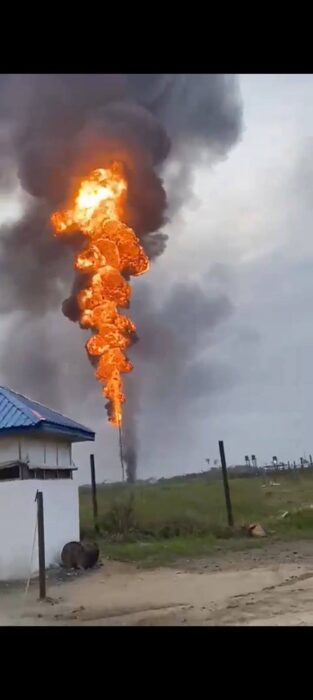
A coalition of non – Civil Society Organisations including other non – State actors converging for the 2026 Climate Week in Upenekang, one of the oil communities devastated by oil spills and gas flaring, have rallied residents for urgent action to draw government attention to menace
The car conferees including the Network Advancement Program for Poverty and Disaster Risk Reduction (NAPDRR), Health of Mother Earth Foundation (HOMEF) and other concerned organisations, lamented the wholesale destruction of farmlands and water pollutions.
Resource persons at the forum noted with empathy that fumes occasioned by oil and gas exploration by both local and International Oil Companies (IOCs) have led to acid rains and other pollutant causing skins’ blights, roofing decays, early menopause in women, impotency in men and subsequent death to residents, especially children.
The forum was organised under the aegis of Ibeno Youth Advocacy Network (IYAN) and supported by the Africa Greengrant Fund (GGF), at the Upenekang Students’ Library Hall, Ibeno LGA, on Monday, with the theme; “The Role of Government in Climate Resilience: From Petrodollars to People-Power.”
Addressing the summit, the guest presenter, Hon. Emem Edoho, the Executive Director, NAPPDRR, noted with regret, the wanton destruction of the natural ecosystems by oil firms with any recourse to best practices as enshrined in the Petroleum Industry Act (PIA), and charged the youths under the IYAN platform to rally peacefully against oil firms plodding their environment without following the regulatory framework.
“My dear youths, custodians of the longest coastline in Nigeria, we stand on oil, we sleep on gas, yet we drink polluted water and breathe flared air. This is not an accident; it is a design.
“I want to start with a question from Prof. PLO Lumumba, a man who speaks for Africa,” he said, recalling PLO’s remarks thus; “In Saudi Arabia, the discovery of oil turned the desert into paradise. It built world-class cities from sand. In Nigeria, in the Niger Delta, in Ibeno, the discovery of oil turned paradise into desert. It turned abundance into misery, wealth into wounds,” he said.
However, Edoho noted that the case in the Nigeria’s Niger Delta appears different as same oil but different leadership brought lamentations and endless woes to residents of oil communities, noting that “in Saudi, oil money built prosperity. In Ibeno, oil money built pollution, poverty and underdevelopment.”
According to him, while government has power in Ibeno, it has no ideas to protect Ibeno, perhaps for it selfish interests.
“Development is not about skyscrapers in Uyo while Upenekang sinks. Development is about how you treat your environment and your people, wondering why the oil and gas community of Ibeno, and other oil producing areas should be allowed to ebbed to ground zero in the climate justice pecking order.
“You know this better than any paper can tell you, because you live it. The Atlantic is eating us. Here in Upenekang, Iwokpom, Mkpanak, Okorutip – we are losing 15-20 meters of shoreline every year. Our ancestral homes, our cemeteries, our playgrounds are going under.
“Our air is on fire. For 60 years, ExxonMobil and others have flared gas in our sky. We flare what should power our cold rooms, our schools, our businesses.
Our waters are dead. Oil spills and polluted water have killed our mangroves, our periwinkles, our crayfish. The fishermen now fish for plastic and oil sheen.
“Our poverty is manufactured. Akwa Ibom gets 13 percent derivation from our oil, yet Ibeno has no shoreline protection wall, no standard general hospital, no climate-resilient housing.
Government cannot claim to be building resilience when it is still licensing our destruction.We did not start this struggle today,” he stressed.
Rallying committed people for the agitations to succeed, the resource person, urged the youths and other aggrieved residents as torch – bearers to borrow a leaf from other freedom fighters like the late Ken Saro-Wiwa (1941-1995), an Ogoni writer who became the voice of all oil minorities that taught the world that the environment is the first human right.
“The environment is man’s first right. Without a safe environment, man cannot exist to claim other rights,” he noted, and reminded the youths that “silence is complicity.”
He also advised the youths to draw strength from other Niger Delta environmental agitators – Oronto Douglas, who moved the struggle from protest to the courtroom against Anglo -Dutch Shell, and
Nnimmo Bassey, an environmental rights activist, using his Foundation, HOMEF, to draw governments and the international community to the plights of the people of Niger Delta wallowing in oil poverty over the years.
“We are not just fighting for our oil, we are fighting for our right to breathe. We thought it was oil, but it was blood. Our mangroves are not bush – they are our seawall, our bank, our future,” he explained, and commended the unsung women of Ibeno and Eket who shut down flow stations with empty basins, Chief Edwin Clark, Annkio Briggs, and Emem Okon of Kebetkache.
Alleging governments’ complicity, Edoho described the authorities as landlord, not guardian, arguing that “government sees Ibeno as an Automated Teller Machine (ATM), but not as a community, adding that its only interest lies in collecting royalties but abandons responsibility.
He accused the government of approving the Environmental Impact Assessments (EIAs) without community consent, “allowing IOCs to break the law, then comes back with NDDC palliatives when flood displaces 5,000 people.
“As we speak today in Upenekang, Akwa Ibom is a State with 129km of coastline, is most threatened by sea-level rise in Nigeria, and has no legally binding State Climate Change Policy, no climate action plan, no local government climate adaptation roadmap,” he stated, explaining that without these, “you cannot access loss and damage funds, you cannot access carbon credits, you cannot force ExxonMobil to pay, you cannot plan shoreline protection, without a policy that is law,” he added.
However, to escalate the advocacies, the NAPPDRR chief charged the youths to organise Climate Assemblies in every ward, attend every budget hearing in Ibeno LGA and in Uyo, interrogate provisions of the 2027 budget for Ibeno’s shoreline and move from protest to policy.
To the the State government and House of Assembly, the conferees called for urgent steps to develop, enact and fund the State climate change policy, climate action plan, and climate justice law within the next six months, and the Ibeno Chairman and Legislative Council to immediately develop and pass into a By-Law, the Ibeno local government climate resilience roadmap and adaptation plan.
“We do not want resilience that teaches us how to swim better in polluted water. We want resilience that stops the pollution. Government’s role is not to give us life jackets while it drills holes in our boat. Government’s role is to stop drilling holes. Ibeno has given Nigeria light for over 60 years. It is time Nigeria gives Ibeno life,” he stressed.
We’ve got the edge. Get real-time reports, breaking scoops, and exclusive angles delivered straight to your phone. Don’t settle for stale news. Join THISTIMES on WhatsApp for 24/7 updates →
Join Our WhatsApp Channel
