The Independent National Electoral Commission (INEC) has commenced nationwide readiness assessments and staff engagements as part of intensified preparations for the 2027 general elections, with procurement of non-sensitive materials and voter register processes also underway.
The Commission said the exercise, being conducted across the six geopolitical zones, is designed to identify operational gaps, assess emerging risks and deploy corrective measures ahead of the elections.
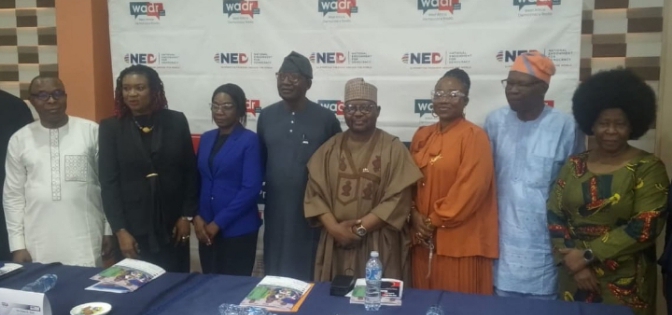
INEC chairman, Prof. Joash Amupitan, disclosed this on Thursday in Abuja in a speech delivered on his behalf by the director, Planning and Monitoring Department, Mrs Helen Omozua Ajayi, at the Democracy and Governance Forum organised by West Africa Democracy Radio (WADR).
The forum brought together electoral officials, civil society organisations, media practitioners, development partners and governance experts to discuss Nigeria’s democratic process ahead of the 2027 elections.
The event was organised under the theme: “Nigeria’s Democratic Process: Accountability, Security and Electoral Integrity.”
Amupitan said INEC’s preparations had moved beyond the planning stage to what he described as “intensified operational readiness, assurance, and deployment.”
He said the Commission’s election timetable had been translated into a coordinated programme covering its 23 departments and directorates, 36 state offices, the Federal Capital Territory and 774 local government areas.
According to him, some activities had been completed, while others are ongoing, with subsequent activities scheduled to commence at the appropriate stages of the electoral timetable.
The INEC chairman said the Continuous Voter Registration (CVR) exercise and display of the Preliminary Register of Voters for claims and objections had been completed.
He added that the generation of the PDF Register of Voters for nationwide display was ongoing, alongside the synchronisation of CVR data and preparations for the collection of Permanent Voter Cards (PVCs).
The Commission also disclosed that procurement and delivery of non-sensitive electoral materials to state offices had commenced, saying the early procurement was intended to provide adequate time for distribution and deployment ahead of Election Day.
Amupitan said INEC had equally undertaken training and capacity-building programmes for election personnel, while preparations for intensified voter education and public enlightenment had commenced.
He said the voter education campaign would cover voting procedures, accreditation, the use of the Bimodal Voter Accreditation System (BVAS), Election Day procedures and PVC collection.
The campaign, he added, would target various groups, including women, young people, persons with disabilities and voters in hard-to-reach communities.
On election technology, Amupitan said improvements to BVAS and the election results management process, including the deployment of the eEC8A form, were aimed at strengthening end-to-end result visibility and reducing opportunities for manual interference.
He said the nationwide readiness assessments would also provide an opportunity to engage Resident Electoral Commissioners, administrative secretaries, heads of departments, electoral officers, assistant electoral officers and other critical personnel on the commission’s expectations ahead of the elections.
Amupitan said electoral preparedness could not be measured solely by INEC’s ability to conduct the election on polling day, stressing that public confidence and trust were equally important.
“The focus is not only on completing scheduled activities, but also on ensuring that the systems, processes, personnel, technology, logistics, and institutional structures required to support the election are ready, functional, and operationally coordinated as the election date approaches,” he said.
INEC’s official timetable currently fixes the Presidential and National Assembly elections for February 20, 2027, while the Governorship and State Houses of Assembly elections are scheduled for March 6, 2027.
Speaking as keynote speaker, WADR Board Member, Dr Muhammad Kudu Abubakar, said the credibility of the 2027 elections would depend heavily on accountability, security and electoral integrity.
Abubakar said technological reforms could not, on their own, resolve the challenges confronting Nigeria’s electoral system, urging INEC to be more transparent about the cleaning and verification of the voters’ register.
He said the integration of the National Identification Number (NIN) into the process of auditing and verifying the voters’ register could help address problems associated with duplicate registrations, deceased voters and other anomalies.
He, however, urged the commission to provide Nigerians with clear figures on the outcome of the exercise.
The keynote speaker also warned that insecurity remained a major threat to electoral participation, saying kidnappings, terrorist attacks and violence could suppress voter turnout, intimidate electoral officials and undermine confidence in election outcomes.
He called for stronger intelligence gathering, improved inter-agency coordination and more vigorous prosecution of vote buying and other electoral offences.
Abubakar also urged security agencies to remain professional and neutral, saying voters must be protected during the electoral process.
On electoral technology, he described BVAS and the electronic transmission and management of results as critical components of public confidence in elections.
He also called for sustained attention to provisions of the Electoral Act and concerns raised by stakeholders over aspects of the law dealing with ballot authenticity and accountability of electoral officials.
WADR also recognised the role of the Institute for Media and Society and its Executive Director, Dr Akin Akingbulu, in supporting the development of community radio partnerships in Nigeria.
Abubakar, in his closing remarks, said the 2027 elections would be closely watched beyond Nigeria’s borders, stressing that the conduct of the polls would have implications for the country’s democratic reputation.
“A credible 2027 election will be more than a vote. It will be a powerful statement that Nigeria is ready,” he said.
In her welcome address, WADR managing director, Agnes Eyatunde John-Thomasi, said the forum was convened to create a platform for citizens, civil society, the media and government institutions to examine the state of democracy and governance in Nigeria ahead of the elections.
She said WADR was particularly concerned about pressures on democratic resilience in West Africa, including shrinking civic space, attacks on freedom of expression, disinformation, weak accountability, political instability and insecurity.
According to her, the organisation’s “Voices for Democracy and Freedoms in West Africa” project, supported by the National Endowment for Democracy (NED), seeks to provide citizens with credible information and create platforms through which communities can contribute to discussions on governance and democratic participation.
She said Nigeria was one of the countries targeted for balanced and impartial information ahead of elections, alongside countries in the central Sahel.
John-Thomasi said the media had a critical responsibility to help citizens understand democratic reforms, scrutinise institutions, challenge misinformation and provide platforms for engagement between citizens and decision-makers.
She urged journalists to maintain professionalism, adhere to the ethics of the profession and report impartially as the country approaches the electoral period.
“The media, however, cannot do this alone. It needs access to information. It needs an environment in which journalists can work freely and responsibly,” she said.
She said the forum was intended to provide an interactive platform where stakeholders could examine what was working, identify gaps and discuss practical measures for strengthening democratic governance and participation.
The forum featured contributions from representatives of civil society, the media, women and youth organisations, as well as governance and development groups.
We’ve got the edge. Get real-time reports, breaking scoops, and exclusive angles delivered straight to your phone. Don’t settle for stale news. Join THISTIMES on WhatsApp for 24/7 updates →
Join Our WhatsApp Channel